Despite all her noble efforts, director Myriam Aziza’s latest French romantic comedy Les goûts et les couleurs (To Each, Her Own) is a rather superficial take on the subject of sexuality. And the reason behind this superficiality is that Aziza fails to transcend beyond the comic elements arising out of a young woman’s confusion around her own sexuality, not once diving deeper into the core of the problem – the more human side of the issue. The film can perhaps be best described as a set piece created only for the purpose of entertainment, with no perceptible motive of discussing a relevant and important issue. While there’s nothing wrong with a light-hearted take on a serious subject, but even as a comedy, the film struggles to evoke chuckles, barring maybe one scene towards the end. That it fails to do so is quite simply because of a poorly written script whose reach exceeds its grasp. [caption id=“attachment_4691631” align=“alignnone” width=“825”]
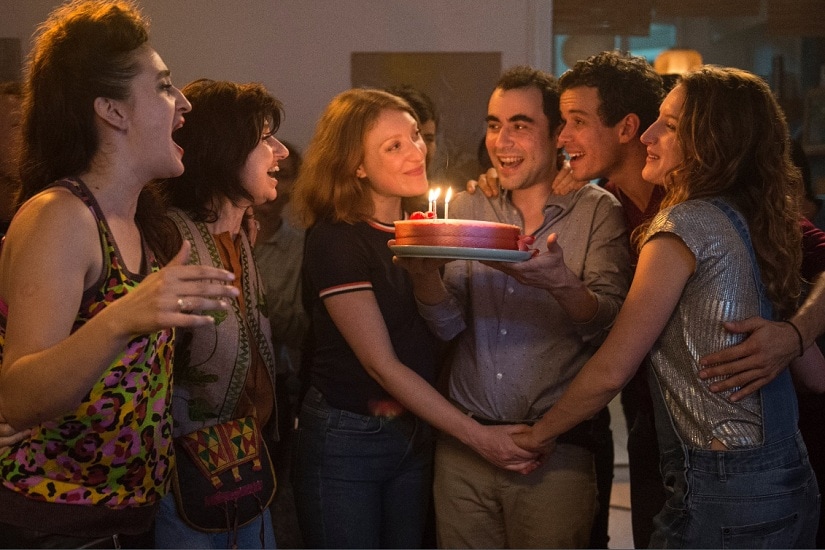 To Each, Her Own. Image from Twitter/@soitsrandy[/caption] The protagonist of the film is a young bank employee named Simone Benloulou, working in Paris. Simone hails from an orthodox Jewish family, and her younger brother is openly gay. Her father has disowned his son for his sexuality, and this has posed a serious dilemma for Simone, who, as it turns out, is a closeted lesbian. Fearing that the news of not one, but two of their children being homosexuals would be too much for her parents to bear, she fails to come out, every time she wants to. Things get complicated when she proposes to her girlfriend Claire and she says yes. That very night, she meets a charming young Senegalese cook and in a drunken stupor, ends up sleeping with him. The confusion does not stop there. Simone’s geeky elder brother has recently developed a dating site exclusively for Jews, and he hooks up his sister with a good-looking Jewish guy. Not interested in meeting this guy on a blind date, Simone sends a co-worker to meet the guy, asking her to introduce herself as Simone, and then to mess up the date, so that the matchmaking stops right there. To add to her woes, this co-worker ends up falling for the date, and refuses to reveal that she is not Simone – thus embarking upon a dangerously deceptive relationship with the unsuspecting man. Meanwhile, the Senegalese cook tells Simone that he wants to open a restaurant in partnership with her, and exhausted with her life as a banker, Simone finds herself accepting his proposal and helping him set the business up. Amidst all this, her girlfriend Claire finds out about her relationship with the cook, and all hell breaks loose. It’s an overly complicated plot, unnecessarily extended without dwelling on the core issues at play. While there are some cleverly crafted sequences – for instance the one where Simone’s date comes home to meet her parents and is shocked to learn that he has been with someone else all this while – but none of these sequences have what was most required in a film of this nature – a heart. None of the scenes are tender, they do not stand out and more often than not, they fail to evoke any emotion whatsoever – which is a shame, because the film had great potential. The resolution of the film’s central crisis is downright illogical and senseless, and it seemed like the makers had finally run out of ideas and were forced to finish it off in a hurry. There are some good performances in the film, but sadly, none of them pass muster and are all dragged down by a weak and convoluted script. Sarah Stern plays Simone, and the confusion of her protagonist rubs off onto her, because she seems to sleepwalk through most of the film like Lady Macbeth – wracked in guilt, and not knowing what to do, or what she wants. Julia Piaton is good as the more matured and sensible Claire, and she plays her part quite well. Jean Christophe Folly plays Simone’s male love interest, and is clearly the best actor in the entire film. And Arie Elmaleh does a fascinating job of playing Simone’s irritating and nosy elder brother David, who has clearly taken after the family’s matriarch. These are all interesting characters. Thrown together in the cauldron, however, these individual performances fail to hold together, because there’s not enough spice to bind them into a fine dish. What the film can boast of, though, is fine editing and some brilliant camerawork. But in the absence of a believable story, they have very little to do. If only the film had tried to do less and tell a good story, it would have worked. Myriam Aziza’s film is a wasted opportunity. She would perhaps do well to remember that in cinema, the end does not justify the means, and that every little detail counts. To Each, Her Own is currently streaming on Netflix.
To Each, Her Own movie review: Netflix's French romcom is a superficial take on sexuality, lacks heart
Bhaskar Chattopadhyay
• July 8, 2018, 14:02:04 IST
Despite all her noble efforts, Myriam Aziza’s French romantic comedy Les goûts et les couleurs (To Each, Her Own) is a superficial take on the subject of sexuality
Advertisement
 "To Each, Her Own movie review: Netflix's French romcom is a superficial take on sexuality, lacks heart")
End of Article