

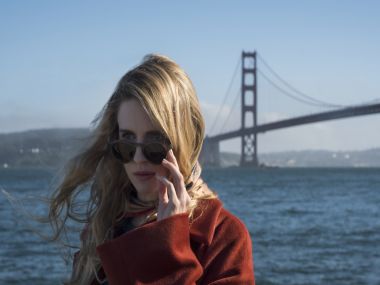
 "The OA season 2 review: A sumptuously complex narrative that offers a lot to chew on")
Storytelling often demands a suspension of reality. Good storytelling utilises creative license to invoke surrender from its viewers. But great storytelling adds uncompromising boldness to the mix, more often than not demanding a leap of faith from the audience. For the few who choose to succumb to its charms and allow themselves to be swept along, moments of transcendence and unsurpassed beauty await like flowers in a winding stream. [caption id=“attachment_6363661” align=“alignnone” width=“826”] 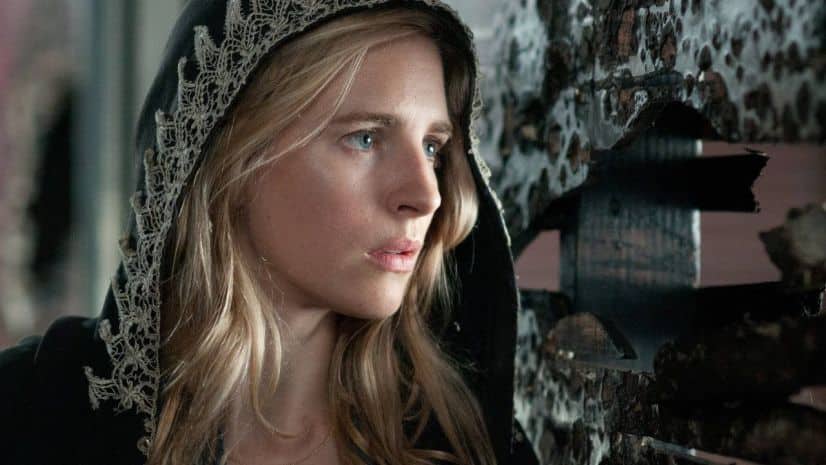 A still from The OA season 2. YouTube[/caption] Faith is the bulwark of The OA, creators Zal Batmanglij and Brit Marling’s befuddling, sometimes mesmerising and often brilliant show, which is that rare thing: an original work. It sojourns in parallel universes and multiverses, plunges back and forth in time, pushes the envelope, hides it up its sleeve in a sleight of hand, sometimes loses it, making you laugh at its missteps, hurling a moment of such piercing beauty at you the very next moment that you can only regard it with awe. But in spite of the blinding curves, it leads you down again and again. It never fails to reward your faith. In the second season, Prairie (Marling) returns as Nina Azarova, a Russian billionaire’s daughter, whose childhood version viewers would remember from the first season. Her boyfriend, Pierre Ruskin, the ‘prophet of the Silicon Valley’, is running a secret project that involves dreams, a cryptic game and an old, dark house with a rose window. She lands up in Dr Hunter Percy’s (Jason Isaacs) clinic as a patient alongside the cast from the previous season. Her attempts to escape Percy and waylay his ‘nefarious’ designs with the help of a young detective on the trail of a missing teenager who played the game and Prairie’s teenage friends from the previous season make up the second season. As the above description makes clear, it is a terribly complex show. The multiple strands from the first season are further complicated in the new one. Add multiverses and time travel to the mix and you have more than a handful. But the complexity of the show mirrors the world that has been presented to us, especially teenagers, whose rebellion is perhaps a pushback against the overweening convolution that underscores the apparent simplicity of adulthood’s homilies. Marling’s OA is the character that forms the anchor a host of people, including the teenagers, try to revolve their lives around in a bid to grasp the ways of the world and in some cases, escape it. The multiple characters (OA, Prairie, Nina and a secret character that comes as a twist right at the end) that converge within Marling’s person delineate her as a true, fully-formed, flawed but beautiful human being that galvanises everyone around her. Mercifully, the show blurs the lines between good and evil more than once, diminishing the simplistic binary with the passage of time. The relationship between OA and Percy can be construed as a battle between faith and rationalism. But these expectations are negated regularly by the ever deepening examination of Percy’s motivations, his exchanges with OA reflecting the anxieties of the modern world. The greatest strength of the show also leads to its most glaring flaws. It often seems to bite on a lot more than it can chew. And even though to manages to gather the hundreds of strands of its narrative and ideas by the time season two ends, its boldness in venturing down all kinds of paths throws up mixed results. There is at least one character whose appearance in the second season can only be construed as a deus ex machina to resolve multiple timelines. Frankly, the creators could have done without her. The complexity and scale of the storytelling also results in characters suddenly surfacing out of the mist after extended periods of time, before disappearing again. Then there is the final twist, which, despite its boundless courage, does not hit home with the impact it deserved. The OA is definitely not a perfect show. But I believe it never set out to achieve that in the first place. It is a cracked mirror that returns the true reflection of who we are. It goes down the forking paths without a doubt in its head, and rewards its followers with glimpses of great beauty and humanity. Batmanglij and Marling’s fearless jump into the whirlpool of time and memory results in a muralistic work of art. It takes a bold step or two towards fulfilling the potential of modern television to create filigreed work that possesses novelistic complexity and detail while offering uniquely manifold joy reserved for the visual form. At its highest points, The OA resembles a dream projected to millions of viewers via Netflix’s streaming capabilities. Just like a person dreaming, you often wish it never ends.
The OA season 2 is a cracked mirror that returns the true reflection of who we are.
Advertisement
End of Article

 "Israel targets top Hamas leaders in Doha; Qatar, Iran condemn strike as violation of sovereignty")
 "Nepal: Oli to continue until new PM is sworn in, nation on edge as all branches of govt torched")
 "Who is CP Radhakrishnan, India's next vice-president?")
 "Israel informed US ahead of strikes on Hamas leaders in Doha, says White House")
 "Israel targets top Hamas leaders in Doha; Qatar, Iran condemn strike as violation of sovereignty")
 "Nepal: Oli to continue until new PM is sworn in, nation on edge as all branches of govt torched")
 "Who is CP Radhakrishnan, India's next vice-president?")
 "Israel informed US ahead of strikes on Hamas leaders in Doha, says White House")



](https://images.firstpost.com/wp-content/uploads/2019/04/oa-825.jpg)