

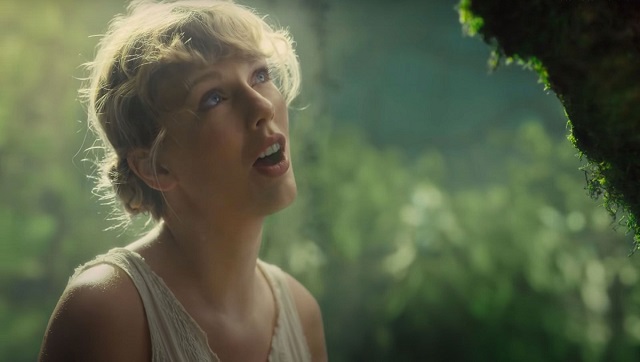
 "Taylor Swift's new album Folklore is a definitive jolt away from a near-decade of her signature big-tent pop")
The song that catapulted Taylor Swift from too-cool-for-country phenom to the-world-is-not-enough pop supernova was ‘We Are Never Ever Getting Back Together,’ the debut single from her fourth album Red in 2012. The first of her songs to top the Billboard Hot 100, it deployed country references as a tease on the way to an ecstatically saccharine, unmistakably pop hook — a universal anthem of I am over it. Right after the gleeful taunt of a first chorus by the song, Swift drilled down on just the kind of guy she was thrilled to be rid of: “You would hide away and find your peace of mind/With some indie record that’s much cooler than mine.” Sick burn. Delivered with an eye roll — literally, in the video of the song — it announced that Swift understood the power and coolth of her own music (which was not, at that point, widely conceded). And it tautly encapsulated the way that mopey interiority has often been perceived as — make that mistaken for — depth. That is about men, of course, but certainly about songs, too. It is a trap that whole genres are built on. Now, eight years later, Swift has made, well, one of those records herself, or at least something like it.
Folklore, her alternately soothing and soppy, pensive and suffocating eighth album, is a definitive jolt away from the last near-decade of Swift’s high-gloss, style-fluid, emotionally astute big-tent pop.
Made from scratch in the quarantine era, Folklore was recorded at her home in Los Angeles, and written and produced in remote collaboration largely with Aaron Dessner (from the National) and her go-to emotional extractor, Jack Antonoff. Choosing this approach may be purely a function of circumstance, but Swift has been due for a re-baptism for some time now. Folklore marks a conclusion (temporary or not, it is unclear) to her long march into the teeth of contemporary megapop, which over the course of four albums — Red, 1989, Reputation, and _Lover_ — has paid decreasing dividends, musical and social. Becoming a true centrist pop star is a battle Swift never quite won, and is a battle no longer worth waging. Folklore is the first attempt at a post-pop Swift, and it is many things that Swift albums generally are not: rough-edged, downtrodden, spacey. It is a completely canny pop album smothered in places by Dessner, whose production can be like wet clothing tugging at Swift, slowing her down, sapping her vim. Swift is not an especially powerful singer, though she achieves a lot with a naturally jumpy tone and enthusiasm. But both of those signatures wilt here as often as not. The tart edge that she specialises in — the one that is viciously effective when taunting or pining — is coated with layers of gauzy strings (there is plenty of cello), austere piano, throbbing Mellotron, smeared saxophone, atmospherics that thicken the air. As Swift has long demonstrated, contemplation and exuberance are not mutually exclusive; nor are brightness and reflection. And so Folklore songs fall into roughly two camps: excellent Swift-penned songs that are sturdy enough to bear the production, and others that end up obscured by murk. Some of the best songs of the album are mildly restrained versions of familiar Swift modes. On ‘Betty,’ she delivers teenage romantic regret with the icy, knowing vocal shiver she deploys in her most felt moments, with faint echoes of the wistful ‘Tim McGraw,’ her 2006 debut single. The airy, earthy ‘Invisible String,’ about trusting fate, is the only truly hopeful-sounding song on the album (and the only one about a happy, fulfilled relationship), and it features some of Swift’s most vivid lyrics: “Cold was the steel of my ax to grind/For the boys who broke my heart/Now I send their babies presents.”
More intriguing are the tracks where the experimentation with tonal approach succeeds. ‘Seven’ opens with an ethereally lustrous vocal, with Swift sighing her lyrics, landing the rhymes in unexpected places. On ‘Illicit Affairs,’ she whispers her words like long-resented secrets — “Tell your friends you’re out for a run/You’ll be flushed when you return” — sprinkled with sunburst syllables designed to freeze perpetrators in their tracks. And then there is ‘Exile,’ the most atypical song on the album. A lovely, anguished duet with Justin Vernon (credited as Bon Iver), it is a stark and unsettling back and forth of recriminations. Swift telegraphs distance and skepticism: “I can see you staring, honey/Like he’s just your understudy/Like you’d get your knuckles bloody for me.” But it is the end of the song, when Swift and a husky-voiced Vernon go line for line in some combination of hard-whiskey country, desperate R&B, and black-box-theater dialogue, that you feel the full emotional corrosion. All around them, pianos toll like grandfather clocks, stern and fatalistic.
Far more often, though, the production dictates Swift’s boundaries. The smoky ‘Cardigan’ has a number of moving parts, distracting from Swift’s breathy, under-sung vocals. The hymnal ‘Epiphany’ feels claustrophobic — Enya-like without the flutter. ‘Mirrorball’ verges on shoegaze, and Mad Woman has the blend of morose and wry that is a Lana Del Rey trademark.
Dessner’s specialty — here and in the National, the rumbling, somber band that has been one of the most acclaimed indie rock acts of the 2000s — is making music that haunts. Swift has displayed a weakness for this aesthetic before; see her 2012 dalliance with the hazy, wheaty folk duo the Civil Wars. She also included the National on a 2017 “Songs Taylor Loves” playlist for Spotify. But the joy of Swift’s music has always stood in contrast to this sort of studied ponderousness. Only on Reputation, her underloved 2017 hip-hop-inflected album, did she seek to trade on the credibility of an unfamiliar genre. But those sounds illuminated Swift’s playfulness and bite — the ones she turns to here are often at direct odds with her gifts as a melodist and lyricist. In fact, they are practically designed to obscure them. If this is a ploy to be cloaked in — and enhanced by — the alleged seriousness of indie rock, it only underscores how frail and unversatile that seriousness is. That is clearest on ‘The Last Great American Dynasty,’ a musical biography of Rebekah Harkness, an heiress with a wild life story who happened to own Swift’s home in Rhode Island. Harkness is a classic Swift heroine — purposeful, disruptive, and misunderstood: “There goes the maddest woman this town has ever seen/She had a marvelous time ruining everything.” On a different Swift album, a song like this would have reveled in the mess, but this version is controlled, almost sad. Inside, there is a brash version of this song yearning for air. Autobiography has always been baked into Swift’s value proposition, both in the way she laded her songs with Easter eggs about her own life, and in how her artistic rise was echoed in tabloid hysterics. But in the Folklore liner notes, she emphasises that the album spans multiple characters and points of view. Maybe it is true, maybe it is a feint — all writing is autobiography, after all. But either way, stating it outright is meant to demarcate the new Taylor from the old, and stakes a claim not to be scrutinised. That is just one of her retreats here. Folklore is also a full retreat to whiteness after dalliances with Black music on Reputation. (It is also, maybe, as close to a backdoor country album as Swift is likely to venture; see the harmonica and pedal steel on ‘Betty.’) Given its overall dourness, the album is a retreat from conventional pop language, which is to say, it may well be a retreat from radio. Not that that much matters for Swift, who has spent more than a decade earning her fans, and may well be approaching the Beyoncé stage of her career, where cultural authority is not dependent on steady hitmaking. That is the new nature of pop superstardom anyhow: mass-scale cult figures superserving their most ardent followers by the millions. Seen that way, perhaps the sonic experimentation on Folklore is not really about embracing a new genre so much as abandoning any sense of duty to the ones she has been built upon. Country, pop, ’80s rock, hip-hop: they have merely been vessels, weapons she knows how to trigger to advance the central tenets of Swiftiness. The desolate, stubborn, overcomposed indie rock of Folklore, though, is a tough thicket to tame. Sometimes she triumphs, wrestling it until it is slack. But when it stifles her, it deserves all the eye rolls it gets. Listen to the full album here. Jon Caramanica c.2020 The New York Times Company

 "Charlie Kirk, shot dead in Utah, once said gun deaths are 'worth it' to save Second Amendment")
 "From governance to tourism, how Gen-Z protests have damaged Nepal")
 "Did Russia deliberately send drones into Poland’s airspace?")
 "Netanyahu ‘killed any hope’ for Israeli hostages: Qatar PM after Doha strike")
 "Charlie Kirk, shot dead in Utah, once said gun deaths are 'worth it' to save Second Amendment")
 "From governance to tourism, how Gen-Z protests have damaged Nepal")
 "Did Russia deliberately send drones into Poland’s airspace?")
 "Netanyahu ‘killed any hope’ for Israeli hostages: Qatar PM after Doha strike")



