 "In The Good Place on Netflix, a life full of contradictions and search for an afterlife well earned")
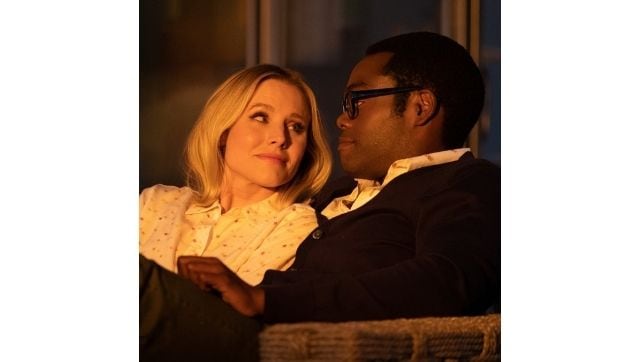
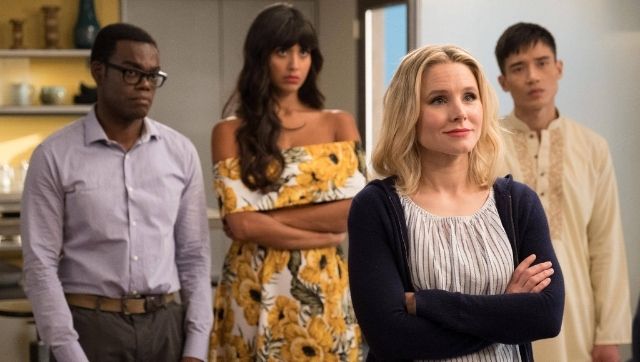
Movies and shows, old and new, have helped us to live vicariously through them. They have allowed us to travel far and wide at a time borders are shut and people are restricted to homes. In our new column What’s In A Setting, we explore the inseparable association of a story with its setting, how the location complements the narrative, and how these cultural windows to the world have helped broaden our imagination. * Flitting between books to read, shows to watch, and subjects to study, the experience of lockdown has seen me pendulum between productivity and apathy. It’s been confusing and straightforward, nonsensical and precise, and a time of living through intense contradictions. As Eleanor, referencing Milton’s Paradise Lost, says in season four of Netflix’s The Good Place, “I guess all I can do is embrace the pandemonium. Find happiness in the unique insanity of being here, now.” Rewatching the show has also been my way of finding happiness in the unique insanity of living through a pandemic. Created by Michael Schur, also responsible for Brooklyn Nine-Nine, Parks and Rec, and The Office among others, it offers an exact balance between deep philosophical inquiry and heartfelt comedy. Excitingly, as the four protagonists of The Good Place – Eleanor, Chidi, Tahani, and Jason – navigate afterlife adventures, studying ethics is the superpower that guides them onward. The show not only highlights the importance of classroom discussions and studies, it also foregrounds the essence of humanness – interesting storytelling in a show that, for the most part, is set in the afterlife. It’s a sitcom that concerns itself with the philosophical query of what it means to be a good person vis a vis the setting. Throughout the series, the characters approach this question through discussing various moral theories, from Aristotle’s virtue ethics to Kantian deontology, and from moral nihilism to Jonathan Dancy’s moral particularism.
The show opens with all the answers. Set in the afterlife, there’s structure and a systemically organised points system in place. The four protagonists are in The Good Place, the show universe’s equivalent of heaven, guided by the neighbourhood’s architect Michael. Each resident has a house created exactly as they’d like and a soulmate, and settles in for an eternity of perfection and happiness. The main conflict the show’s first season poses is ‘what happens when there’s a mistake and someone who doesn’t belong there enters The Good Place?’ referring to first Eleanor, and then also Jason. The two are concerned with becoming better people to earn the Good Place spots they’ve mistakenly been allotted. As the season finale rolls around with its big reveal that the four are actually in the Bad Place and being used to psychologically torture each other, with an instant switch of setting, all those questions and concerns are turned on their head. The main question now is ‘why try to be good in a bad system?’ This is creator Michael Schur’s message – to try is the most important, and most human, thing we can do. Each time they figure out they’re actually in the Bad Place and being tortured, their memories are wiped and the experiment restarts. But in each reboot, the four find each and help each other, and figure out what’s actually going on. Each time, through Chidi’s philosophy lessons and spending time with each other, they improve as people. “You thought we would torture each other, and we did for a little. But we also took care of each other, we improved each other, and the four of us became a team,” as Eleanor points the first time she figures it out, and which remains true with every subsequent reboot. As they then team up with Michael, narrowly escape from the actual Bad Place, and reach the judge, this is what they convince her to see – that they deserve to go to the Good Place because they’re better people now. “The only reason we’ve come this far is because we’ve helped each other. And I don’t think anything’s going to feel like the Good Place if we’re not together,” Eleanor boldly claims.