

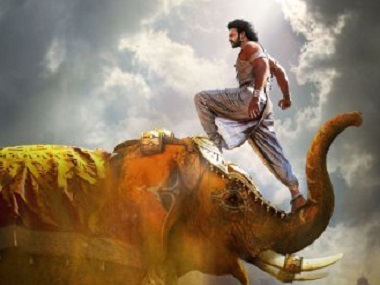
 "Dissecting the language of Baahubali trolls: 'Hindu film’, ‘Urduwood’, ‘Chrislamist critic’")
You are not the story, you are the chroniclers of that story. You are not at the centre of the action, you are observers on the sidelines. I have lost count of the number of times I have repeated these lines to my students in the eight years since I added the job of teacher to my resume. A journalist should naturally be self-effacing, I have told them, we must avoid placing the spotlight on ourselves, the primary requirement of our jobs being to place the spotlight on the lives and work of others while we stay in the background. This belief is what has caused me to hesitate for almost a week since my editor asked if I wished to write about Baahubali’s social media trolls (he very kindly left the decision to me) when the communal bile began flowing my way from the moment my review of S.S. Rajamouli’s film was published on Firstpost last Friday. [caption id=“attachment_3413930” align=“alignnone” width=“825”]
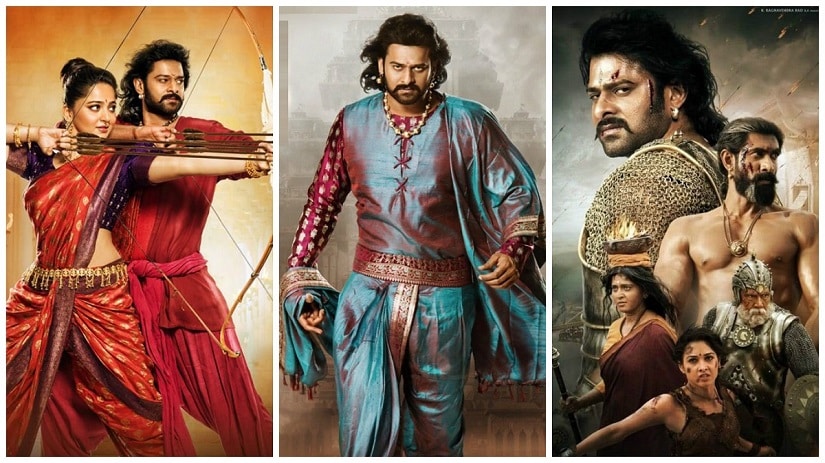 Posters of Bahubali 2/Baahubali 2: The Conclusion[/caption] Here then is an addendum to that journalistic principle: sometimes our personal experiences become the particular from which the universal can be derived. And so, this week I find myself in the unfortunate position of being an example I ought to report. As film critics we are used to vile abuse from fans whenever we disagree with a choice made by their favourite star. Religion-specific targeting of critics on a large scale is a new phenomenon though. This is why it becomes imperative to discuss the response to my review of Baahubali 2: The Conclusion. Here is a sampler from Twitter: “Commie Chrislamist goon @annavetticad also giving film reviews. Her hatred of Hinduism is quite appalling.”
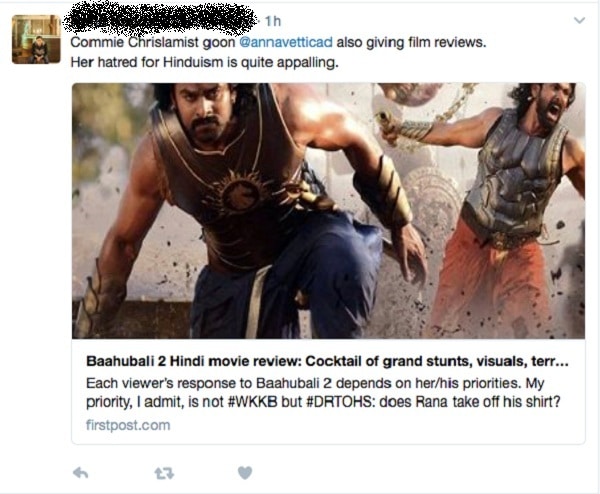
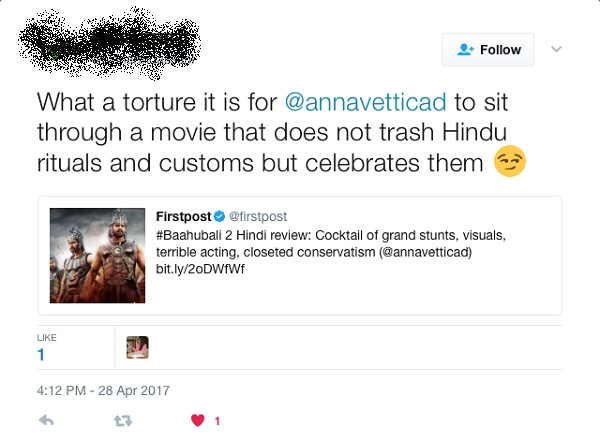
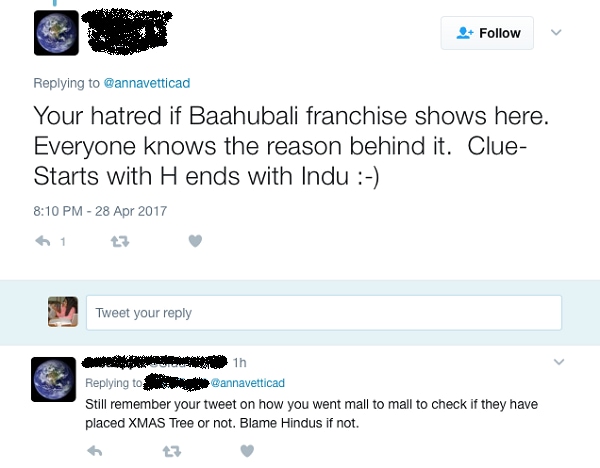
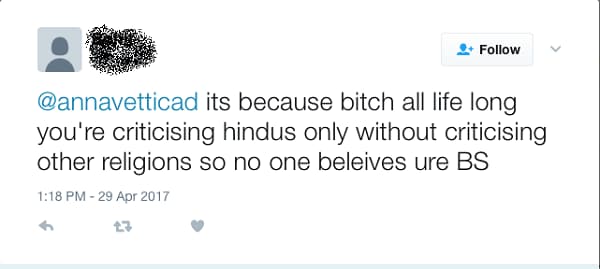
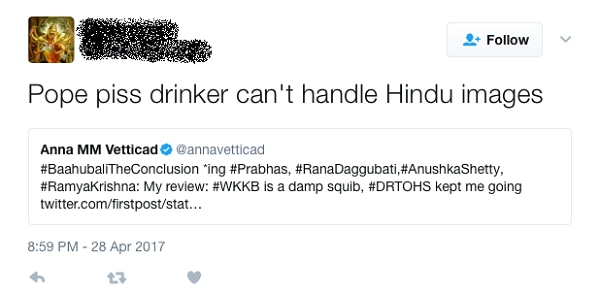
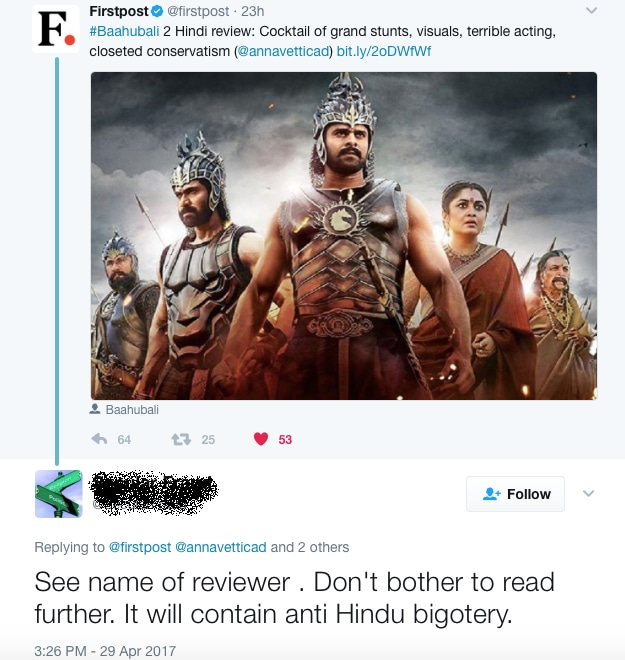
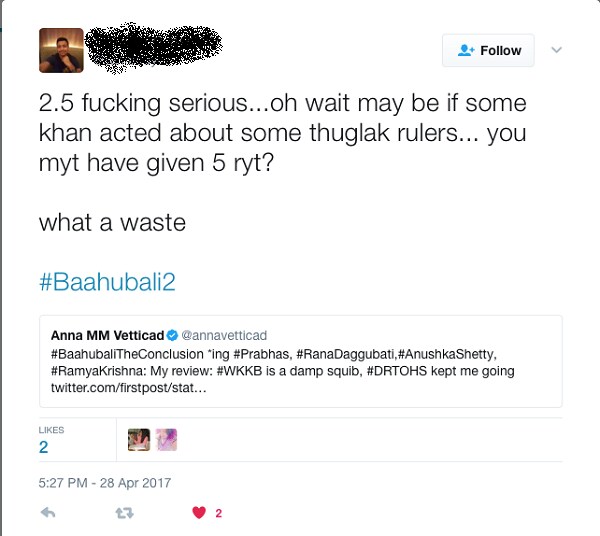
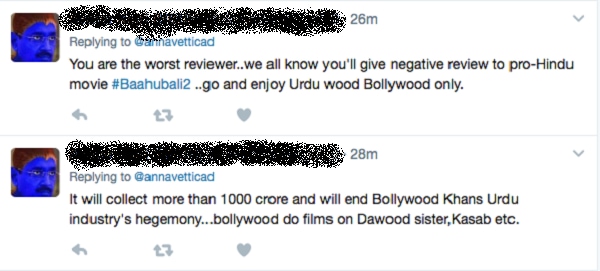
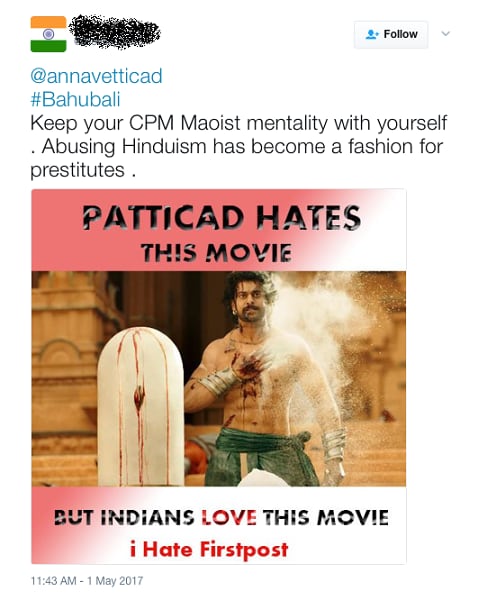
They have been unrelenting since then. Repugnant labels such as “Hindu actor”, “Muslim actor”, “Hindu film”, “Christian critic” and “Muslim critic” are now the norm.
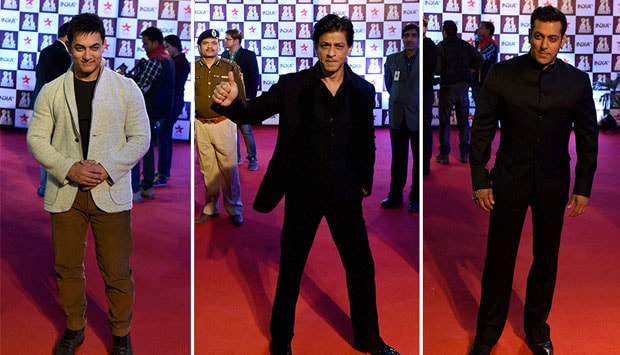
Early this year I had written about how, when Raees clashed with Kaabil in theatres, the Sangh lobby on the Net were out in full force urging audiences to skip the “Muslim film” Raees starring Shah Rukh and to turn the Hrithik Roshan-starring “Hindu film” Kaabil into a hit. Those prone to dismiss this analysis as wild allegations based on unfounded assumptions ought simply to track the parallel behaviour patterns and language of these trolls and the party they support. For instance, while trolls were brushing aside Raees and upholding Kaabil, BJP national general secretary Kailash Vijayvargiya made his own oblique promotional pitch on Twitter: “The #Raees who are not for the country are of no use. We should all stand with a #Kaabil (worthy) patriot. It is now the turn of the country’s kaabil janta (worthy people). The rights of the kaabil (worthy) should not be snatched away by the dishonest raees.” He claimed that he was referring to demonetisation, not films. Yeah sure. [caption id=“attachment_3219732” align=“alignnone” width=“825”] 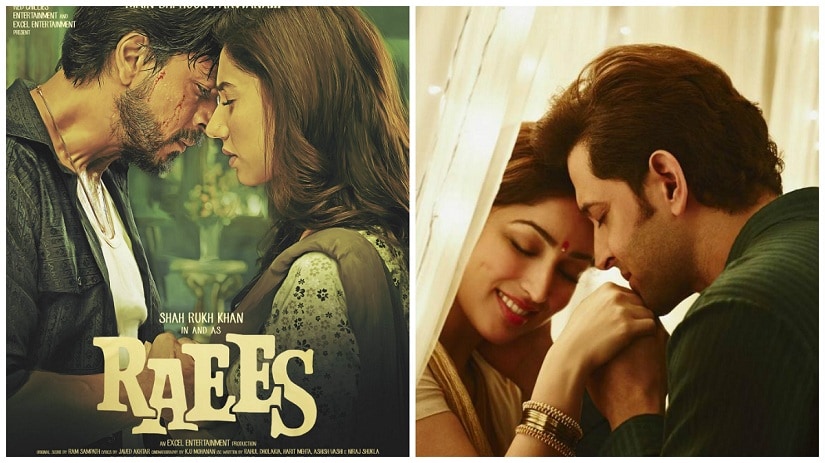 Shah Rukh Khan with Mahira Khan in ‘Raees’; (R) Yami Gautam and Hrithik Roshan in ‘Kaabil’[/caption] Roshan, Akshay Kumar and Ajay Devgn are the darlings of these trolls. Apart from their religious identity, it is no coincidence that Devgn is a long-time vocal supporter of Modi, and that Kumar has chosen, since 2014, to work in several films pegged on nationalism, a pet theme of the reigning Right. It is only fair to mention here that Roshan has not overtly done anything so far to invite or encourage this communal profiling, beneficial though it is to him too. Bless him! For more parallels with the ruling party, rewind to 2015 when trolls exhorted the public to boycott the Shah Rukh Khan-starrer Dilwale, spammed the e-commerce website Snapdeal to rid themselves of Aamir as a brand ambassador and called on “nationalists” to boycott Snapdeal. Simultaneously, Aamir’s long-time brand ambassadorship of the Tourism Ministry’s Incredible India campaign was brought to a close. At a public event a few months later, then Defence Minister Manohar Parrikar pretty much confirmed, without naming names, that the party had had a team working online to badger Snapdeal into submission. Note too the relative kid-glove treatment reserved for Salman Khan by these forces while they direct burning hatred at Aamir and Shah Rukh. This is not to say that Salman is never reviled for being Muslim – of course he is. But ever since he made a public appearance with Modi at the height of the 2014 general election campaign, he is rarely singled out for his religion by the online army of trolls, and right-wing viciousness comes his way these days usually only when he is clubbed with the others in generalised remarks about “the Khans. It is convenient too that Salman’s father is close to Modi – Salim Khan even inaugurated the Urdu website on Modi in the summer of 2014 – and Salman himself has, for several years now, steered clear of commenting on any issues that might possibly rile the government or BJP. [caption id=“attachment_3425830” align=“alignnone” width=“940”] 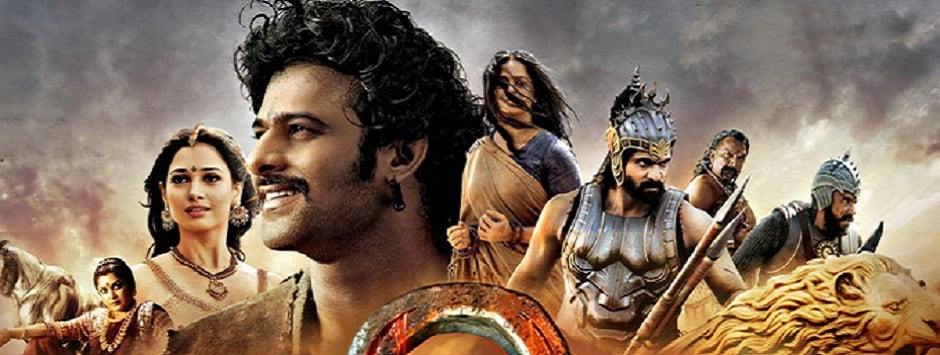 The characters of Baahubali series.[/caption] Interestingly, while all these are developments related to Hindi cinema, the communalisation of online discussions on films has peaked in the past three years with two Telugu, not Hindi, films: Baahubali: The Beginning in 2015 and Baahubali: The Conclusion now. It is as if the online sena has decided that if Kumar, Devgn and Roshan cannot be counted on to dethrone the Khans, then the job must be outsourced to another industry. There is rich irony in this considering that the BJP has long been accused of Hindi-centricity. In fact, it is this Hindi-centricity that has kept the party’s trolls largely focused on the Hindi film industry even today. As it happens, dear readers, I faced similar venom in 2015 for a column headlined “ The Rape of Avanthika” in The Hindu Businessline on the sexual subjugation of Avanthika by Shivudu/Shiva in Part 1 of Baahubali. Although I was by then used to being communally trolled for comments specifically about political parties, and had received stray “you Xtian fanatic” jibes for my film writings, this was my first experience of religious profiling on such a scale for a column on a film. Let me make it clear that as much as I have been trolled persistently for my critiques of both _Baahubali_s, there has also been a deluge of support from those who are committed to both cinema and debate. The website Daily O even carried an article early on, titled “ Film critic Anna Vetticad trolled for her Baahubali 2 review shows ugly face of India’s intolerance,” even as I delayed writing this piece.
Let me make it clear too that I am not using the word “troll” casually to dismiss all criticism of my work.
Trolls are those who are abusive and/or needlessly aggressive, who threaten and try to intimidate, who make personal attacks, who assess your identity (gender, ethnicity, appearance, religion, sexual orientation, caste) rather than the content of your comments. I have had occasional enriching discussions over the years on the social media with confident, polite people offering sane, logical opposition to my views. Conversations are obviously not possible, however – or even desirable, some might say – with those whose reaction to a review is to tell the “Chrislamist…bitch” that she has rejected a “Hindu film”. Such claptrap is not worth responding to, though it is definitely important to highlight it so that the general public becomes aware of this verbally violent online gang trying hard to browbeat us into adopting their views on cinema, just as they are trying hard to terrorise us offline into eating, dressing, loving, marrying and making all life’s decisions by their rules. Related link: For Anna M.M. Vetticad’s review of Baahubali: The Conclusion, click here .

 "US ready to ‘impose costs’ on Russia if war in Ukraine drags on, says Hegseth")
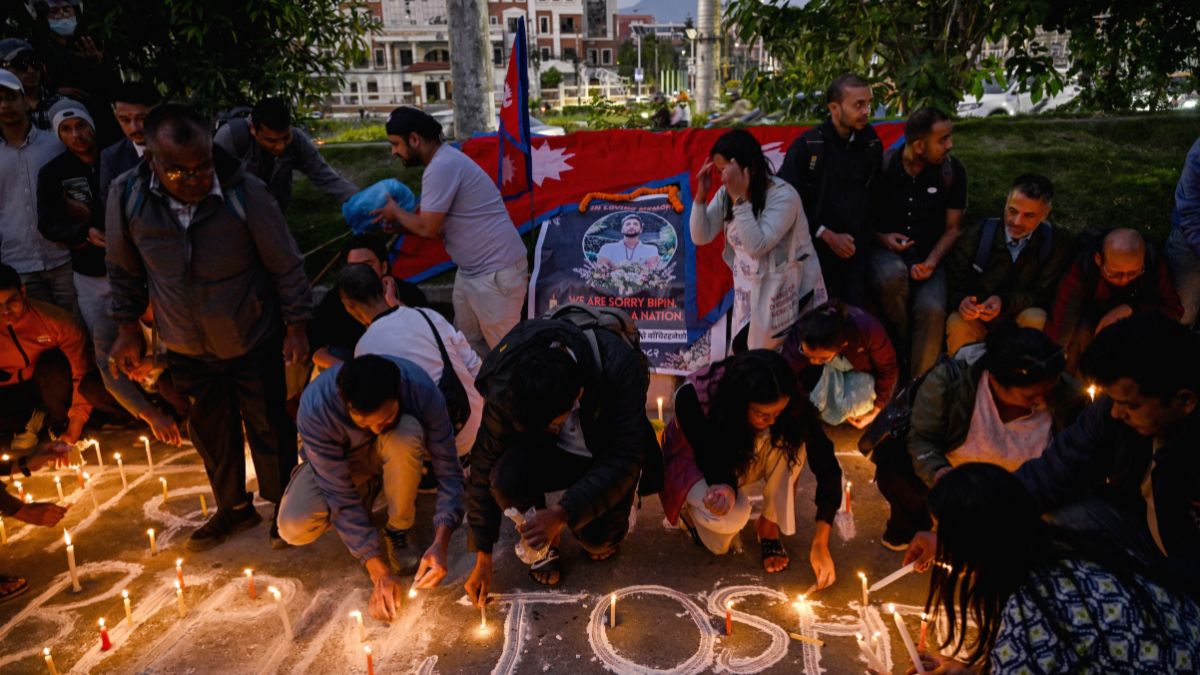 "US tells Hamas to stop violence against Gaza civilians and disarm 'without delay'")
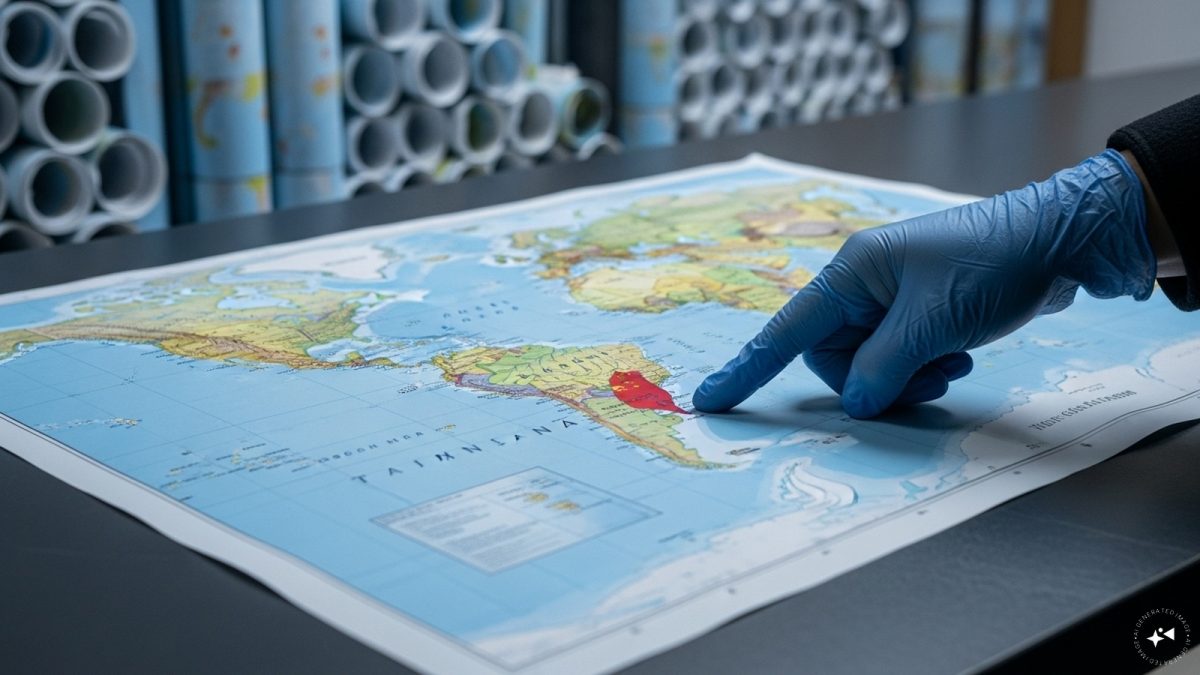 "China seizes 60,000 maps mislabelling Taiwan, omitting South China Sea islands")
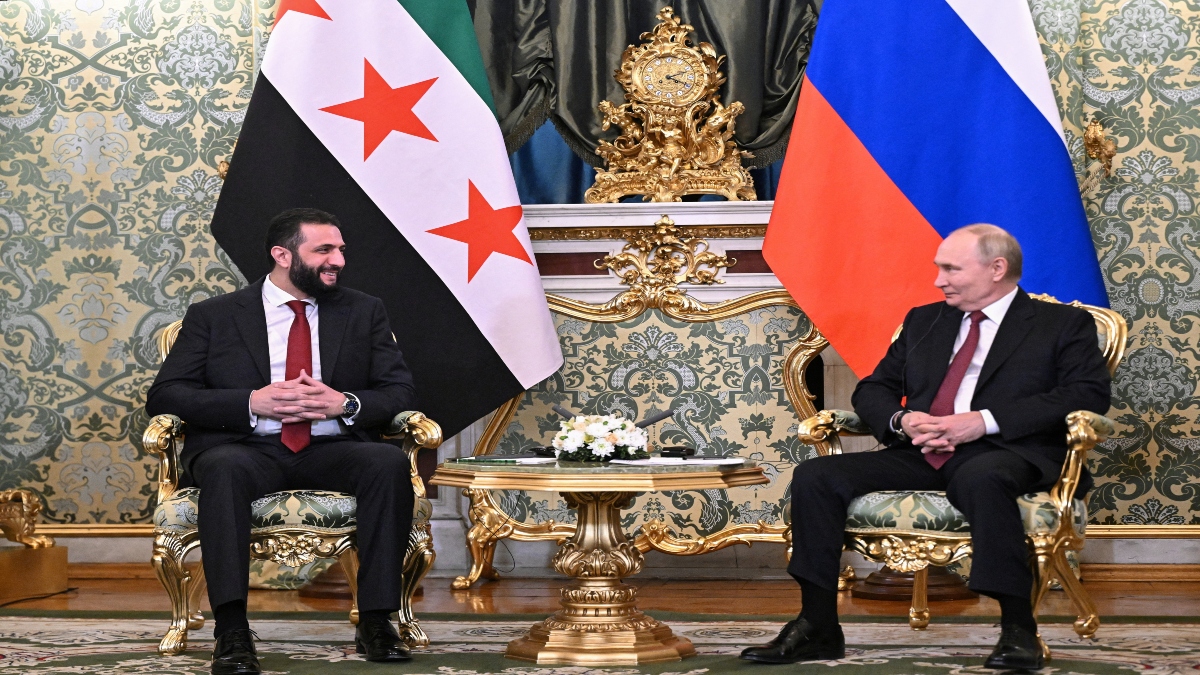 "Syria’s Sharaa pledges to honor Russia ties, seeks economic and military support in Kremlin visit")
 "US ready to ‘impose costs’ on Russia if war in Ukraine drags on, says Hegseth")
 "US tells Hamas to stop violence against Gaza civilians and disarm 'without delay'")
 "China seizes 60,000 maps mislabelling Taiwan, omitting South China Sea islands")
 "Syria’s Sharaa pledges to honor Russia ties, seeks economic and military support in Kremlin visit")



](https://images.firstpost.com/wp-content/uploads/2017/04/baahubali-collage-825.jpg)
](https://images.firstpost.com/wp-content/uploads/2014/12/SRK-Salman-and-aamir_PTI.jpg)
](https://images.firstpost.com/wp-content/uploads/2017/01/kaabil-raees-825.jpg)
](https://images.firstpost.com/wp-content/uploads/2017/05/baahubali-2-in-2017-heres-what-we-loved-most-in-baahubali-the-beginning-22-10-16.jpg)