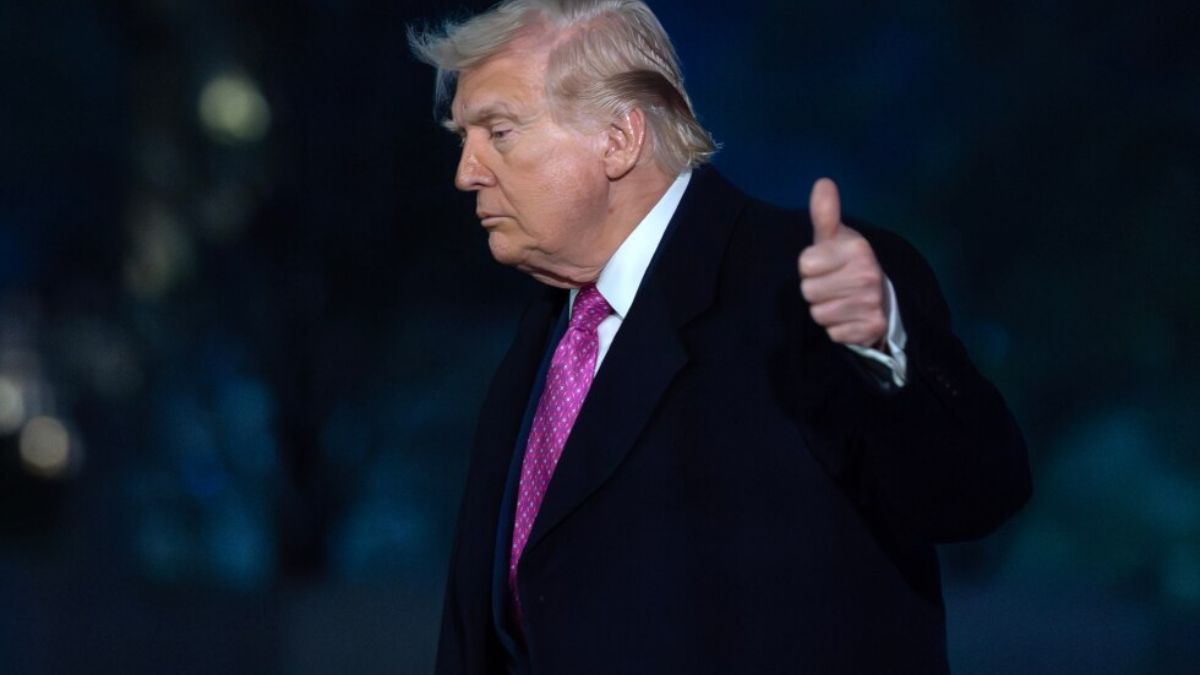
 "One year of Liberation Day tariffs: US trade deficit rose, manufacturing boom never arrived")
One year after US President Donald Trump unveiled sweeping “Liberation Day” tariffs aimed at reshaping global trade and reviving domestic industry, the policy’s economic record appears increasingly mixed — and, in key respects, contrary to its stated goals.
Fresh data released this week showed the US trade deficit widened in February, even as Washington doubled down on its protectionist stance with a new round of tariffs on pharmaceuticals and metals.
Deficit widens despite tariff push
The US trade deficit rose to $57.3 billion in February, marking a 4.9 per cent increase from January, as imports surged faster than exports. Imports climbed 4.3 per cent to $372.1 billion, while exports rose 4.2 per cent to $314.8 billion.
The widening gap underscores a central contradiction: tariffs designed to curb imports and narrow the deficit have, at least in the short term, coincided with stronger inbound flows, as businesses continue to adjust supply chains amid policy volatility.
While the cumulative deficit for the first two months of 2026 remains sharply lower than a year earlier — when firms front-loaded imports ahead of anticipated tariffs — the latest monthly data points to continued instability in trade flows.
Legal setback deepens uncertainty
Compounding the policy’s uneven economic impact, the US Supreme Court in February struck down a core pillar of the tariff regime, ruling that the administration had overstepped its authority by imposing sweeping duties under emergency powers without explicit congressional approval.
The decision forced the White House to pivot quickly, introducing temporary tariffs under alternative legal provisions. However, these measures are set to expire mid-2026, leaving businesses grappling with an uncertain policy horizon.
For companies planning long-term investments — particularly in manufacturing and energy — the stop-start nature of tariff enforcement has complicated capital allocation decisions and procurement strategies.
Manufacturing boom fails to materialise
A central promise of the Liberation Day tariffs was to catalyse a renaissance in American manufacturing by shielding domestic producers from foreign competition.
So far, that revival has not materialised at scale.
While certain sectors linked to domestic production and energy security have attracted investment, broader industrial expansion has lagged expectations. Persistent supply chain disruptions, higher input costs — especially for metals — and policy unpredictability have tempered corporate appetite for large-scale manufacturing shifts.
Quick Reads
View AllGlobal ripple effects and investor rethink
Beyond US borders, the tariffs triggered a sweeping reassessment of global capital allocation.
Investors have increasingly diversified away from US assets over the past year, with emerging markets and developed peers in Europe and Asia drawing stronger inflows. The shift reflects growing concerns over policy unpredictability, currency volatility, and the long-term implications of an interventionist trade regime.
Market participants have coined trends such as “Anywhere But the USA” to describe the evolving investment landscape, highlighting a departure from the long-standing dominance of US markets in global portfolios.
Protectionism persists despite mixed results
Despite legal setbacks and ambiguous economic outcomes, the Trump administration has signalled that its protectionist strategy remains firmly intact.
To mark the first anniversary of Liberation Day, Washington imposed fresh tariffs targeting pharmaceuticals and metals, while also exploring additional trade actions through ongoing investigations into key trading partners.
The move suggests that, politically at least, tariffs retain significant traction.
Some conservative commentators argue that the policy’s most enduring legacy may not be economic but ideological — normalising a more assertive, interventionist trade posture among US voters who might previously have resisted such measures.
A shifting baseline for global trade
One year on, Liberation Day appears to have reset expectations around US trade policy.
While the data shows limited success in narrowing the trade deficit or sparking a manufacturing boom, the broader shift toward protectionism — and the uncertainty it brings — is already reshaping corporate strategies, investment flows and the global economic order.


 "Iran Israel War Live News: Iran claims second F-35 jet shot down, pilot unlikely to survive crash")
 "After Pam Bondi, is Trump going to fire Kash Patel and Tulsi Gabbard?")
 "Trump warns of 'more to follow' as US destroys Iran's largest bridge")
 "Iran Israel War Live News: Iran claims second F-35 jet shot down, pilot unlikely to survive crash")
 "After Pam Bondi, is Trump going to fire Kash Patel and Tulsi Gabbard?")
 "Trump warns of 'more to follow' as US destroys Iran's largest bridge")