 "Hyundai India’s Rs 27,870 crore IPO oversubscribed by 2.28X, largely driven by institutional investors")
 "How Indian fintech startups are driving Malaysia’s UPI-like digital payments revolution")
Stock Market Today Latest Updates: Market gave up previous session’s gains and ended lower on Wednesday, the first day of the financial year of 2020-2021 with Nifty slipped below 8,300 level. The Sensex tanked 1,203.18 points or 4.08 percent to 28265.31 while the Nifty was down 343.95 points or 4 percent at 8253.80 at close. As many as 1,098 shares advanced, while 1,067 shares declined, and 167 shares remained unchanged. Tech Mahindra was the top loser in the Sensex pack plunging over 9 percent. Other top losers included Kotak Mahindra Bank, TCS, Infosys, Axis Bank, SBI, HUL and HCL Tech. Domestic credit rating agency Icra said credit quality of Indian companies worsened in fiscal year 2019-20 as it downgraded Rs 7 lakh crore of debt and warned of “unprecedented strain” on credit profiles of corporates due to the coronavirus pandemic. The agency said policymakers will have to unleash more measures to avoid “severe economic imbalances” if the COVID-19 crisis prolongs. In its annual credit quality review after the end of the fiscal year, Icra said it downgraded Rs 7 lakh crore of debt in FY20, as against Rs 3 lakh crore in the year-ago period, driven largely by actions against financial sector companies. However, this wasn’’t accompanied by an increase in the overall default rates which softened to 2.3 per cent in FY20 in comparison with the past five-year average of 3 per cent, it noted. It downgraded debt of 584 entities in FY20, as against 282 upgrades, the agency said, adding the downgrade rate has moved to 16 per cent, while the upgrade rate has dipped to 8 per cent. Going ahead the economic outlook looks muted as the COVID-19 leaves an economic cost, it said. Market made a slight recovery as Sensex was down 1297.57 points or 4.40 percent at 28,170.92 and Nifty held 8,200-level at around 2.30 pm. The market slipped into the red again as European markets opened on lower after the US warned of jump in death toll due to coronavirus pandemic. Wipro Ltd, Wipro Enterprises Ltd and Azim Premji Foundation have together committed Rs 1,125 crore towards tackling the unprecedented health and humanitarian crisis arising from the COVID-19 outbreak in the country. These resources will help enable the dedicated medical and service fraternity in the frontline of the battle against the pandemic and in mitigating its wide-ranging human impact, particularly on the most disadvantaged of our society, as per a company statement released on Wednesday. Of the Rs 1,125 crore, Wipro Ltd’s commitment is Rs 100 crore, Wipro Enterprises Ltd’s is Rs 25 crore, and that of the Azim Premji Foundation is Rs 1,000 crore, it added. These sums are in addition to the annual corporate social responsibility (CSR) activities of Wipro, and the usual philanthropic spends of the Azim Premji Foundation, the statement said. Sensex plunged 1203.20 points or 4.08 percent to 28,265.29 while the broader Nifty was down 331.55 points or 3.86 percent at 8,266.20 at around 1.10 pm. The market continued its opening losses as Sensex plunged 1114.49 points or 3.78 percent to 28,354 while Nifty was down 322.05 points or 3.75 percent at 8,275.70 at around 11.15 am even as coronavirus pandemic kept the investors on edge. Except for Nifty FMCG and realty, all sectoral indices at the National Stock Exchange (NSE) were in the negative terrain with Nifty private bank down by 2.6 percent, financial service by 2.4 percent, auto by 1.9 percent and IT by 1.8 percent. Sensex plunged 1002.17 points or 3.40 percent to 28,466.32 while Nifty was down 292.50 points or 3.4 percent at 8,305.25 at around 10.50 am even as factory activity contracted sharply across most of Asia in March due to coronavirus pandemic. Kotak Mahindra Bank tanked nearly 10 percent while RIL fell 5.35 percent in the morning session. Factory activity contracted sharply across most of Asia in March as the coronavirus pandemic paralysed economic activity across the globe, with sharp falls in export power-houses Japan and South Korea overshadowing a modest improvement in China. Manufacturing gauges also tumbled in Indonesia, Vietnam and the Philippines, Purchasing Managers’ Index (PMI) surveys showed on Wednesday, underscoring the widening damage brought by the pandemic that has infected more than 700,000 people, upended supply chains and led to city lockdowns worldwide. China’s factory activity improved slightly more than expected in March after plunging a month earlier, a private business survey showed, but growth was marginal, highlighting the intense pressure facing businesses as domestic and export demand slumps. Sensex tanked 852.02 points or 2.89 percent to 28,616.47 and while Nifty was down 206.65 points or 2.4 percent at 8,391.10 at around 10.40 am. Kotak Mahindra Bank and Tech Mahindra were the top losers in the Sensex pack. Sensex tanked 710.68 points or 2.41 percent to 28,757.81 while Nifty was down 206.65 points or 2.4 percent at 8,391.10 at around 10.28 am. Kotak Mahindra Bank and Reliance Industries were the top losers in the Sensex pack. Sensex 430 points down, Nifty below 8,600 mark; Kotak Mahindra, ONGC among top losers New York: Asian shares faced another leg lower on Wednesday as the coronavirus sharply slows global growth, leading a gauge of world stocks to post its biggest quarterly decline in more than a decade and oil prices to trade near lows last seen in 2002. Shares on Wall Street tumbled on Tuesday, with the Dow registering its biggest quarterly fall since 1987 and the S&P 500 its steepest quarterly drop since a decade ago on growing evidence of the massive downturn the pandemic will incur. E-Mini futures for the S&P 500 traded 1 percent lower in after-hours trade, while Asian futures suggested the rout would continue. FTSE China A50 futures in Singapore were down 0.85 percent and Japan’s Nikkei fell 1.86 percent in early trade. The first-quarter decline was the biggest on record for the S&P 500 as consumers hunkered down at home, leading businesses to announce massive staff furloughs and to shut temporarily. US economic activity is likely to be “very bad” and the unemployment rate could rise above 10 percent because of efforts to slow the spread of the coronavirus, Cleveland Federal Reserve Bank President Loretta Mester told CNBC. [caption id=“attachment_2408126” align=“alignleft” width=“380”]
 Representational image. Reuters[/caption] The United States marked 700 deaths in a single day from COVID-19 for the first time on Tuesday, lifting total US fatalities from the disease to more than 3,700. MSCI’s broadest index of Asia-Pacific shares outside Japan gained 0.35 percent in early trade. MSCI’s gauge of stocks across the globe shed 0.48 percent following modest gains in Europe. The index fell nearly 22 percent for the quarter. Bucking the broader decline, Australian shares opened higher as a slowdown in new coronavirus cases brightened investor sentiment while rising iron ore prices gave miners a lift. Australia’s S&P/ASX 200 index rose 1.59 percent after the benchmark fell 2 percent on Tuesday. The number of coronavirus infections globally headed toward 800,000. Deutsche Bank analysts noted, however, that for two consecutive days the global growth in new cases was below 10%, having exceeded that rate for most of the past two weeks. Health officials were much more cautious. A World Health Organization official warned that even in the Asia-Pacific region, the epidemic was “far from over.” The dollar slid against a basket of currencies, pressured by the latest Federal Reserve measures to ensure sufficient liquidity in the global financial system. The Fed is now allowing foreign central banks to exchange their holdings of US Treasury securities for overnight dollar loans. The dollar index fell 0.275 percent while the Japanese yen strengthened 0.12 percent versus the greenback at 107.44 per dollar. Government bond yields held steady as investors remained cautious about buying riskier assets. The benchmark 10-year US Treasury note rose 15/32 in price to yield 0.6538 percent. Crude oil benchmarks ended a volatile quarter with their biggest losses in history, with both US and Brent futures hammered throughout March due to the pandemic and the eruption of the Saudi-Russia price war. Global fuel demand has been sharply cut by travel restrictions due to the coronavirus. Forecasters at major merchants and banks see demand slumping by 20 percent to 30 percent in April, and for weak consumption to linger for months. Crude futures ended the quarter down nearly 70 percent after record losses in March. US crude fell 31 cents to $20.17 a barrel and May Brent crude futures ended 2 cents lower at $22.74 a barrel ahead of expiration.
Stock Market Today Latest Updates: Market ends in red on Day 1 of FY21; Sensex plunges over 1,200 points, Nifty below 8,300-mark
Stock Market Today LIVE Updates: Sensex 430 points down, Nifty below 8,600 mark; Kotak Mahindra, ONGC among top losers
)
Market ends in red on Day 1 of FY21; Sensex tanks over 1,200 points, Nifty below 8,300-mark
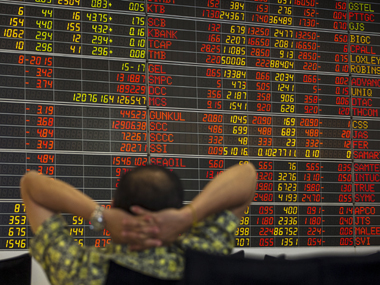
Market gave up previous session’s gains and ended lower on Wednesday, the first day of the financial year of 2020-2021 with Nifty slipped below 8,300 level.
The Sensex tanked 1,203.18 points or 4.08 percent to 28265.31 while the Nifty was down 343.95 points or 4 percent at 8253.80 at close.
As many as 1,098 shares advanced, while 1,067 shares declined, and 167 shares remained unchanged.
Tech Mahindra was the top loser in the Sensex pack plunging over 9 percent. Other top losers included Kotak Mahindra Bank, TCS, Infosys, Axis Bank, SBI, HUL and HCL Tech.
BEL achieves record turnover in excess of Rs 12,500 cr
Navratna Defence PSU Bharat Electronics Limited (BEL) posted a turnover in excess of Rs 12,500 crore (Provisional & Unaudited) during 2019-20, a six per cent growth over the previous year’’s figure of Rs 11,789 crore.
BEL’s order book as on Wednesday is Rs 51,800 crore, the Bengaluru-headquartered company said in a statement.
The year saw BEL securing orders worth Rs 13,000 crore, including Akash missiles (seven squadron), coastal surveillance systems (CSS), upgrade for EW system, radars, AMCs for radars & weapon systems, software defined radio (SDR), sonars and advanced communication systems, it said.
Some of the flagship projects executed during 2019-20 are: Command & control systems, thermal Imagers for tanks, upgrade of communication system, land based EW systems, weapon repair facility, various Radars, smart city projects, Delhi CCTV project, avionics package for LCA, classroom jammers, real time information system for Railways and LRSAM, BEL said.
India switches to world’s cleanest petrol, diesel with no increase in prices
India on Wednesday joined a select league of nations having the world’s cleanest petrol and diesel as oil companies rolled out Euro-VI emission compliant fuels without either disruption or a price increase.
Leapfrogging from BS-IV grade fuel straight to BS-VI grade, equivalent to Euro-VI fuel, petrol and diesel would have resulted in an up to Re 1 per litre increase in cost but oil companies decided against passing this on to consumers and instead adjusted it against the reduction warranted from international oil prices plummeting to a 17-year low.
“We are today 100 per cent supplying BS-VI petrol and diesel. All the over 68,700 petrol pumps in the country are selling the cleaner fuel from today,” said Sanjiv Singh, Chairman, Indian Oil Corp (IOC) – the firm that controls roughly half of the market.
Nestle buys Lily’s Kitchen to boost premium pet food
Nestle’s Purina PetCare division has acquired London-based Lily’s Kitchen, which makes premium wet and dry natural foods for dogs and cats, the Swiss group said on Wednesday, boosting its fastest-growing product category.
It gave no purchase price for the acquisition. The brand has around 85 million pounds ($105 million) in sales across 6,000 stores in 30 countries, it said.
Lily’s Kitchen will continue to be run as a stand-alone business from its base in London, Nestle said.
Petcare was Nestle’s fastest-growing category with 7 percent organic growth and sales of 13.622 billion Swiss francs ($14.12 billion) in 2019.
Ed-tech platform upGrad appoints former Byju’s executive Arjun Mohan as India CEO
Ed-tech platform upGrad on Wednesday said it has appointed Arjun Mohan as its chief executive officer for India operations.
The position of the CEO – India at upGrad was unoccupied since its inception.
“Mohan brings with him a rich understanding of the online education space, the evolving consumer landscape and keen business acumen,” upGrad co-founder and MD Mayank Kumar said.
Mohan is Byju’s former chief business officer (CBO). He brings over a decade of experience in the edtech sector and was one of the early employees of Think and Learn (which runs Byju’s), the statement said.
Prior to Byju’s, he has worked with Titan Industries, Tata Motors, Tata Realty and Infrastructure Ltd (TRIL) and Sir Dora.
Indiabulls Group pledges Rs 21 cr to PM CARES Fund
In the wake of the coronavirus pandemic that has spread across the world, the Indiabulls Group pledged Rs 21 crore to the Prime Minister’s ‘Citizen Assistance and Relief in Emergency Situations Fund’ (PM CARES Fund).
The group hopes to keep supporting the exemplary work done by the Centre and state governments in conjunction with healthcare professionals across the country, as they lead the unsung efforts against the pandemic.
“This outbreak has spared no nation, and it will take the collective spirit of our entire country to best fight it. Indiabulls Group will aim to support every effort towards that objective,” said, Sameer Gehlaut, chairman, Indiabulls Group
NMDC’s March iron ore production slips 31.7%
Credit quality of Indian companies worsened in FY20: ICRA
Domestic credit rating agency Icra said credit quality of Indian companies worsened in fiscal year 2019-20 as it downgraded Rs 7 lakh crore of debt and warned of “unprecedented strain” on credit profiles of corporates due to the coronavirus pandemic.
The agency said policymakers will have to unleash more measures to avoid “severe economic imbalances” if the COVID-19 crisis prolongs.
In its annual credit quality review after the end of the fiscal year, Icra said it downgraded Rs 7 lakh crore of debt in FY20, as against Rs 3 lakh crore in the year-ago period, driven largely by actions against financial sector companies.
SEBI slaps Rs 55-lakh fine on 11 entities
Market regulator SEBI has imposed a penalty totalling Rs 55 lakh on 11 entities for indulging in fraudulent trading in the scrip of Unisys Software and Holding Industries Ltd.
The regulator levied a fine of Rs 5 lakh each on 11 entities —Deepa Saurabh Shah ,Sunil Jain, Rahul Gupta, Decent Vincom,Anthony Gayen, Dilip Kumar Mandal, Badri Prasad & Sons, Premsagar Vinimay, Nityadhara Plaza, Conquer Barter and Navdurga Investment Consultants.
The regulator had conducted an investigation between January 2010 and November 2014 regarding the scrip of Unisys Software.
During the investigation, Sebi found that these entities are connected to each other and had indulged in fraudulent trade practices that created a misleading appearance of trading and contributed to manipulation in the scrip price of Unisys, which misguided the investors in the securities market.
Escorts’ total sales down 54.3% in March
India’s March electricity use falls 9.2%
India’s electricity use fell 9.2 percent in March, provisional government data showed on Wednesday, as consumption fell for the first time in three months due to a nationwide lockdown to prevent the spread of the coronavirus.
Electricity supply fell to 100.2 billion units in March from 110.33 billion a year earlier, an analysis of load despatch data by state-run POSOCO showed.
Jindal Aluminium contributes Rs 5 cr to PM CARES Fund
Jindal Aluminium Ltd (JAL) on Wednesday said that it has contributed Rs 5 crore to Prime Minister’’s Citizen Assistance and Relief in Emergency Situation (PM CARES) fund in order to help the government fight the coronavirus pandemic in India.
“We are confident that India will conquer the COVID-19 crisis. In this exceptionally difficult period, we have made our humble support to the PM-CARES fund towards relief efforts,” said Jindal Aluminium Ltd chairman and managing director Sitaram Jindal.
Prime Minister Narendra Modi had earlier announced an emergency relief fund and invited contributions from the citizens as the country continues to battle coronavirus or COVID-19.
October-March sugar production down 21.6%
Market extends losses; Sensex down 1,343 points, Nifty holds 8,200-mark
The market extended the morning losses in the afternoon trade as the COVID-19 cases witnessed jump on Wednesday.
Sensex plunged 1342.66 points or 4.56 percent to 28,125.83 and Nifty was down 379.60 points or 4.42 percent at 8,218.15 at around 2.10 pm.
HUL announces completion of GlaxoSmithKline merger
FMCG major Hindustan Unilever on Wednesday announced completion of GlaxoSmithKline Consumer Healthcare Ltd’s merger (GSKCH) with itself.
The company has received all the necessary regulator approvals along with the National Company Law Tribunal for the merger of GSKCH into the company, HUL said in a statement.
In addition, the board of HUL also approved acquisition of popular health drink brand Horlicks from GSK for a consideration of Euro 375.6 million (Rs 3,045 crore), exercising the option available in the original agreement between its parent firm Unilever and GSK.
Lack of medical funds poses challenge in fight against COVID-19: Fitch
Continued lack of medical funds and healthcare infrastructure despite additional funding poses challenges in mounting an effective response against the coronavirus outbreak, according to a report.
“The continued lack of medical funding and healthcare infrastructure inform our view for the potential epidemic to be worse in India if it is not adequately contained. With 8.5 hospital beds per 10,000 population and 8.0 physicians per 10,000, the country’s healthcare sector is not equipped for such a crisis,” Fitch Solutions said.
Moreover, the significant inefficiency, dysfunctioning, and acute shortage of the healthcare delivery systems in the public sector appear to be insufficient to match up with the growing needs of the population, it said.
Unable to assess impact of present situation on operations, financials: Tata Steel
MP print media hit hard due to COVID-19 outbreak and lockdown
The coronavirus outbreak and lockdown has severely affected the print media in Madhya Pradesh as over 300 newspapers have been forced to suspend publications due to issues like lack of transport facilities and rumours that newspapers could be carriers of the virus.
Some of the affected media organisations have started putting out online editions to keep their readership intact.
“More than 300 medium and small newspapers from various districts have stopped printing their editions in the absence of transport facilities and drastic decline in advertisements,” an official said.
“Misgivings” that newspapers could carry the deadly virus to people’’s homes also led to suspension of printing after the lockdown, he said on condition of anonymity.
Nearly 670 newspapers are registered with the state government and out of these, 287 are published from Bhopal, the official said.
Aavishkaar Capital invests Rs 35 cr in Ergos
Aavishkaar Capital, the venture capital arm of Aavishkaar Group, on Wednesday said it has invested Rs 35 crore in agri-tech startup, Ergos.
Aavishkaar Capital had invested in Ergos in 2015 at ideation stage, and has worked with the promoters in scaling the company, a statement said.
The Series A funding round is expected to mop up Rs 100 crore with an Aavishkaar Capital partner and a technology venture capital fund also set to join the round, it added.
Founded by Kishor Jha and Praveen Kumar, Ergos has been building a GrainBank model that has been piloted in Bihar. The model enables farmers to digitise their foodgrain and also provides doorstep access to end-to-end post-harvest supply chain solutions to farmers.
Dollar rallies as investors brace for global downturn
The dollar gained broadly against riskier currencies on Wednesday, with markets staring at what is likely to be one of the worst economic contractions for decades as the world locks down to fight the coronavirus pandemic.
The greenback advanced against the Australian and New Zealand dollars, sterling, and most emerging market currencies as fresh selling in global shares highlighted growing risks from the pandemic that has shown little sign of abating.
The Australian dollar dropped 0.35 percent to $0.6115 and the New Zealand dollar fell 0.3 percent to $0.5945 while the British pound shed 0.4 percent to $1.2376.
PFC disburses Rs 11,000 cr in first week of lockdown
State-owned Power Finance Corporation (PFC) has disbursed Rs 11,000 crore to finance power sector projects during the first week of lockdown till 31 March.
The company claimed that the lockdown to fight COVID-19 has not affected it’’s work as it disbursed Rs 5,300 crore on 31 March, itself.
“During the lockdown period of one week, we disbursed more than Rs 11,000 crore and on the last day we disbursed Rs 5,300 crore, which is a remarkable achievement,” PFC chairman and managing director Rajeev Sharma said in an internal letter to company employees on Wednesday.
“I am extremely happy to share that work of PFC did not suffer any pullbacks due to the lockdown and everyone contributed by working from home using the IT systems. This would not have been possible without the team-spirit displayed by PFCians,” Sharma.
Oil down in Asian trade as Saudi Arabia hikes output
Oil fell in Asian trade Wednesday as a rally lost steam with Saudi Arabia flooding the market with crude and the escalating coronavirus pandemic sapping global demand.
Prices plunged to their lowest levels in 18 years on Monday but staged a strong rebound the following day as investors took heart from moves by policymakers to support the virus-hit world economy.
In afternoon Asian trade Wednesday, US benchmark West Texas Intermediate (WTI) was down 1.66 per cent to USD 20.14 a barrel after trading higher in the morning.
Brent, the international benchmark, tumbled 3.42 per cent to USD 25.45 a barrel in volatile trade.
Wipro, Azim Premji Foundation commit Rs 1,125 cr to tackle COVID-19 crisis
Wipro Ltd, Wipro Enterprises Ltd and Azim Premji Foundation have together committed Rs 1,125 crore towards tackling the unprecedented health and humanitarian crisis arising from the COVID-19 outbreak in the country.
These resources will help enable the dedicated medical and service fraternity in the frontline of the battle against the pandemic and in mitigating its wide-ranging human impact, particularly on the most disadvantaged of our society, as per a company statement released on Wednesday.
Of the Rs 1,125 crore, Wipro Ltd’s commitment is Rs 100 crore, Wipro Enterprises Ltd’s is Rs 25 crore, and that of the Azim Premji Foundation is Rs 1,000 crore, it added.
These sums are in addition to the annual corporate social responsibility (CSR) activities of Wipro, and the usual philanthropic spends of the Azim Premji Foundation, the statement said.
Market down 3.4%; research agencies may cut India’s GDP growth rate
Market was trading on a lower note by 3.4 percent tracking weakness in Asian peers as rising coronavirus cases along with concerns over growth due to large scale shutdown of businesses worried investors on Dalal Street, said Sundar Sanmukhani, head of fundamental research desk, Choice Broking.
“Multiple research agencies have projected a sharp cut in India’s GDP growth rate. Also weak auto sales numbers for the month of March further dented sentiments. Selling pressure in Index heavyweight stocks like Kotak Bank, RIL, SBI and HDFC bank among others dragged the market lower,” he said.
Sectorially all indices were trading on lower note with banking stocks taking most hit. Volatility is likely to persist in the market amid the ongoing coronavirus pandemic and its global economic impact, he added.
Sensex tanks over 1,200 points, Nifty below 8,200-mark
The market slipped into the red again as the European markets opened on Wednesday on lower after the US warned of jump in death toll due to coronavirus pandemic.
Sensex plunged 1203.20 points or 4.08 percent to 28,265.29 while the broader Nifty was down 331.55 points or 3.86 percent at 8,266.20 at around 1.10 pm.
LPG cylinder prices slashed up to Rs 65
Two-thirds of Lufthansa’s staff to shorten work hours
Almost two-thirds of Lufthansa’s global staff will work reduced hours after the German airline grounded much of its fleet due to the coronavirus pandemic, a news site reported on Wednesday.
Citing unnamed company sources, Business Insider said Lufthansa would apply for about 60,000 employees in various sister companies to work reduced hours, after it announced short-time working for cabin and ground staff on Monday.
Arcil pledges Rs 1.5 cr to PM-CARES Fund
The country’’s oldest asset reconstruction firm Arcil on Wednesday said it has committed Rs 1.5 crore to support the fight against novel coronavirus pandemic.
It has donated Rs one crore to the Prime Minister’’s Citizen Assistance and Relief in Emergency Situations Fund (PM-CARES Fund), and has given Rs 25 lakh to the CM relief fund-Covid 19 for Maharashtra, the company said in a statement.
It further said Rs 25 lakh will be parked for future preventive measures to contain the virus spread.
The company’’s employees will also donate voluntarily to PM-CARES Fund.
All branches of OBC, UBI start functioning as PNB branches
State-owned Punjab National bank on Wednesday said all nation-wide branches of United Bank of India (UBI) and Oriental Bank of Commerce (OBC) has started functioning as PNB branches.
The amalgamation of Punjab National Bank, United Bank of India and Oriental Bank of Commerce has come into effect from 1 April 2020.
The merger will create the second largest nationalized bank of the country – both in terms of business and branch network.
The synergy from the amalgamation will create a globally competitive, next generation bank, PNB 2.0, the bank said in a release and added that all customers, including depositors, will be treated as PNB customers.
PNB 2.0 will be offering specified inter-operable services through all branches and all platforms including Mobile and Internet Banking, it added.
European markets open sharply lower
Market recovers from day’s low as Sensex down over 900, Nifty above 8,300-mark
The market made slight recovery in the afternoon though remained in the red zone in the afternoon trade.
Sensex plunged 995.52 points or 3.38 percent to 28,472.97 while Nifty was down 287.65 points or 3.35 percent at 8,310.10 at around 12.45 pm.
Kotak Mahindra Bank and Tech Mahindra were the major losers in the Sensex pack.
Experion Developers donates Rs 1.85 cr to PM CARES Fund
FDI-funded realty firm Experion Developers on Wednesday said it has donated Rs 1.85 crore to PM CARES Fund for fighting the coronavirus pandemic.
In addition to the Rs 1.85-crore contribution, Experion Developers has extended the material supply of medicines and essential items to the Municipal Corporation of Gurgaon (MCG), the company said in a statement.
The firm has also contributed Rs 20 lakh to Haryana Corona Relief Fund.
The Gurugram-based company is backed by Singapore’s Experion Holdings, which is the real estate investing arm of the $2.5 billion AT Holdings group of companies.
Retail trade incurs losses worth $30 bn last fortnight: CAIT
Traders’’ body CAIT on Tuesday said India’’s retail trade has incurred losses to the tune of whopping USD 30 billion (about Rs 2.2 lakh crore) in the last fortnight alone due to the coronavirus pandemic.
According to the Confederation of All India Traders (CAIT), the country’’s retail sector, comprising 70 million small, medium and big traders employing 450 million people, undertakes a monthly business of about $70 billion (approximately Rs 5.2 lakh crore), and is one of the hardest hit due to the global pandemic.
CAIT secretary general Praveen Khandelwal said that even if global economies and other sectors of the Indian economy bounce back sooner than expected.
RBI announces further measures to deal with COVID-19 pandemic
Zen Technologies to develop ventilator prototype for India to fight COVID-19
In its bid to fight against the COVID-19 pandemic, Zen Technologies on Wednesday said it is in the process of developing a ventilator prototype for India.
The product is expected to be ready soon, according to a BSE filing.
“As a part of the corporate social responsibility… Zen Technologies has dedicated a small research and development team to develop a prototype of a ventilator for India,” the company said.
Global stocks give up meager gains as virus anxiety prevails
Asian shares and Wall Street futures fell on Wednesday in the first trading session of the quarter as the coronavirus pandemic and the prospect of a global recession tore through investor confidence.
E-Mini futures for the S&P 500 slumped 2.27 percent as dire predictions of more virus casualties in the United States weighed on sentiment.
MSCI’s broadest index of Asia-Pacific shares outside Japan erased gains to trade 0.33 percent lower. Shares in South Korea, hit hard by the virus, fell 1.34%.
Japanese shares fell 3.48 percent as a rapid increase in infections in Tokyo fueled speculation the government would place the capital on lockdown.
Futures in Europe were also battered with Euro Stoxx 50 futures down 2.99 percent, German DAX futures off 2.89 percent and FTSE futures falling 3.09 percent.
NEC Tech India appoints Aalok Kumar as president, CEO
EC Technologies India on Wednesday said it has appointed Aalok Kumar as its president and chief executive officer.
With this appointment, Takayuki Inaba (former chairman and managing director) has been appointed as executive chairman of NEC Technologies India, a statement said.
This change reflects NEC Corporation’s strong commitment to the country and India’s growing importance to the company’s global business, it added.
“This management restructuring exercise is aimed at accelerating our evolution in India. Capacity building in India will not only bolster our business in this country but also support our global businesses,” NEC Corporation president (global business unit) Akihiko Kumagai said.
MG Motor sells 1,518 units in March
MG Motor India on Wednesday reported total retail sales of 1,518 units in March 2020, including 116 ZS EV and 1,402 Hector SUV, the company said in a statement.
“Both MG Hector and MG ZS EV have made a mark in the Indian car market. Despite supply chain disruption globally, MG Motor continues to serve its customers,” MG Motor India president and managing director Rajeev Chaba said.
“In February, our sales were impacted due to the disruption, while the situation improved during March before the lockdown was announced, resulting in the shutting down of our manufacturing plant,” Chaba added.
DigitalKites appoints Amit Lall as senior vice-president
DigitalKites, an open and collaborative digital advertising ecosystem with products AudiencePlay and AudiencePrime, has roped in Amit Lall as senior vice-president-partnerships.
In his new role at DigitalKites, Lall will be leading the AudiencePrime Partnerships team.
With around two decades of experience, Lall is an industry veteran whose strength lies in developing and executing digital strategies and roadmaps, it said in a press statement.
He was at the forefront of developing and executing the digital advertising strategies for several global brands such as Beiersdorf, Daimler, Sony Pictures, Parle Agro, Hyatt, Bunge, Qantas, TransUnion Cibil, Snapchat, Bumble, Hasbro, J&J and many others.