The real-time measurement of sentiments of the Twitter community during the match was a key feature of IBM’s ScoreWithData (@scorewithdata) campaign…
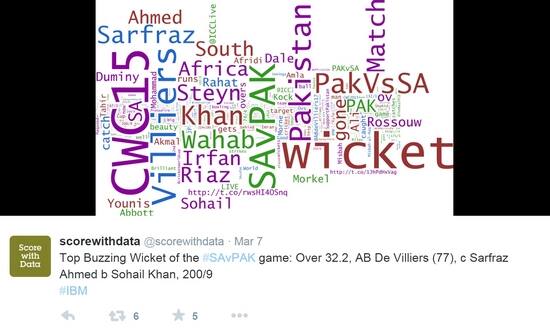
On March 7, 2015, at Eden Park in Auckland, New Zealand, the South Africa vs Pakistan match at the Cricket World Cup 2015 captured the attention of a global audience. The high tension match kept fans on the edge of their seats until Pakistan achieved victory thanks to some masterful bowling. Each fallen wicket at the hands of Pakistani bowlers saw the crowd scream with excitement. The most emotional reaction was when Sarfraz Ahmed caught out AB De Villers in the 32nd over, changing the flow of the game. But the loudest cheers weren’t just in the stands of Eden Park but those on Twitter.
![AB De Villers]()
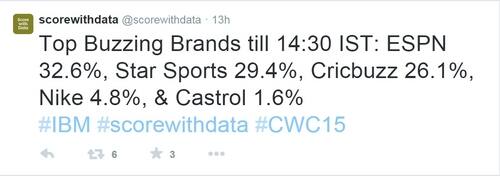
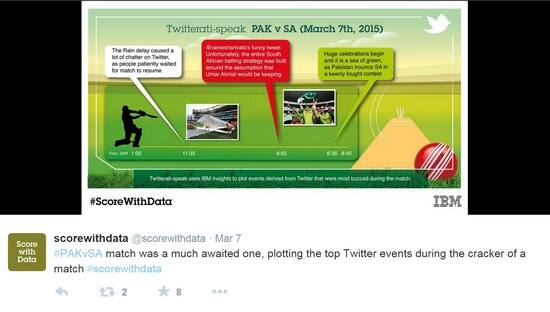
The real-time measurement of sentiments of the Twitter community during the match was a key feature of IBM’s ScoreWithData (@scorewithdata) campaign. IBM is known for building smarter companies and countries, but now the computing giant is employing the full force of its IBM Content Analytics as a part of its efforts to deliver insights from the ongoing Cricket World Cup. By applying it to the Twitter community the ScoreWithData campaign was able to gauge the social sentiments of viewers in reaction to every ball bowled during the match. IBM Social Media Analytics examines social discussion around teams, players, events, as well as examines sentiments across different entities and identifies topics that are trending. This IBM technology analyses and presents fan sentiment and answers questions like who fans think will win, or the player fans are betting on to be the most effective, etc. From a business angle, advertisers can use the discussion to appropriately position their products and services. IBM Content Analytics examines large social content more deeply and tries to mimic human cognition and learning behaviour to answer complex questions like the impact of certain player or attributes determining the outcome of the game. IBM Data Curation and Integration capabilities on BigInsights and Social Data Accelerator (SDA) have been used to extract social insights from streaming Twitter feed in real time, for instance about top brands buzzing, top batsmen, top celeb tweets, etc. Moreover, IBM uses Text Analytics and Natural Language Processing to perform fine grained temporal analytics around events (short lifespan but important events, like boundaries, sixes and wickets). IBM has gone on to partner with major companies like Twitter to truly exploit enterprise service value using Watson’s cognitive computing platform. As IBM’s Social Sentiment Index demonstrates - the voice of the online consumers today is a great opportunity for modern businesses everywhere.
![Brands]()
Using content analytics, business’ can scour the web in search for opinions and thoughts directly from their consumers. But given the near infinite expanse of the Internet and the high density flux of information online, finding the right information in the shortest time possible can prove to be difficult. In the scenarios of marketing, business planning and customer service we can confidently say that cognitive computing powered social sentiment analysis has become an essential element of business strategy - but only if it is done right. Early incidents from social sentiment analysis have proven fairly basic, measuring generic variables in terms of keyword mentions and frequency. They have never crossed over into genuinely insightful findings that represent the depth and context from which they are drawn
![SocialSentiment]()
Other developers from all over the world such as AlchemyAPI, have also initiated their own deep-learning cognitive computing programs which claim to see through the noise of the online chatter. In the case of AlchemyAPI these claims are well founded as the company services billions of API calls from dozens of countries every month. For this reason, among many others, IBM chose to acquire AlchemyAPI on 6 March 2015. By absorbing the AlchemyAPI’s team within the Watson development group at IBM, the opportunity to develop deep learning artificial intelligence has taken a massive step forward. The goal of these programs is to develop a program that can not only analyse unstructured data in real-time along different parameters for enterprise users but also employ natural language interface for a more precise understanding of the information available. The cloud services suite for enterprises provided by IBM already includes Watson Content Analytics, allowing businesses to efficiently process and analyse high volumes of data. The new features will also make it capable of comprehending queries that are posed to it in natural language which it will then answer using evidence-based findings. The ability to progressively learn based on its on-going interactions and operations makes future interactions with Watson easier and more efficient. The goal however still remains to allow individual enterprises with an effective applications program interface or API which they can customise to their evolving needs. This is why recent acquisitions like AlchemyAPI and others become an important evolution for IBM’s cognitive computing division. Another move to embolden the range of deep-learning by IBM is the recently announced partnership with Twitter. The deal was announced at the IBM InterConnect conference in Las Vegas on February 21. It is the first time that a company as established as IBM has acknowledged the enterprise value of social media data. This deal allows IBM access to real-time raw information it needs in order to repackage and analyse information for global business interests. This direct channel between consumer information, content analytics, enterprise APIs and businesses is expected to yield interesting results in the months to come. This isn’t only significant for IBM but for social sentiment analysis services as well, since it will prove once and for all the potential cognitive computing holds for enterprise needs.


 "Sponsored: Can Social Sentiment Analytics Drive Enterprise Insights?")


 "Israel targets top Hamas leaders in Doha; Qatar, Iran condemn strike as violation of sovereignty")
 "Nepal: Oli to continue until new PM is sworn in, nation on edge as all branches of govt torched")
 "Who is CP Radhakrishnan, India's next vice-president?")
 "Israel informed US ahead of strikes on Hamas leaders in Doha, says White House")
 "Israel targets top Hamas leaders in Doha; Qatar, Iran condemn strike as violation of sovereignty")
 "Nepal: Oli to continue until new PM is sworn in, nation on edge as all branches of govt torched")
 "Who is CP Radhakrishnan, India's next vice-president?")
 "Israel informed US ahead of strikes on Hamas leaders in Doha, says White House")



