

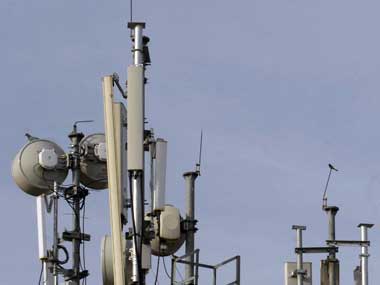
 "Spectrum sharing in present form may not help telcos enough")
New Delhi: By the look of it, telcos may not really get much benefit even when the government allows spectrum sharing. Spectrum sharing has been allowed by the cabinet but detailed guidelines are still being formulated by the Department of Telecom. And if draft guidelines, which have been reviewed by Firstpost, are anything to go by, telcos may not really gain much even when spectrum sharing is allowed. Spectrum sharing means two telecom service providers share spectrum or airwaves in a service area.
Here is why these draft norms will leave telcos cold:[caption id=“attachment_1295043” align=“alignleft” width=“380”]  New telecom policy soon. Reuters [/caption]
1• DoT has proposed that no spectrum sharing be allowed in the case of 3G airwaves. But it is in 3G where telcos probably would have welcomed this facility the most since there is no pan-Indian 3G spectrum holder. And there have already been enough disputes between telcos and the government over intra-circle roaming for 3G customers. Basically, if telcos are not permitted to share 3G spectrum, holes in 3G connectivity will remain.
2• The draft permits sharing between two service providers who have both already paid one-time charge for spectrum holding above 4.4 mhz GSM spectrum and 2.5 mhz CDMA spectrum. Here again, no gain really for telcos who may have wanted to avoid these payments by sharing some spectrum.
3• The draft guidelines say spectrum usage charge-which is a hotly contested levy right now for various reasons-will be levied on each telco sharing spectrum but for the total spectrum held by both operators together. So if operator X has 4.4 mhz GSM spectrum and share it with another operator Y which already has its own 4.4 mhz GSM spectrum, then both X and Y will be liable to pay SUC applicable to 8.8 mhz of spectrum. This is another dampener.
4• Spectrum sharing can only be done when both the telcos involved used each other’s airwaves, it cannot lead to a situation where one telco leases some spectrum to another - the draft guidelines make it clear that spectrum leasing is not permitted. Again, this may mean a very limited benefit of sharing spectrum.
Impact Shorts
More Shorts5• Spectrum sharing can only be done by two telcos which hold spectrum in the same service area and only when DoT gives specific permission for this. It can only be between two spectrum holders, both of which are holding spectrum either in 900, 1800 or 800 mhz bands. The first two frequencies are used to provide 2G voice services as of now while 800 mhz airwaves are right now used by telcos for CDMA operations.


 "Russian drones over Poland: Trump’s tepid reaction a wake-up call for Nato?")
 "As Russia pushes east, Ukraine faces mounting pressure to defend its heartland")
 "Why Mossad was not on board with Israel’s strike on Hamas in Qatar")
 "Turkey: Erdogan's police arrest opposition mayor Hasan Mutlu, dozens officials in corruption probe")
 "Russian drones over Poland: Trump’s tepid reaction a wake-up call for Nato?")
 "As Russia pushes east, Ukraine faces mounting pressure to defend its heartland")
 "Why Mossad was not on board with Israel’s strike on Hamas in Qatar")
 "Turkey: Erdogan's police arrest opposition mayor Hasan Mutlu, dozens officials in corruption probe")



](https://images.firstpost.com/wp-content/uploads/2013/12/tower380.jpg)