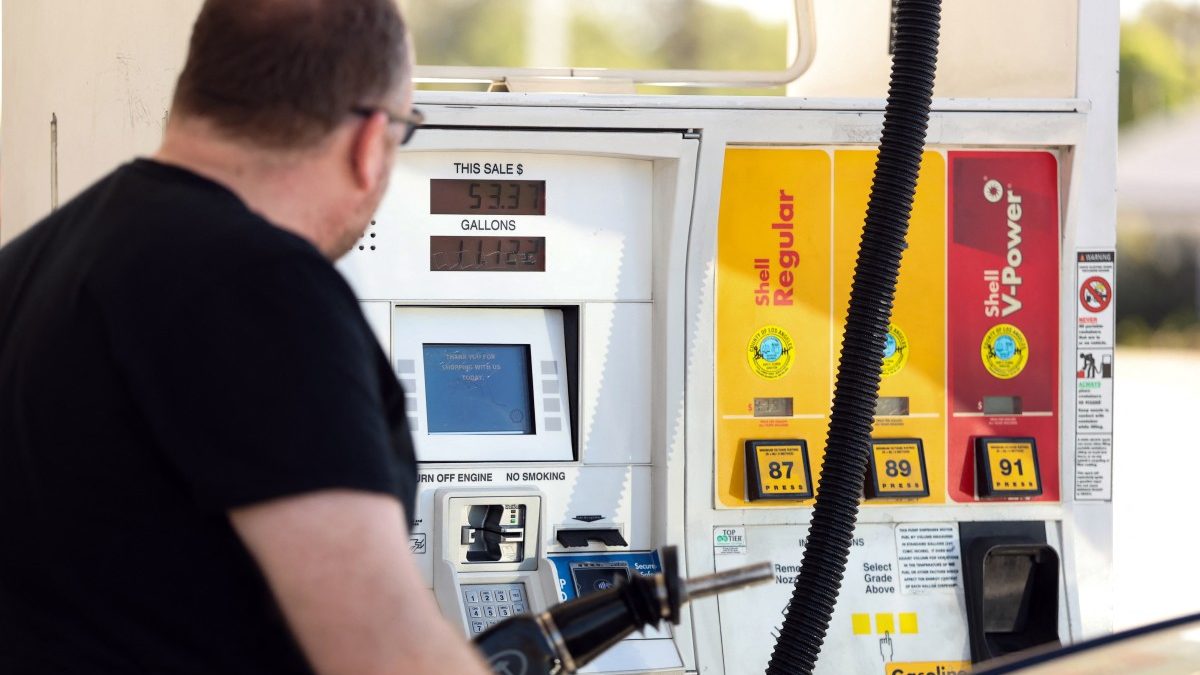
 "Recession odds at 49%: Economists split on how long US can absorb $100 oil")
The risk of a US recession has climbed to the brink of a coin toss, with economists increasingly divided over whether the oil shock triggered by the Iran conflict could tip the world’s largest economy into a downturn.
Moody’s Analytics has put the probability of a US recession within the next 12 months at 49 per cent, citing a combination of weakening macroeconomic data and a fresh surge in oil prices following the escalation in West Asia.
Mark Zandi, chief economist at Moody’s, said the economy was already showing signs of strain even before the latest military escalation. “Behind the recent jump are primarily the weak labour market numbers, but almost all the economic data have turned soft since the end of last year,” he noted.
Zandi’s recession indicator, which has historically tracked downturns with reasonable accuracy, is now nearing the critical 50 per cent threshold — a level that has preceded every US recession since World War II, barring the pandemic-induced contraction.
He warned that the latest spike in crude prices could push the indicator over that line. “Oil prices are an important variable in the model, and with good reason: every recession since WWII, save the pandemic recession, has been preceded by a spike in oil prices,” Zandi said.
Oil shock at the centre of debate
The sharp rise in crude — hovering above $100-a-barrel mark — has become the central fault line in the debate.
A Trump-aligned economist cautioned that the US economy “won’t be able to handle $100 oil for long,” an unusually stark warning from within the president’s own policy orbit.
Quick Reads
View AllYet others argue that the structure of the US economy has evolved enough to cushion the blow. Analysts at Oxford Economics said oil would likely need to surge to around $140 a barrel for a sustained period to trigger a global recession, suggesting current levels, while painful, may not be catastrophic.
They added that the trajectory of the conflict — particularly the stability of shipping through the Strait of Hormuz — would be critical in determining both the depth of any slowdown and the pace of recovery.
‘Like an ocean liner’: Furman strikes a calmer note
A more sanguine view has come from Jason Furman, former chair of the White House Council of Economic Advisers under Barack Obama.
Writing in a New York Times opinion piece, Furman argued that the US economy remains fundamentally stable despite political rhetoric and geopolitical shocks.
“The American economy, like an ocean liner, is extremely hard to turn,” he wrote, suggesting that neither recent policy shifts nor the Iran war are likely to dramatically alter its trajectory in the near term.
Furman noted that most key indicators — from GDP growth and unemployment to inflation and wage gains — have remained broadly consistent with 2024 levels, even as narratives around the economy have shifted sharply.
He also argued that while higher oil prices will hurt consumers, the US economy is far less oil-intensive than in past decades, reducing the risk of a 1970s-style stagflation shock.
Powell flags uncertainty
Jerome Powell has struck a cautious tone, acknowledging heightened uncertainty while pushing back against comparisons with the stagflation era.
The Fed chief indicated that while energy-driven inflation is a concern, structural differences — including lower oil dependence and more anchored inflation expectations — make a repeat of the 1970s unlikely.
Even relatively optimistic forecasts acknowledge that American households are likely to feel the strain.
Zandi warned that higher fuel costs would feed into a broader cost-of-living squeeze at a time when consumers are already “increasingly nervous spenders.” That, in turn, could dampen demand — the backbone of US economic growth.
Furman echoed this concern, noting that consumer sentiment has deteriorated sharply, even as underlying economic indicators have remained relatively stable — a phenomenon he described as a shift from a “vibecession” to a deeper “vibedepression”.

 "Israel-Iran War News: Tehran mocks Trump over $200-bn budget request for war, calls it ‘tip of the iceberg’")
 "Gabbard & CIA chief contradict Trump on Iran’s nuclear bomb & ‘imminent’ threat level")
 "Investors lose Rs 9 lakh crore in 1 session. What caused stock market to tank?")
 "Can the Red Sea replace the Strait of Hormuz amid global oil crisis?")
 "Israel-Iran War News: Tehran mocks Trump over $200-bn budget request for war, calls it ‘tip of the iceberg’")
 "Gabbard & CIA chief contradict Trump on Iran’s nuclear bomb & ‘imminent’ threat level")
 "Investors lose Rs 9 lakh crore in 1 session. What caused stock market to tank?")
 "Can the Red Sea replace the Strait of Hormuz amid global oil crisis?")