

 "Prices of petrol, diesel at 3-year highs: 7 charts that explain why we pay higher price")
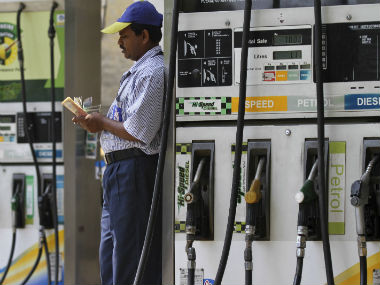
Ever since the oil marketing companies started the daily revision, prices of petrol and diesel have only been going up. And surprisingly, there are no protests from any political parties. The simple reason is that the rise is gradual and it goes unnoticed. [caption id=“attachment_4027671” align=“alignleft” width=“380”]  Representational image. Reuters.[/caption] As a senior oil company executive told PTI, “Previously, everybody felt the pinch when rates would go up by Rs 2 or 3 per litre in one go. Now they are being increased by 1 paisa to 15 paise a litre everyday, hikes that have largely gone unnoticed.” This precisely seems to be the NDA government’s aim too. But the rising prices of fuel have indeed started pinching the common man and the growing discomfort is palpable. An analysis of the price over the last three years shows that though there were periods when the common man enjoyed the benefit of lower prices, the government’s tax policies for the fuel sector has by and large denied them the ache din. Even when the government undertook the biggest indirect tax reform, the goods and services tax (GST), it ensured that the petroleum products do not come under the regime. Because of this the prices vary at locations depending on the applicable state taxes. Here’s a look at the trend over the last three years:
Petrol prices (Rs per litre) Infogram
On Tuesday, petrol price in Mumbai stood at Rs 79.48 per litre - a three-year high. In other three metros, namely Delhi, Kolkata and Chennai, the prices were at eight-month high. Ever since daily revision was introduced on 16 June this year, petrol price has gone up by Rs 5.09 in Kolkata, by Rs 4.90 in Delhi, Rs 4.93 in Chennai and Rs 2.78 in Mumbai, respectively. Under the NDA rule, the highest that petrol price hit was Rs 81.75 per litre in Mumbai on 1 August 2014 and lowest was Rs 62.75 on 1 March 2016.
Diesel prices (Rs per litre) Infogram
On Tuesday, diesel price in Kolkata was at 3-year high of Rs 61.38 per litre. In other three metros, the prices were at eight-month high. After the daily revision got introduced on 16 June this year, diesel price has risen by Rs 4.72 per litre in Kolkata, Rs 4.43 in Chennai, Rs 4.23 in Delhi and Rs 2.47 in Mumbai. In the current NDA’s tenure, the highest the diesel price (in Mumbai) hit was Rs 67.26 on 31 August 2014 and the lowest Rs 49.51 on 1 September 2015.
Retail selling price in neighbouring countries (Rs per litre) Infogram
While introducing the daily price revision, the government had said that the move is in keeping with the international practice. So, how do our petrol and diesel prices compare with our neighbouring countries? They are much higher. For instance, 1 September 2017, petrol in Delhi cost Rs 69.26 per litre whereas in Pakistan it cost just Rs 40.82 per litre, Sri Lanka Rs 49.80 per litre and Nepal Rs 61.88 per litre. In Bangladesh, it was at par with India at Rs 69.16 per litre. In case of diesel, the price in Delhi was Rs 57.13 per litre, Sri Lanka Rs 40.43 per litre, Nepal Rs 46.72, Pakistan Rs 47.15 and Bangladesh Rs 52.27.
Crude oil prices (Indian basket) $ per barrel Infogram
Now let’s look at what was the price that our government paid for the basket of crude that we bought. For the uninitiated, the Indian basket comprises 73 percent sour-grade Dubai and Oman crudes, and the balance in sweet-grade Brent. Soon after the NDA assumed office in June 2014, the Indian basket stood at $109 per barrel. The price fell 74 percent to hit a low of $28.1 per barrel in January 2016. However, during the same period, the fall in petrol and diesel price (in Mumbai) was just around 20 percent. On the contrary, as the price of the basket rose 91 percent from the lowest level to the present $53.6 per barrel, the retail fuel prices increased by around 20 percent. Why so? The charts below will provide an explanation to the puzzle.
Central taxes on petrol and diesel in Rs per litre Infogram
Clearly, the reason why the consumers do not get the benefit is due to several taxes levied by the government. The central excise duty on petrol shot up 127 percent from Rs 9.48 per litre in June 2014 to Rs 21.33 in January 2016. In case of diesel, the rise is a much sharper 387 percent during the period. In June 2014, the excise on the fuel stood at Rs 3.56 per litre and in January 2016, it was at Rs 17.33. This is not all. There are other state levies too that add up in the fuel bill. Following two charts show top 10 states/Union Territories that charge higher sales tax/VAT on petrol and diesel.
Top 10 states/UTs that charges higher sales tax/VAT on petrol (In %) Infogram
Top 10 states/UTs that charges higher sales tax/VAT on diesel (In %) Infogram
In nutshell, the higher taxes ensured that the common man never got the benefit of the lower crude oil prices. The question is will the government be ready to cut the taxes if the crude oil prices rise further? The prices are already rising. From June 2017 till date, the prices of the Indian basket have already risen by $7 or 15 percent. If the indications from the government are to be believed, there is unlikely to be any such luck. Recently oil minister Dharmendra Pradhan ruled out cutting the taxes to cushion the impact of rising international oil prices. “That situation has not come where we should relook at tax structure,” Pradhan was quoted as saying in a PTI report. So, tighten your belt and brace for a rough ride ahead. (With inputs from Rajesh Pandathil)


 "‘I’d love to do it’: Trump refuses to rule out third term — despite constitutional limit")
 "What is the ‘Golden Fleet’ of navy ships that Trump wants to counter China with?")
 "‘Ramayan country’: Why Trinidad and Tobago wants to build a large Ram temple")
 "How China's rare earths choke changed America's trade deals")
 "‘I’d love to do it’: Trump refuses to rule out third term — despite constitutional limit")
 "What is the ‘Golden Fleet’ of navy ships that Trump wants to counter China with?")
 "‘Ramayan country’: Why Trinidad and Tobago wants to build a large Ram temple")
 "How China's rare earths choke changed America's trade deals")



](https://images.firstpost.com/wp-content/uploads/2017/09/petrolstation-Reuters-380p1.jpg)