

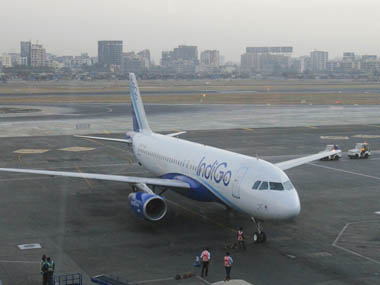
 "IndiGo is making money hand over fist; Jet struggles")
New Delhi: IndiGo, the single largest passenger airline in India (it overtook Jet recently by marketshare), now seems to be the most profitable as well.
Centre for Asia Pacific Aviation (CAPA) estimates that IndiGo made a profit of Rs 106 crore in the June quarter, its single largest profit since inception. What’s more, the CAPA estimate for IndiGo is double the profit that SpiceJet has declared and more than three times what legacy carrier Jet Airways reported for the same period.
Jet and SpiecJet are listed entities, while IndiGo, Air India and GoAir are unlisted so there is no official confirmation of these figures. Air India’s finances are declared with a lag in Parliament (since it is fully owned by the government) but there is no way to authenticate figures for the other two privately held airlines.
[caption id=“attachment_428839” align=“alignleft” width=“380”]  IndiGo profit is double of what SpiceJet has declared and more than three times what legacy carrier Jet Airways reported for the same period. Reuters[/caption]
Also, there is no clarity on whether these figures are after accounting for tax or before. As per the CAPA report, which was released late last night, GoAir has posted a profit of Rs 30 crore, Jet Airways of Rs 24 crore and JetLite Rs 11.7 crore.
So where does IndiGo go from here? CAPA warns that a high-cost environment in the domestic market has already resulted in a downward impact on its Q1 performance. And unless it reports “strong results” in the third and fourth quarters of this fiscal, it may fall short of achieving record profit for 2012-13.
Impact Shorts
More Shorts“With international services still in their first year, the losses associated with establishing these new routes have also brought down IndiGo’s numbers. The impact of international services could be greater than expected and hence IndiGo’s net profit for Q1 may be less than the Rs 106 crore estimated by CAPA. Nevertheless, the carrier could be on track to record its highest annual profit to date, subject to the performance of its international operations and the direction of the overall cost environment,” CAPA said.
CAPA noted that the pressure of rapid growth has already begun to impact the consistency of service at IndiGo and this is where the airline needs to gear up for corrective action.
Go Air, the smallest Indian carrier by fleet size, is the surprise package, performing better than most of its larger competitors. CAPA noted that the carrier is maintaining stable operations with a high level of customer satisfaction and has achieved the highest gross fares in the market (Rs 5,100?5,200) amongst the low-cost carriers, aided by the fact that it operates several routes on which it faces limited competition.
So what has GoAir done right? A focused network with a small fleet, judicious route selection and an overall upward tide in terms of yields. But CAPA has a word of caution for GoAir too. It needs to reduced its debt levels which CAPA estimates to be around Rs 900 crore so that its bottom line also improves.
Commenting on Kingfisher’s near moribund state, CAPA has prescribed a bitter pill: unless the airline gets $600 million in the next 30?60 days and access to a further $400 million over the next 12?18 months to fully?fund its business plan, it faces the prospect of a temporary operational shutdown.
CAPA has reserved its most scathing comments for Jet Airways, which together with JetLite was the largest airline group in India till last month when IndiGo usurped it. CAPA has said Jet’s low-cost strategy is ill-defined and “the confusion is highlighted by the fact that certain aircraft operate as full service in one direction and then return under a low-cost designation. Also, progress on the rationalisation of JetLite and JetKonnect under a single brand is slow”.
Another fault with Jet lies in insufficient focus on cutting non-fuel costs. CAPA has a three-pronged prescription: Introduce strategic clarity and greater definition of low-cost subsidiaries; control and rationalise non?fuel costs; focus on generating ancillary revenues.
All in all, the prognosis for Indian aviation is still far from healthy. CAPA has concluded by saying that for most carriers underlying profits remained modest at best after excluding sale?and leaseback and other non?operating income during Q1 despite it being the peak travel quarter and when strong yield improvements were seen. “This means that structural imbalances remain. As a result CAPA believes that significant improvements will be required in Q3 and Q4 financial performance to suggest that a sustainable recovery is underway.”


 "Israel targets top Hamas leaders in Doha; Qatar, Iran condemn strike as violation of sovereignty")
 "Nepal: Oli to continue until new PM is sworn in, nation on edge as all branches of govt torched")
 "Who is CP Radhakrishnan, India's next vice-president?")
 "Israel informed US ahead of strikes on Hamas leaders in Doha, says White House")
 "Israel targets top Hamas leaders in Doha; Qatar, Iran condemn strike as violation of sovereignty")
 "Nepal: Oli to continue until new PM is sworn in, nation on edge as all branches of govt torched")
 "Who is CP Radhakrishnan, India's next vice-president?")
 "Israel informed US ahead of strikes on Hamas leaders in Doha, says White House")



](https://images.firstpost.com/wp-content/uploads/2012/08/IndiGo1_Reuters3.jpg)