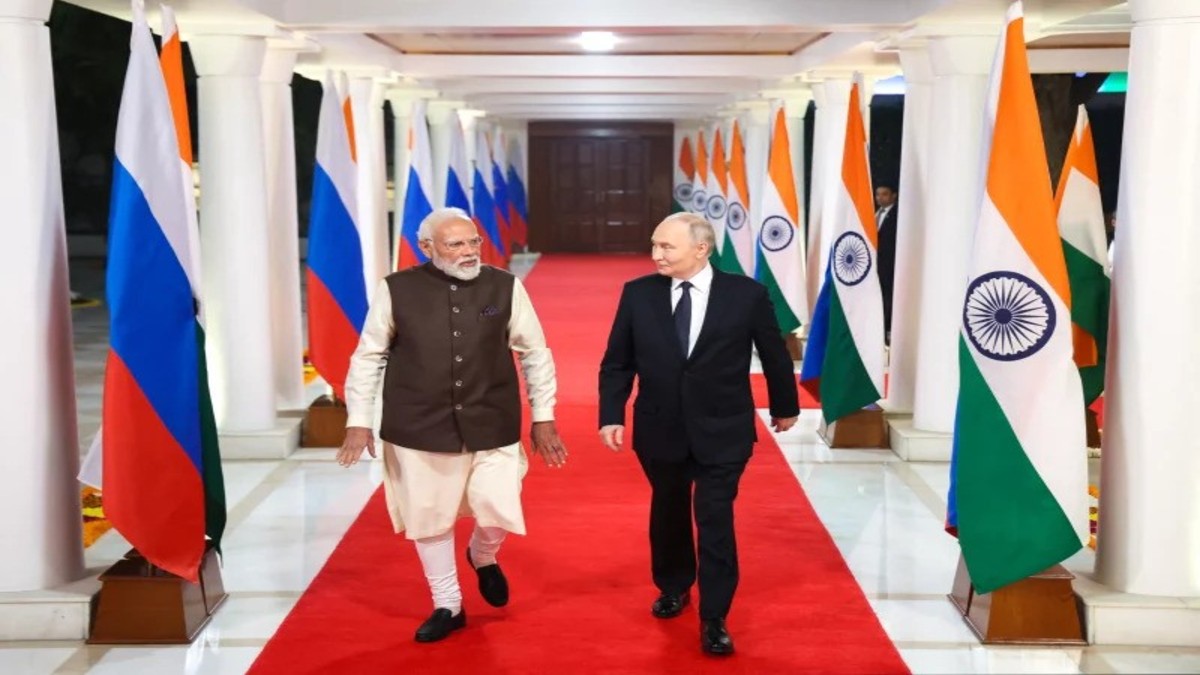
 "India-Russia trade ties")
India and Russia have unveiled an ambitious five-year roadmap to scale up bilateral trade to $100 billion by 2030, signalling a decisive shift towards deeper economic engagement even as geopolitical uncertainties intensify.
The roadmap was announced following high-level talks in New Delhi between Prime Minister Narendra Modi and Russian First Deputy Prime Minister Denis Manturov, alongside key Indian ministers including External Affairs Minister S Jaishankar, Finance Minister Nirmala Sitharaman, and National Security Advisor Ajit Doval.
The agreement marks a strategic push to rebalance India-Russia ties, traditionally anchored in defence, towards broader economic cooperation. Both sides identified priority sectors including energy, fertilisers, investment flows, and industrial collaboration as key drivers of future growth.
Officials said the roadmap builds on progress reviewed during the 23rd India-Russia Annual Summit between Modi and Russian President Vladimir Putin, with both nations reaffirming their “Special and Privileged Strategic Partnership.”
The roadmap anticipates rolling out concrete implementation mechanisms and sector-specific targets in phases over the next five years.
Manturov’s visit coincided with India’s decision to procure an additional batch of five S-400 air defence missile systems from Russia, reinforcing the defence pillar of the relationship.
The move follows the reported operational success of the S-400 systems during Operation Sindoor, where they played a critical role in strengthening India’s air defence posture against Pakistan.
Quick Reads
View AllThe new order builds on the 2018 $5 billion deal for five S-400 units, signed despite the threat of US sanctions under the Countering America’s Adversaries Through Sanctions Act (CAATSA).
The talks also took place against the backdrop of escalating tensions in West Asia, with both sides assessing the potential economic fallout—particularly on global energy markets and supply chains.
Officials indicated that regional instability and disruptions to key maritime routes could impact energy flows, trade logistics, and pricing dynamics, making India-Russia coordination in energy and commodities even more critical.
The discussions highlighted the growing overlap between economic cooperation and strategic security considerations in bilateral ties.
If successfully implemented, the roadmap could significantly expand India-Russia economic interdependence, reducing the current over-reliance on defence cooperation and opening new avenues in manufacturing, energy, and trade.
However, analysts caution that external pressures—including Western sanctions, evolving global alliances, and prolonged instability in West Asia—could pose risks to the pace and scale of execution.