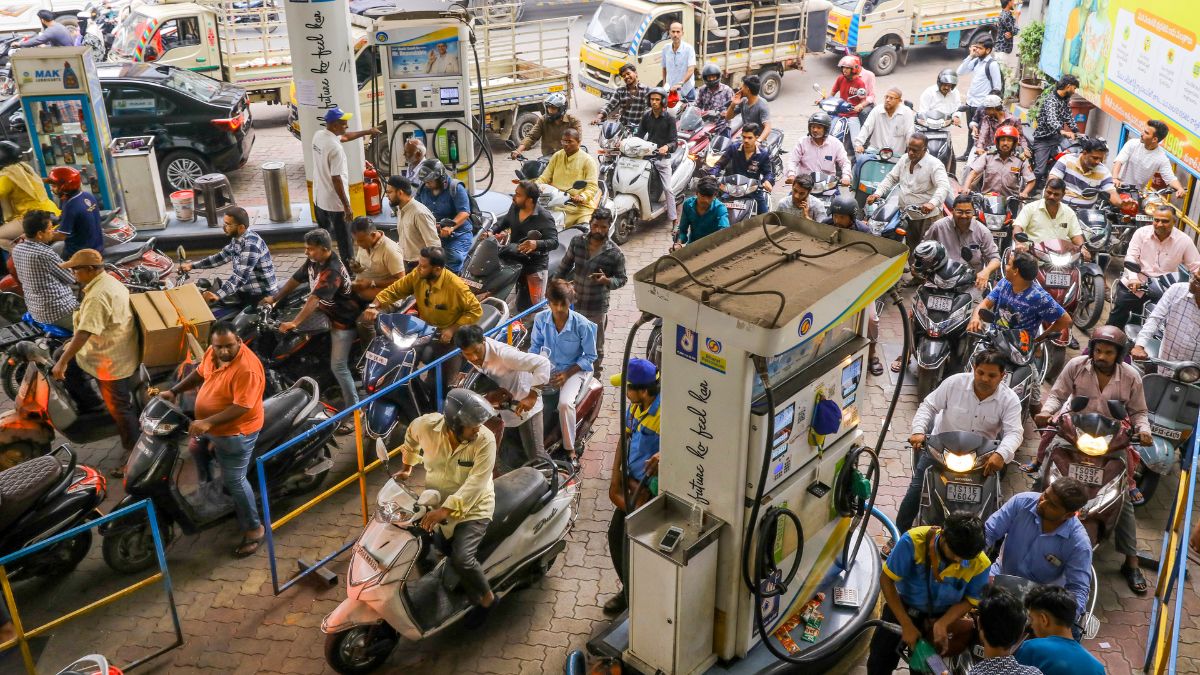
 "People queue up at a petrol pump in large numbers amid rumours of fuel shortage in the wake of the West Asia conflict, in Hyderabad, Telangana. File/PTI")
India has sharply reduced taxes on petrol and diesel while imposing export duties on refined fuels, as the government moves to shield domestic consumers from the fallout of the escalating West Asia conflict.
In a late intervention, the Centre cut the effective central excise duty on petrol and diesel for domestic consumption by Rs 10 per litre each, a move aimed at cushioning households from surging global oil prices and supply disruptions triggered by the US-Israel war with Iran.
The government also imposed export duties of Rs 21.5 per litre on diesel and Rs 29.5 per litre on aviation turbine fuel (ATF), signalling a shift toward prioritising domestic availability amid tightening global supplies.
External Affairs Minister S. Jaishankar said the measures followed a “swift and decisive intervention” by Prime Minister Narendra Modi to protect Indians from global price and supply shocks.
In a post on X, Jaishankar described the move as a “citizen-first approach” aimed at safeguarding affordability and ease of living, as energy and commodity markets remain under stress.
Hormuz disruption drives urgency
The policy shift comes as the Strait of Hormuz—one of the world’s most critical oil chokepoints—faces severe disruption, choking supplies and driving up freight and insurance costs. The route handles a significant share of global crude flows, and the ongoing conflict has heightened fears of a prolonged energy crunch.
India, the world’s third-largest oil importer, meets over 90 per cent of its crude needs through imports, making it highly vulnerable to such external shocks. It also depends heavily on West Asia for cooking gas imports, amplifying the risks to household budgets.
Quick Reads
View AllFiscal cost and industry impact
The government did not disclose the fiscal impact of the duty cuts. However, Madhavi Arora, chief economist at Emkay Global, estimated the annualised hit at roughly Rs 1.55 trillion.
According to her estimates, the reduction could offset about 30–40 per cent of the losses being incurred by oil marketing companies on auto fuels at current price levels, offering partial relief to refiners grappling with elevated crude costs.
Unlike China, which has moved to curb exports of refined fuels to protect domestic supply, India has so far refrained from imposing such restrictions, signalling confidence in its supply management strategy.
Government moves to reassure markets
The tax cut comes amid reports of panic buying in parts of the country, with long queues seen at fuel stations earlier this week. Authorities have repeatedly said there is no shortage of fuel and that supply chains remain intact.
Prime Minister Narendra Modi has emphasised that contingency measures are in place to ensure energy security, including adequate supplies of fertilisers for the summer sowing season and sufficient coal stocks to meet rising electricity demand.
While the conflict continues to inject uncertainty into global oil markets, India’s latest move underscores a policy pivot—from capturing windfall gains to shielding consumers and ensuring supply stability—as the economic fallout of the West Asia crisis deepens.
With inputs from agencies.
Dheeraj Kumar is a Business Correspondent at Firstpost, reporting on markets, macroeconomics and corporate developments. A postgraduate in English Journalism from the Indian Institute of Mass Communication (IIMC), New Delhi, he previously worked with Reuters’ Global News Monitoring team and has also worked with Prasar Bharati, and PTI. He is an avid reader with a deep interest in philosophy and the evolving role of artificial intelligence in journalism.