New Delhi: Reversing a five-quarter slide in GDP growth, Indian economy bounced back from a three-year low to expand by 6.3 percent in July-September as manufacturing revved up and businesses adjusted to the new GST tax regime. The GDP growth in the second quarter of 2017-18 compares to 5.7 percent in April-June, the lowest growth rate since the Narendra Modi government took office, and 7.5 percent in the September quarter of the previous fiscal, showed government data released here on Thursday. In the fourth quarter of 2013-14, economy had grown at 4.6 percent. Coming close on the heels of Moody’s recent upgrade of India’s sovereign credit for the first time in nearly 14 years, the growth buoyancy comes as a shot in the arm for the Modi government, which has been fighting off charges that demonetisation and GST launch disrupted the USD 2.4-trillion economy. Moody’s expects the world’s seventh-largest economy to grow by 6.7 percent in 2017-18 and by 7.5 percent in the next. Chief Statistician T C A Anant hinted that the numbers could be revised upwards as businesses uncertain of the new Goods and Services Tax (GST) regime may have accounted for lesser taxes. After the five quarters of growth decline, “we see reversal of GDP in the second quarter”. [caption id=“attachment_4188031” align=“alignleft” width=“380”]
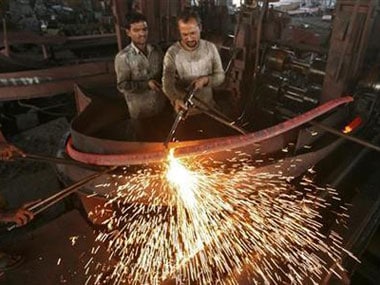 Representational image. Reuters[/caption] Finance Minister Arun Jaitley tweeted: “Government’s reforms to push economic growth are working, can be seen from that manufacturing has shown robust growth of 7 percent in Q2 and services at 7.1 percent. Gross fixed capital formation has increased from 1.6 percent in Q1 to 4.7 percent in Q2.” The September quarter GDP growth, he said, “is quite a significant trend reversal” and has been driven by pick-up in manufacturing. Traditionally, July-September is a quarter where a lot of production takes place to cater to festive demand, he said, adding that in the previous quarter, businesses were delaying production amid preparations for the GST launch. The output in the September quarter is primarily for consumption and sales, he pointed out. However, agriculture growth slumped to 1.7 percent. Gross value added (GVA), a key input of GDP that is tracked by the RBI, rose 6.1 percent in July-September compared to 5.6 percent in the June quarter this year and 6.8 percent in the September quarter of the last fiscal. The expansion in GVA in the first half of the current fiscal has been estimated at 5.8 percent, down from 7.2 percent in the year-earlier period. The economic activities that registered growth of over 6 percent in the second quarter of 2017-18 year-on-year are manufacturing, electricity, gas, water supply and other utility services, trade, hotels, transport and communication and services related to broadcasting. The growth in agriculture, forestry and fishing was 1.7 percent, mining and quarrying 5.5 percent, construction 2.6 percent, and ‘financial, insurance, real estate and professional services’ 5.7 percent. The growth in public administration, defence and other services stood at 6 percent.
GDP expands by 6.3% in September quarter boosted by pick up in manufacturing
Press Trust of India
• November 30, 2017, 20:14:08 IST
According to Central Statistics Office (CSO) data, the economic activities that registered growth of over 6% in the second quarter are manufacturing, electricity, gas, water supply, other utility services and trade, hotels, transport and communication, and services related to broadcasting
Advertisement
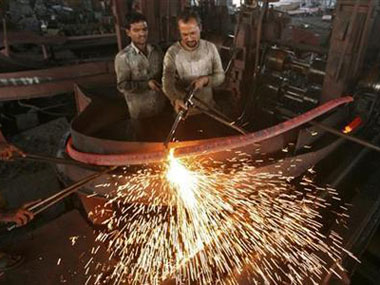 "GDP expands by 6.3% in September quarter boosted by pick up in manufacturing")
End of Article