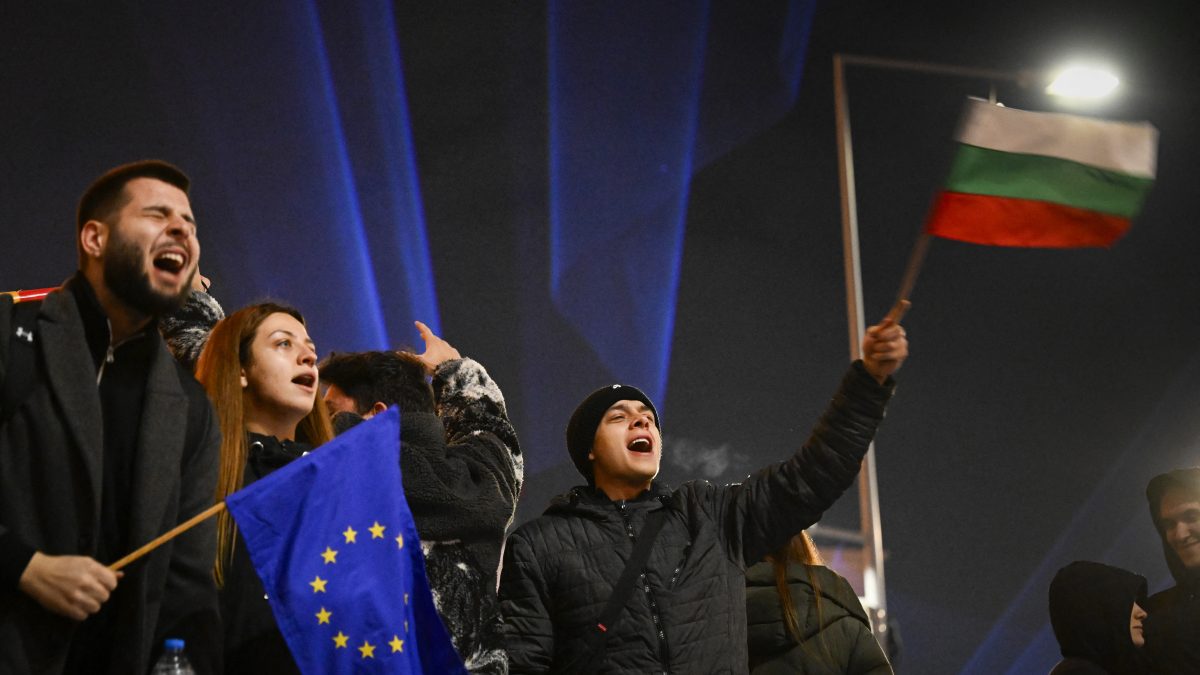
 "EU flags during an anti-government demonstration in Sofia on December 10, 2025. Tens of thousands of people held anti-government protests in Bulgaria on December 10, 2025 widening an anti-corruption movement sweeping the European Union's poorest country as it prepares to adopt the euro. (Photo by DIMITAR KYOSEMARLIEV / AFP)")
The European Union is moving to craft a unified response to surging energy prices triggered by the Iran war, with finance ministers set to coordinate measures aimed at protecting vulnerable households without repeating the costly policy missteps of the past.
At a key meeting on Friday, EU finance ministers are expected to emphasise targeted and temporary interventions, as policymakers remain wary of unleashing broad subsidies that could strain public finances and distort markets.
The European Commission, in a note ahead of the discussions, highlighted the need for coordination across member states to prevent market fragmentation and optimise policy impact. “EU-level coordination is essential… to reduce the overall need for intervention,” it said.
The latest spike in oil and gas prices follows U.S.-Israeli strikes on Iran that began on February 28, disrupting flows through the Strait of Hormuz—a critical artery for global energy supplies. The resulting shock echoes Europe’s 2022 energy crisis after Russia’s invasion of Ukraine, though the bloc is now better cushioned due to a stronger renewable energy base.
Renewables account for nearly 48 per cent of the EU’s energy mix today, up sharply from 36 per cent in 2021. Yet vulnerabilities persist. A significant share of transport still depends on fossil fuels, and roughly one-fifth of Europe’s oil imports originate from the Gulf region, now under strain.
Quick Reads
View AllTo manage the crisis, the Commission has proposed a calibrated approach. Instead of blanket subsidies, governments are encouraged to directly support low-income households — a move seen as less distortive to price signals.
Officials are also considering measures to curb energy demand, including incentives for public transport use, industrial efficiency upgrades, and housing renovations. Temporary tax cuts on electricity remain an option but are viewed cautiously due to their impact on already stretched public finances.
Another proposal under discussion is a two-tier pricing system for electricity and gas, where basic consumption is priced lower to protect vulnerable users, while higher usage is charged at market rates to preserve conservation incentives.
Crucially, the Commission has stressed that any intervention must come with a clear sunset clause. Funding could be sourced from carbon market revenues or windfall taxes on energy firms benefiting from elevated prices.
With uncertainty looming over how long the disruption in the Gulf will last, EU policymakers are walking a tightrope—balancing immediate relief with long-term fiscal discipline and the bloc’s broader transition away from fossil fuels.