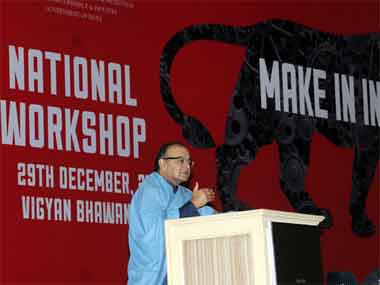
To a man with a hammer everything appears to be a nail. To a banker everything is about capital. Unfortunately the situation is similar for our Finance Minister who believes every problem can be solved with capital. Speaking today at a workshop on Make in India, Arun Jaitley said that manufacturing will remain a challenge unless radical steps are taken. The Finance Minister said the cost of capital was the single factor that has in recent times slowed manufacturing. However, the cost of capital does not prevent a business from manufacturing. Once a manufacturing plant is set up there is a fixed cost that is embedded into the system. This cost includes the cost of land, factory, plant and equipment and labour. While labour is seen as a variable cost, as temporary workers dominate shop floor, it is not always so. Now, the cost of capital is based on the borrowings that the entrepreneur has made to set up the facility. The borrowing cost is largest for factory, and plant and equipment. Borrowers are rarely able to get funds for buying land. Now will a factory owner stop manufacturing of the cost of capital rises by say 100 basis points or even 500 basis points? The answer is an emphatic no. He won’t reduce using existing facilities if the cost of capital rises even by 5 per cent. [caption id=“attachment_2021085” align=“alignleft” width=“380”]
 Jaitley at the Make in India conference. PIB image[/caption] The reason is that no business survives or is done for a margin of 5 per cent. A manufacturer looks at his cost of manufacturing and looks at a margin of anywhere between 25 percent to 50 percent. In manufacturing such a high margin is considered substantial as a portion of it is shared down the value chain, with distributors, or resellers or retail. Depending upon the product, whether it is for the end consumer or business, the margin sharing value chain is longer. But nobody gets into the business without getting a higher return than you would get by lending capital directly. Any businessman will get into the business of manufacturing only if his return are higher than 24 percent as that is what he would get if he were to lend money in the local market. Even traders borrow money from other traders, giving 2 per cent interest per month. Therefore, when Jaitley talks about cost of capital as being the biggest reason for slowdown in manufacturing, he is missing the point. Once a manufacturer has set up a unit he will only stop or slow-down his manufacturing unit if deploying those funds somewhere else will give him an higher or equivalent return. The higher the better as manufacturing is not an easy business, while lending is much easier. This is where the ease of doing business comes in. The government reduces the number of interfaces and manufacturing may become easier. But again, ease is not the reason that an entrepreneur will get into the business. Forget ease, today it is impossible to set up a manufacturing unit anywhere in the country thanks to the UPA-II’s land law. Haryana which was one of the first Congress state to implement the law has suffered the most. Bureaucrats in Haryana, say, that not an inch of land has been acquired by the state after Jan 2013 for public purpose. If the state is not able to acquire land, how can a businessman even think of doing so? If the cost of land becomes so prohibitively high, the cost of manufacturing will never be competitive in the country. But this is not the only barrier, and the government will hopefully pass the ordinance to amend the law. But will that be enough to kick start manufacturing or start green field projects? Again the answer is no. It is not just one factor, and the Finance Minister knows it well. He also understands that if manufacturing does not kick off now, India won’t get a second chance ever. “The danger would be if we lost out on cost, if we lose out on quality then we will be faced with a situation, where we become a nation of traders rather than a nation of manufacturers," Jaitley said. The possibility of India losing this race is very high if we don’t get our act together. There are enough economists, entrepreneurs and others talking about what needs to be done locally. However, it is important to have a clear policy on imports and Free Trade Agreements (FTAs). One of the biggest destroyers of the Indian manufacturing industry has been one individual: Anand Sharma, the erstwhile Commerce Minister. Sharma was so hell bent on signing FTAs that he did not consult or even co-ordinate with the Finance Ministry. I have pointed out several times in the past about the role FTAs have played
with ASEAN countries and others and how they have led to a deluge of imports.
When Jaitley talks about Indian becoming a nation of traders, it will be partially due to the open border policy we have followed on FTAs. The Commerce Ministry needs to understand the importance of manufacturing and the role of FTAs in destroying it. Modi and Jaitley’s efforts will not really have an impact unless the import gateways are curtailed and the FTAs curbed. It is not easy to re-negotiate the FTAs as these are international agreements between governments, so successive governments have to accept them. As a matter of fact there is no reason for the Commerce Ministry to sign or negotiate any FTAs until they are ratified by the Finance, Industry and discussed at a meeting of industry associations. Our negotiating stance has to change from giving away the Indian market to foreign investors ( read Chinese companies) to protecting and building local jobs as part of an economic, trade and foreign policy. K Yatish Rajawat is a senior journalist based in Delhi. He tweets @yatishrajawat.
Jaitley at the Make in India conference. PIB image[/caption] The reason is that no business survives or is done for a margin of 5 per cent. A manufacturer looks at his cost of manufacturing and looks at a margin of anywhere between 25 percent to 50 percent. In manufacturing such a high margin is considered substantial as a portion of it is shared down the value chain, with distributors, or resellers or retail. Depending upon the product, whether it is for the end consumer or business, the margin sharing value chain is longer. But nobody gets into the business without getting a higher return than you would get by lending capital directly. Any businessman will get into the business of manufacturing only if his return are higher than 24 percent as that is what he would get if he were to lend money in the local market. Even traders borrow money from other traders, giving 2 per cent interest per month. Therefore, when Jaitley talks about cost of capital as being the biggest reason for slowdown in manufacturing, he is missing the point. Once a manufacturer has set up a unit he will only stop or slow-down his manufacturing unit if deploying those funds somewhere else will give him an higher or equivalent return. The higher the better as manufacturing is not an easy business, while lending is much easier. This is where the ease of doing business comes in. The government reduces the number of interfaces and manufacturing may become easier. But again, ease is not the reason that an entrepreneur will get into the business. Forget ease, today it is impossible to set up a manufacturing unit anywhere in the country thanks to the UPA-II’s land law. Haryana which was one of the first Congress state to implement the law has suffered the most. Bureaucrats in Haryana, say, that not an inch of land has been acquired by the state after Jan 2013 for public purpose. If the state is not able to acquire land, how can a businessman even think of doing so? If the cost of land becomes so prohibitively high, the cost of manufacturing will never be competitive in the country. But this is not the only barrier, and the government will hopefully pass the ordinance to amend the law. But will that be enough to kick start manufacturing or start green field projects? Again the answer is no. It is not just one factor, and the Finance Minister knows it well. He also understands that if manufacturing does not kick off now, India won’t get a second chance ever. “The danger would be if we lost out on cost, if we lose out on quality then we will be faced with a situation, where we become a nation of traders rather than a nation of manufacturers," Jaitley said. The possibility of India losing this race is very high if we don’t get our act together. There are enough economists, entrepreneurs and others talking about what needs to be done locally. However, it is important to have a clear policy on imports and Free Trade Agreements (FTAs). One of the biggest destroyers of the Indian manufacturing industry has been one individual: Anand Sharma, the erstwhile Commerce Minister. Sharma was so hell bent on signing FTAs that he did not consult or even co-ordinate with the Finance Ministry. I have pointed out several times in the past about the role FTAs have played
with ASEAN countries and others and how they have led to a deluge of imports.
When Jaitley talks about Indian becoming a nation of traders, it will be partially due to the open border policy we have followed on FTAs. The Commerce Ministry needs to understand the importance of manufacturing and the role of FTAs in destroying it. Modi and Jaitley’s efforts will not really have an impact unless the import gateways are curtailed and the FTAs curbed. It is not easy to re-negotiate the FTAs as these are international agreements between governments, so successive governments have to accept them. As a matter of fact there is no reason for the Commerce Ministry to sign or negotiate any FTAs until they are ratified by the Finance, Industry and discussed at a meeting of industry associations. Our negotiating stance has to change from giving away the Indian market to foreign investors ( read Chinese companies) to protecting and building local jobs as part of an economic, trade and foreign policy. K Yatish Rajawat is a senior journalist based in Delhi. He tweets @yatishrajawat.
To boost Make in India, Jaitley must stop complaining and start correcting UPA's mistakes
K Yatish Rajawat
• December 30, 2014, 08:31:45 IST
The Finance Minister said the cost of capital was the single factor that has in recent times slowed manufacturing.
Advertisement
 "To boost Make in India, Jaitley must stop complaining and start correcting UPA's mistakes")
End of Article