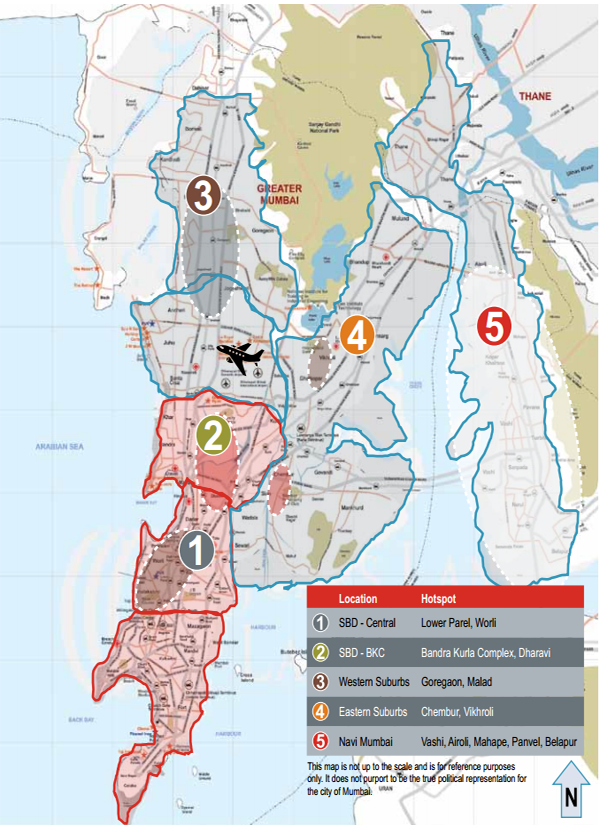
 "Map: Check out the hotspots in Mumbai's office market")
The old Mumbai central business district has lost its crown and glory. The most glaring example of this is South Mumbai’s Nariman Point, Fort and Churchgate. Once the heart of Mumbai’s busiest and most expensive business districts, the three locations have now given way to newer hotspots like Lower Parel, Bandra Kurla Complex and Andheri East.
The change was sparked by the lack of quality office stock and the complicated ownership structure that was evident throughout South Mumbai, as a consequence of which companies looked for and found alternatives outside the traditional areas.
So what will become of this area in 2020?
According to a report by global real estate consultancy firm Jones Lang Lasalle, there will be an accelerated migration of multinationals from the central business districts unless the state government conceptualises and executes a comprehensive action plan to regenerate these areas.
“The impact will be partially negated by other tenant types taking up space, such as law and accountancy firms, shipping companies and creative industries. Meanwhile, it is inevitable that some offices will be converted toresidences or hotels. However, the flagship Starbucks in Fort is a confident signal that business will not foresake this area totally and, of course, tourists will continue to be attracted to its quality hotels and colonial heritage,” said the consultancy in a report tilted “Mumbai: Hope on the Horizon.”
In fact, limited infrastructure and long commuting hours is likely to result in a number of mini business districts emerging over the next few years. Theupcoming hotspots include Lower Parel and Worli in South Central Mumbai, Bandra Kurla Complex (BKC) and Dharavi, north of Mumbai’s airport since around 200 acres of land belonging to Mumbai Airport is either lying vacant or can be freed, Navi Mumbai to the East such as Vashi, Airoli, Mahape, Panvel and Belapur given the upcoming infrastructure developments in the area (the international airport being constructed near Panvel, the Mumbai Trans Harbour Link (MTHL) over Thane Creek scheduled to be completed by 2019 and a new west-east monorail bound to open up this area),as well as Eastern Suburbs like Chembur and Vikhroli.
[caption id=“attachment_83402” align=“aligncenter” width=“600”]
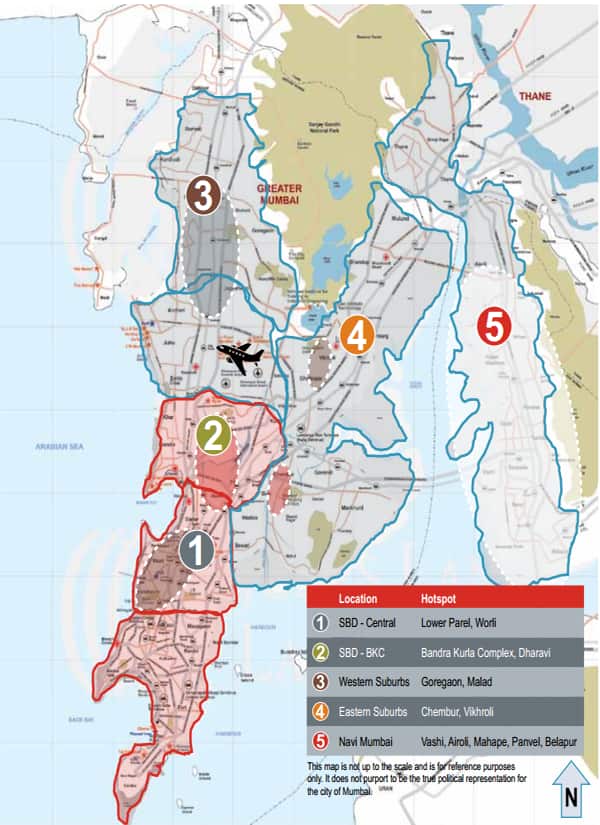 Source: JLL[/caption]
JLL believes these hotspots will have the following features- security, effective public transport, good car, taxi and auto rickshaw access, enough parking, shopping and entertainment, food and fine dining as well as the ‘walk-to-work’ concept.
“We reaffirm that Mumbai will continue to be acknowledged as the financial capital of India. We have established that high quality, iconic and well-positioned workspaces are going to be a key attraction, and that the sustainability agenda will not render Mumbai’s office stock entirely obsolescent just yet. We have also underscored the inevitable fact that limited infrastructure and high commuting times will lead to a number of mini-CBDs in Mumbai,” said Ramesh Nair, COO - Business, JLL India.