

 "FIIs not gung ho about Indian banks, but we still beat China")
Pessimism across the banking sector seems to be all-pervading, including among investors. Most investors abroad are underweight on Indian banks, something that would not change in the near term. Indian banks have been battling high interest rates, slowing credit growth and bad loans, all of which make the prospects of posting good numbers this quarter very weak.
And what’s worse? With slowing economic growth none of this is likely to improve any time soon. But there’s a silver lining to every story. For our banking sector, the good news is that we may not be an investor’s first choice, but we are at least ahead of the Chinese.
This argument is well supported by a recent Macquarie report which talks of reluctance among all 35 investors it met in Hong Kong and Singapore to invest in Indian banks.
[caption id=“attachment_104941” align=“alignleft” width=“380” caption=“Investors are skeptical of private sector names like ICICI and Axis as they are not sure of the quality of their loan book exposures. AFP”] 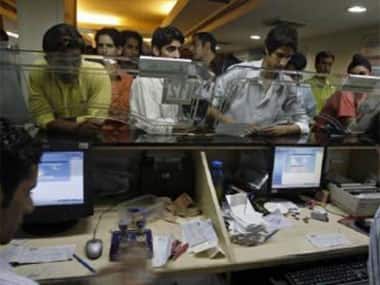 [/caption]
Though investors are not gung ho about Indian banks, they believe at least they are better than Chinese banks. Indian banks are at least ready to admit concerns about asset quality and are reporting their bad numbers. The move to system calculate non-performing or bad loans is also throwing light on the actual quality of assets for the banks. On the contrary, “Chinese banks remain a black box, yet to see a bad result” and their numbers cannot be trusted, says the report.
The report, however, says some investors in Singapore think Indian banks deserve valuation as low as 0.5 times their book value (value at which assets of a bank are carried on the balance sheet). Private banks are now trading at a multiple of 2 times their book value while public banks are trading at 1.1 times their book value, on basis of 2012 earnings estimates. And India could well be in deeper rot than 2008 as government is unlikely to speed up any policy decisions.
Hardly any investor had any holding in public sector banks with the exception of HDFC Bank that formed the core holding for many of them. They also liked Kotak Mahindra, but as the report mentions, “they argued that they would rather own HDFC Bank and would not prefer owing both HDFC and Kotak.”
State Bank of India was the big “No” for all of them, while hedge funds were short on Punjab National Bank and LIC Housing Finance. (You take a short position when you sell a stock, commodity or currency that you have borrowed in the open market, thinking its price will go down further. When price falls, you buy it again at a cheaper rate, thereby earning profits, which is called covering the short position).
The bad times for Indian banks are far from over due to no positive trigger in the near term which could give valuations any fillip. Even if the RBI does not raise interest rates further, a cut is not likely anytime soon. The investors are therefore skeptical of private sector names like ICICI and Axis as they are not sure of the quality of their loan book exposures. The fact that banks are feeling the heat is evident from what Chanda Kochhar, managing director and CEO of ICICI Bank told Business Standard. “In the last two years, all rate hikes by RBI were passed on by banks. But the last one has not really been passed on because of low credit offtake and higher deposit growth rates”, she said.
The other interesting aspect which is certainly not good news for banks is the growing skepticism about the retail portfolio of banks. If the growth in the economy falls, it is not possible that obligations to repay loans would perhaps not be entirely fulfilled by the retail segment.
This “also possibly explains the recent weakness in HDFC Bank’s share price”, says the report. Almost half of its loan book consists of retail advances. Banks are still assuring that retail segment is seeing healthy growth and pose no threat in terms of bad loans, the fears are not illogical. If one buys the argument that slowdown in corporate earnings is not insulated from job losses and slowdown in individual earnings levels, the last leg of the downfall could indeed be driven by retail. The Street is not yet including this in its estimates. If it starts doing that, banking stocks could go for a toss yet again.

 "Israel targets top Hamas leaders in Doha; Qatar, Iran condemn strike as violation of sovereignty")
 "Nepal: Oli to continue until new PM is sworn in, nation on edge as all branches of govt torched")
 "Who is CP Radhakrishnan, India's next vice-president?")
 "Israel informed US ahead of strikes on Hamas leaders in Doha, says White House")
 "Israel targets top Hamas leaders in Doha; Qatar, Iran condemn strike as violation of sovereignty")
 "Nepal: Oli to continue until new PM is sworn in, nation on edge as all branches of govt torched")
 "Who is CP Radhakrishnan, India's next vice-president?")
 "Israel informed US ahead of strikes on Hamas leaders in Doha, says White House")



](https://images.firstpost.com/wp-content/uploads/2011/10/bankcounter2.jpg)