 "Hike in ready reckoner rates won't bring down black money")
The government wants to encourage affordable housing but the recent increase in ready reckoner rates in Maharashtra is bound to contradict the move since it will result in higher prices for not only land plots but also flats at a time when buyers are already burdened with the artificially-inflated cost of realty.
Ready reckoner (RR) rates are similar to circle rates wherein the government sets the minimum prices below which sales are not allowed. The stamp duty is paid on either the transaction amount or RR price, whichever is higher.
RR has been based on built-up area since 2008, before which it used to be based on the actual carpet area. In other words, it is used to calculate the actual market value of houses for the purpose of determining the stamp duty and registration costs. Hence higher ready reckoner rates means higher stamp duty and registration chargers, which can have three implications:
1. Dampen the recent revival in Mumbai realty, which has seen sluggish sales for the last 18-months, beginning in the fourth quarter of 2010. Higher RR rates will force buyers to defer flat purchases and increase the supply of unsold inventory in the market.
2. Result in more black money in the already tainted real estate market as buyers are likely to fudge agreements and offer a larger portion of the cost in black to avoid paying higher stamp duty and registration charges. Stamp duty in Maharashtra is 5 percent of the total cost. Hence the rise in the black money component in property transactions will defeat the government’s aim of generating revenue by levying higher stamp duty.
[caption id=“attachment_577379” align=“alignleft” width=“380”]
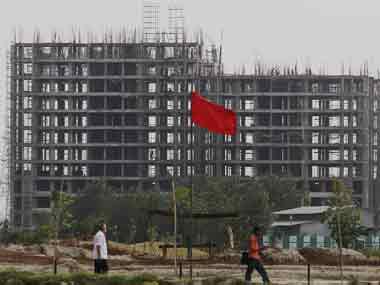 Higher RR rates will force buyers to defer flat purchases and increase the supply of unsold inventory in the market. Reuters[/caption]
3. Even though the government has increased the ready reckoner rates by 25 percent from 1 January to increase state revenues, in reality it will not be able to make its kitty cash-rich since higher ready reckoner rates post the hike in property taxes will only result in lesser sales and fewer flat registrations. Secondly, property transactions will also become costlier as the government plans to abolish octroi and replace it with 1 percent local body tax per transaction, according to this T_imes of India_ report.
“The hiked Ready Reckoner rates could dampen revival, given the fact that home buyers are already burdened with service tax, sales tax, VAT, taxes and duties on construction materials, etc, which constitute around 25 percent of the real estate cost to buyers,” Ramesh Nair,Managing Director - West, Jones Lang LaSalle India, told Firstpost.
Imposition of VAT, service tax and stamp duty, along with new RR rates on the built up area rather than the carpet size, will surely increase the per square foot rates, which the builders are sure to pass on to consumers.
Moreover, even though the state government has already asked builders to sell their properties on the basis of carpet area (the actual internal area of the apartment), the revenue department continues to levy stamp duty on built-up area (the overall area which includes walls and balconies), as evident in the recent ready reckoner.
“The government has promised mass housing for the lower-income class but in reality it is not pro aam aadmi at all. It is asking buyers to shell out extra money just to fill the state’s coffers when prices have already shot through the roof.” Pankaj Kapoor, MD at real estate consultancy firm Liases Foras told Firstpost.
This is primarily because RR rates are periodically raised by the government to align the government-determined price with the current market price. But in a market like Mumbai, the market price is decided by speculation among builders and not actual demand-supply economics.
Since 2007, an average 100 percent rise in property prices has taken place in the Mumbai metropolitan region. “This is surely not a fair rate,” he says.
Kapoor also thinks the hike will increase the scope of correction. “If builders were planning to offer 10-15 percent reduction in the form of discounts prior to this hike, , they will now have to offer more to accommodate this and boost sentiment.”
Firstpost had previously also said that the builders’ move to hike property prices due to RR changes raises questions about their credibility. If they had wanted genuine buyers rather than investors, they would have cut the prices to open up points of entry.
In 2012, not many projects were launched in the festive season or in the last couple of months, and those that did were only under-construction ones.
Realty prices in Mumbai have already seen an increase of about 10 percent in the last year because of lesser ready-to-occupy flats.
In 2008, the government had provided relief to home buyers and developers by not increasing the Ready Reckoner rates due to the slowdown in the market. But given the current uncertainties in the real estate market, the government should reconsider its move since it will negatively affect sales. There is already a pronounced lack of liquidity in the sector despite the finance minister urging the banks to lend more to the sector.
“Given the unaffordability of housing to common people in India, perhaps it is high time that the government takes a holistic view of the taxes being levied on purchase and construction of houses, and seeks to rationalise such taxes. The government has to realise that these are not taxes on builders, though levied on them, but taxes on house purchasers,” says Gautam Nayak, a chartered accountant, in a column in Mint .