

 "FIIs prefer emerging markets but not India")
Foreign institutional investors (FIIs) have pruned allocations to India. The net inflow into Indian equities by FIIs in the first six months of 2011 is the lowest since 2002, according to Securities & Exchange Board of India (Sebi) data. We have to exclude the net outflow of $6.6 billion in 2008 as that was due to an extraordinary situation witnessed across global markets.
In 2011, FIIs have so far invested only $381 million in Indian equities against $4.3 billion and $5 billion during the same period in 2010 and 2009. See table for the last 10 years statistics for the Jan-June cumulative data.
[caption id=“attachment_32060” align=“alignleft” width=“380” caption=“Though India is a long-term investment destinations, investors are wary over the rising inflation and interest rates. Reuters”]  [/caption]
While for FIIs India remains a long-term investment destination, investors are concerned about the rising inflation, interest rates and potential slowdown in earnings growth.
Over the past three months foreign institutional investors have injected only $40 million in India against over $1.8 billion in Taiwan and Korea, said a source who manages several FII accounts.
Look at the FTSE chart, the London-based independent global index company, above: The comparison of the performance of FTSE All Emerging Markets index and FTSE India index shows a massive divergence over the past one year.
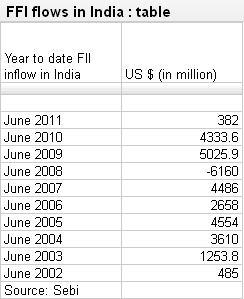 This indicates that India would remain a considerable underperformer in the emerging market class. “The valuation of Indian equities continues to be relatively expensive in comparison to other markets, the source added. Companies are finding it difficult to raise capital and meet earnings expectations. Besides this, there are macro-economic factors like inflation and rising interest rates that concern international investors.
“In my opinion, India has more reason to be concerned (about inflation),” Robert J Horrocks, chief investment officer and portfolio manager, at Matthews International Capital, which has several Asia-focused funds said previously to Firstpost.
A Bank of America- Merrill Lynch fund manager survey said in May 2011 that overall, global asset allocators were overweight on emerging markets at a plus 29% but were underweight on India at minus 47%.
FIIs control almost half of the non-promoter holding of BSE 200 index and more than a third of of BSE 500 index. They own $100 billion worth of Indian equities against a mere $20 billion owned by domestic institutional investors. The total non-promoter market cap of BSE 500 index is $500 billion. This shows that foreign capital flows can have a significant influence on Indian equities.

 "Israel targets top Hamas leaders in Doha; Qatar, Iran condemn strike as violation of sovereignty")
 "Nepal: Oli to continue until new PM is sworn in, nation on edge as all branches of govt torched")
 "Who is CP Radhakrishnan, India's next vice-president?")
 "Israel informed US ahead of strikes on Hamas leaders in Doha, says White House")
 "Israel targets top Hamas leaders in Doha; Qatar, Iran condemn strike as violation of sovereignty")
 "Nepal: Oli to continue until new PM is sworn in, nation on edge as all branches of govt torched")
 "Who is CP Radhakrishnan, India's next vice-president?")
 "Israel informed US ahead of strikes on Hamas leaders in Doha, says White House")



](https://images.firstpost.com/wp-content/uploads/2011/06/MONEY_REUTERS.png)
](https://images.firstpost.com/wp-content/uploads/2011/06/FFI.png)