

 "Everyone's feeling glum about India. Should we care?")
Is the world losing faith in the India growth story?
Seems like it. In recent weeks, a number of globally renowned economists and market experts have voiced pessimism about the direction in which the economy is headed - and its performance until now.
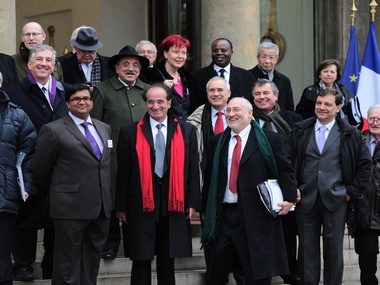
Earlier this week, it was the turn of American economist Joseph Stiglitz, who said that India had “clear road map of where it is going”.
“Fifty years from now, does it see itself much as it is today - a divided country, only with the rich much richer, the poor perhaps a little better than they are today?” he was quoted as saying by Business Standard. The economist made his remarks during a speech at the Indian Statistical Institute.
[caption id=“attachment_181294” align=“alignleft” width=“380” caption=“Stiglitz also thought the controversial Food Security Bill was a great idea. Reuters”] 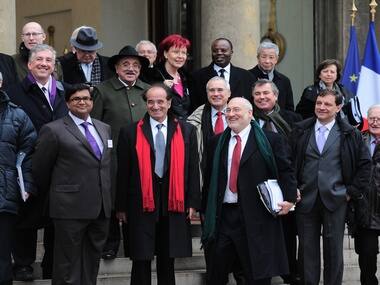 [/caption]
“Does it see itself evolving like the US, where even the middle (class) has not been sharing in the gains of the growth? India’s 8 percent growth rate has been truly impressive. GDP could be going up, even though most individuals in society could be getting worse off, as has been in the US,” he told his audience.
Incidentally, Stiglitz also thought the controversial Food Security Bill was a great idea, and that the country was on the verge of implementing ’the world’s largest social protection programme against hunger'.
Overall, he thought India needed to do much more to reduce the growing income disparity, and said that a high GDP, in itself, achieved very little.
That point was underscored by economist and Nobel laureate Amartya Sen, who said that in terms of social indicators, India has been a laggard despite spectacular growth in gross domestic product over the past few years.
“There is a huge gap there (on the social front) as China is one of the best performers in terms of social indicators,” Sen said while speaking at the Indian Economic Association convention last week.
He said India’s average ranking in terms of basic social indicators of quality of life among six South Asian economies (India, Pakistan, Bangladesh, Sri Lanka, Nepal and Bhutan) has “fallen from being the second-best to being second-worst and this is so despite the fact that India has grown immensely faster than all other economies in South Asia in terms of GNP or Gross Domestic Product (GDP).”
Well, even that fast economic growth is under doubt now. While a lot of people think India should pat itself on the back for growing by 7 percent under trying local and international conditions, many international experts remain unimpressed. One of them is Nouriel Roubini, an economist and chairman of Roubini Global Economics, who, in an interview to NDTV Profit, said that it would be “disappointing” if the economy expanded by just 7 percent.
In another interview to The Economic Times, he also noted that “important economic and structural reforms that should be undertaken have been essentially stalled. That is not good news for accelerating economic growth over time”.
Still, he did think that India is better placed among BRIC nations - Brazil, Russia, India and China- in terms of growth.
But even that’s not a commonly held view anymore. Last month, Stephen Roach, non-executive chairman at Morgan Stanley, said he thought India, not China, was the country to worry about in Asia .
India is the only economy burdened by twin deficits - current account and budget - which limits its ability to use monetary or fiscal policy to ease a slowdown, he said.
Even the man who coined the BRIC acronym - Jim O’Neill of Goldman Sachs Asset Management, had harsh words to say about India recently.
“All four countries have become bigger (economies) than I said they were going to be, even Russia. However there are important structural issues about all four and as we go into the 10-year anniversary, in some ways India is the most disappointing,” he said, adding that India’s record on productivity, FDI and reform had been the most disappointing.
CLSA’s respected equity strategist Christopher Wood, a long-term believer in India, also recently downgraded India from “overweight” to “neutral” in the brokerage’s Asia Pacific (excluding Japan) relative-return portfolio. It was the third cut of India’s weight in December in favour of China and South Korea.
In a report, Wood pointed out that the government was wrongly blaming the European debt crisis for the economy’s troubles, since most of the problems were mainly self-inflicted.
Clearly, India’s sputtering growth and lack of progress is shaking the faith of investors and economists alike, who are worried that any positive news on the economy might prove temporary.
But then, again, as Firstpost notes in this story , should we really care what the world thinks?

 "Israel targets top Hamas leaders in Doha; Qatar, Iran condemn strike as violation of sovereignty")
 "Nepal: Oli to continue until new PM is sworn in, nation on edge as all branches of govt torched")
 "Who is CP Radhakrishnan, India's next vice-president?")
 "Israel informed US ahead of strikes on Hamas leaders in Doha, says White House")
 "Israel targets top Hamas leaders in Doha; Qatar, Iran condemn strike as violation of sovereignty")
 "Nepal: Oli to continue until new PM is sworn in, nation on edge as all branches of govt torched")
 "Who is CP Radhakrishnan, India's next vice-president?")
 "Israel informed US ahead of strikes on Hamas leaders in Doha, says White House")



](https://images.firstpost.com/wp-content/uploads/2012/01/stigltz-reuters.jpg)