 "After fiscal debauchery, the rupee needs to fall further")
By Ganesh Rathnam
The drop in the value of the rupee against the major currencies of the world was long overdue. We still believe, given the fundamentals, the rupee is overvalued.
India has been debasing its currency by about 14 percent per annum for quite a long time now. For a while, this provided a backdrop for an artificial boom that subsequently attracted foreign capital in a virtuous cycle of rising asset prices and a rising currency.
However, there were a few fundamental differences between India and, say, China. One, despite the brouhaha of high growth, we run perpetual trade deficits. And we also run huge fiscal deficits. No country in the world can run twin deficits for long without their currency tanking. You can delay economic reality for only so long before it hits you on the head.
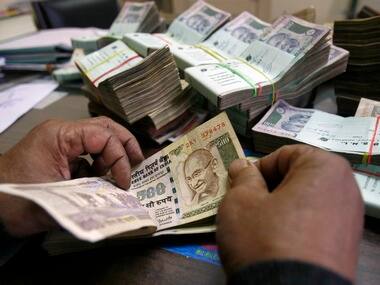
[caption id=“attachment_310171” align=“alignleft” width=“380” caption=“Reuters”]
 [/caption]
When late last year, our policy makers imposed a ban on ‘speculative’ currency trading, we said it wouldn’t work for too long. We’ve been proven right. That’s not to say the rupee cannot rally from here temporarily, just that if it does, it’s a fake rally and will be moving against the fundamentals (and makes purchasing hedges cheaper).
Any measures the Reserve Bank takes from now will eventually fail if the fundamentals don’t change. To save us from another balance of payments crisis like the one seen 20 years ago, we need to do two things: One, stop debasing the rupee and let it strengthen, and, two, remove all import duties.
Of course, the solution I suggest is just the opposite of what our policy makers are doing and will continue to do. They will first try to sell dollars in the market but we don’t have an unlimited supply of dollars to throw at the problem. People betting rightly against the rupee will realise that when the Reserve Bank begins selling dollars wholesale, the jig is up. Reason: as its dollar reserves are depleted, there’s even less dollars remaining to back up the enormous quantities of rupees in the market.
That’s essentially how George Soros broke the Bank of England when he bet against the pound, forcing the Bank of England (BoE) to sell its foreign reserves to support the pound. That couldn’t last forever and eventually the BoE threw in the towel. Besides, selling foreign reserves only addresses the symptoms and not the problem.
Contrary to common belief, high import tariffs and a weak currency are the biggest causes of trade deficits. Think about this: in the early 1990s, the rupee-dollar exchange rate ranged from Rs 32-36. Today it is close to 54, or a 50 percent devaluation. If weakening currencies help exports, should we not be running huge trade surpluses by now?
What a weak currency does is raise your import bills. And high import bills are the chief culprit behind widening trade deficits.
In addition to a weak currency, high import tariffs contribute to trade deficits. India’s import tariffs on both raw materials and finished goods are some of the highest in the world. Import tariffs exacerbate trade deficits in two ways: firstly, most imports serve as raw materials for our exports (eg, gold, machinery, etc.), so higher import tariffs raise the prices of our exports.
Secondly, high import duties on finished goods protect indigenous companies from foreign competition, lulling them into delivering substandard or high-priced products. Or both. If you force your citizens to buy crap by limiting competition, that’s one thing. But you can’t force foreigners to pay for your crap.
Think about it, how many Ambassador cars did India export in the 1960s and 1970s and where in the world was owning an Ambassador considered a ‘status’ symbol? Enough said.
A strong currency, on the other hand, attracts tons and tons of capital, both foreign and domestic, further strengthening the currency. What capital does is, as it accumulates, it lowers the overall cost of production while improving product quality, the hallmarks of a desirable good. This, in turn, boosts exports and allows a country to run huge trade surpluses.
America was a shining example of this until the 1980s when they were the world’s largest creditor and also had a very strong currency. Will our policy makers ever learn the right lessons from history and applying an ounce of common sense?
The author of this article is President and Chief Portfolio Strategist of Arkanis Capital ( http://www.arkaniscapital.com/ ), a boutique wealth management firm. His views can be found at his blog ( http://impassionedlibertarian.wordpress.com/ ).