

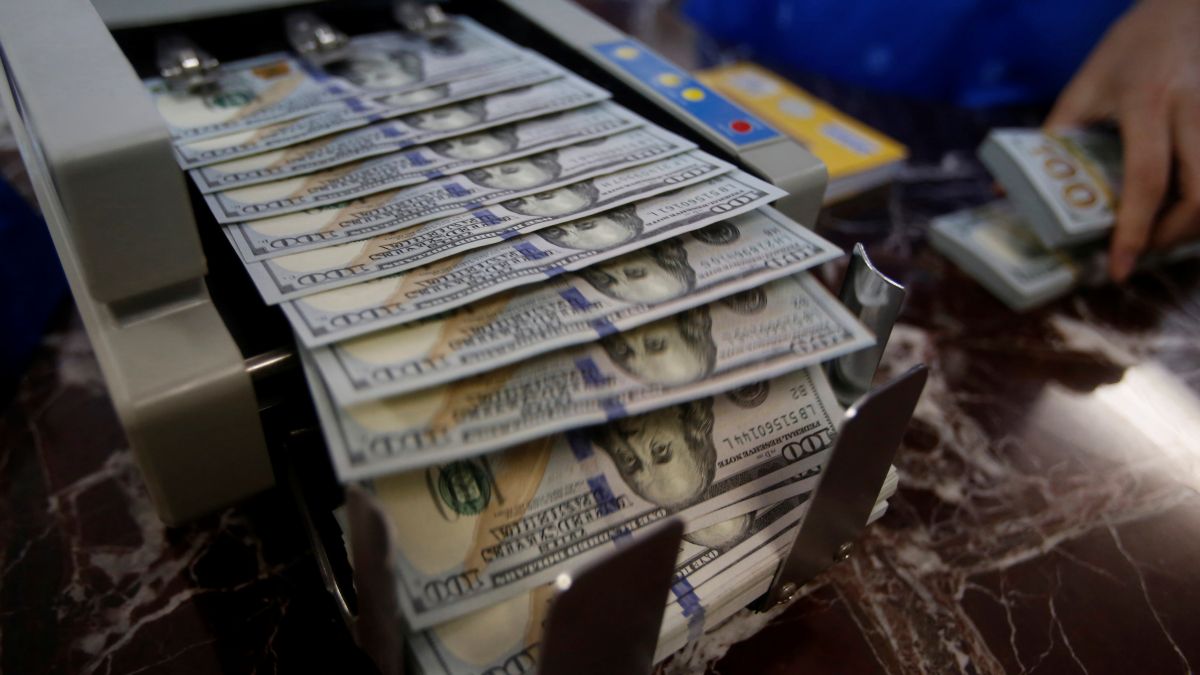
 "Dollar–rupee outlook for 2026: forecasts diverge as markets brace for a range-bound currency")
As the global economy looks ahead to 2026, forecasts for the Indian rupee against the US dollar present a mixed picture. Projections from global banks, credit rating agencies and economists range from modest appreciation to extended range-bound trading, while some warn of further depreciation in the near term amid lingering global risks.
Bank of America Global Research expects the rupee to strengthen moderately in 2026 as dollar demand eases. The bank forecasts the USD/INR rate at around ₹86 per dollar by end-2026, arguing that recent rupee weakness has largely stemmed from external pressures. A softer US dollar environment, it says, could lend support to a gradual appreciation.
In contrast, Japanese financial group MUFG sees continued weakness in the rupee through 2026. “Our forecasts imply further INR weakness against key currency crosses such as the euro, Japanese yen and Chinese yuan,” the bank said, pointing to unfavourable global currency dynamics.
Credit rating agency Fitch takes a more balanced view, projecting the rupee to recover towards ₹87 per dollar by the end of 2026. Fitch attributes this outlook to India’s robust growth trajectory and relatively benign inflation, which it believes will underpin medium-term currency stability.
Independent economists, however, remain cautious. Several analysts believe the rupee could trade in the ₹90–92 range for much of 2026 if global uncertainty persists. Echoing this view, Union Bank of India expects the currency to drift towards the ₹90 mark by March 2026 on both fundamental and technical grounds, unless there is a meaningful surge in equity inflows or a major breakthrough in global trade negotiations.
UBS Global Research has also revised its stance. Moving away from its earlier ₹87–88 projection, the bank now expects USD/INR to remain between 90 and 92 through much of 2026, citing slow progress on trade talks and limited intervention by the Reserve Bank of India as near-term risks.
Quick Reads
View AllOffering cautious optimism, ING Bank expects the rupee to strengthen towards ₹87 per dollar by late 2026. The bank’s outlook is anchored in India’s strong macroeconomic fundamentals and the potential progress of an India–US trade agreement.
Economists broadly agree that if US Federal Reserve rate cuts materialise amid signs of easing in the US labour market and moderating inflation the dollar could come under pressure in 2026. Such a shift would likely ease stress on emerging-market currencies, including the rupee. However, divergent monetary policies across major economies and an uneven global growth outlook continue to cloud the currency’s trajectory.
In sum, India’s sound economic fundamentals provide a floor for the rupee in 2026, but markets should be prepared for episodic volatility rather than a sustained directional move.

 "India’s backyard in flux: From Gen-Z chaos in Nepal to civilian surrender in Pakistan")
 "'I see that happening': Trump says Russia, Ukraine & US could meet in trilateral talks soon")
 "Bangladesh to run out of condoms in the next 39 days. Here’s why")
 "Back from exile, BNP’s Tarique Rahman files nomination to contest Bangladesh polls")
 "India’s backyard in flux: From Gen-Z chaos in Nepal to civilian surrender in Pakistan")
 "'I see that happening': Trump says Russia, Ukraine & US could meet in trilateral talks soon")
 "Bangladesh to run out of condoms in the next 39 days. Here’s why")
 "Back from exile, BNP’s Tarique Rahman files nomination to contest Bangladesh polls")



