 "It's a key election day for India: These charts tell you all you need to know about polls")
The big leagues as far as polling goes, starts today. Voting has begun for 91 seats across 11 states and three union territories, including all seats in Delhi, Haryana and Kerala and several in UP, Bihar, Odisha and Maharashtra.
The charts below tell you all you need to know about India’s elections.
India is a multi-party parliamentarian federal democracy and the forthcoming elections are for the Lok Sabha, the lower house of parliament. The country is divided into 543 constituencies, each represented by a member of parliament. The party/coalition with a simple majority (272 seats) forms the government.Currently, two main coalitions are the United Progressive Alliance (UPA) led by the Indian National Congress (INC) - also the ruling party - and the National Democratic Alliance (NDA) led by the Bharatiya Janata Party (BJP). There are 11 other regional parties that have come together to form a third front.
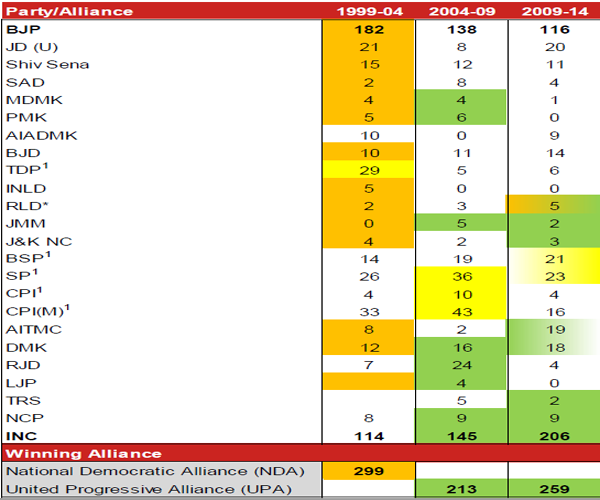
Seats held in the Lok Sabha (key parties)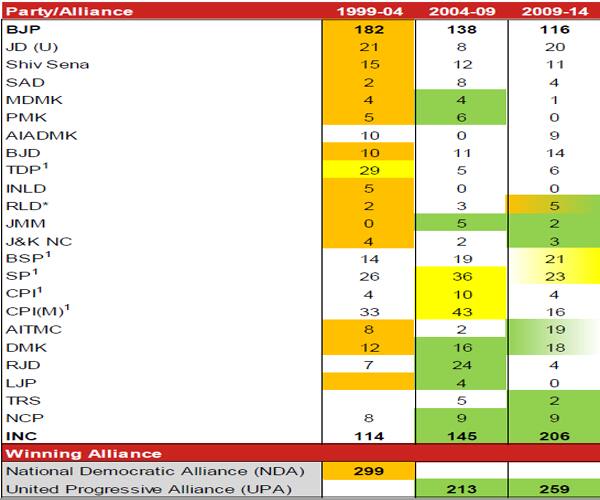
Source: Election Commission of India and Nomura Global Economics. Note: Orange represents NDA; green representsUPA and yellow represents outside support.
15 basic facts about India’s elections
[caption id=“attachment_81668” align=“aligncenter” width=“600”]
 Source: Nomura[/caption]
Key leaders of BJP and INC

The INC-led UPA government (centre-left) has been in power since 2004. The UPA government has focused on inclusive growth and has boosted rural terms of trade, but corruption and rising inflation appear to be giving way to a wave of anti-incumbency. The main opposition, the BJP-led NDA was in power from 1999 to 2004.
Number of national, state and registered (unrecognised) parties since 1952
[caption id=“attachment_81670” align=“aligncenter” width=“600”]
 Source: Nomura[/caption]
Indian politics is becoming increasingly fragmented. In the 2009 elections, as many as 363 political parties participated in the general elections. Of these, only seven were national parties (BJP, BSP, CPI, CPM, INC, NCP, RJD), 34 were state parties and a staggering 322 were registered but unrecognised parties. The number of non-national parties is set to increase further in the 2014 elections.
According to the Nomura report, for the past 15 years, the share of INC and BJP - the two main parties - has fallen to less than 50% of total votes, while the share of the other regional parties has risen.
[caption id=“attachment_81671” align=“aligncenter” width=“600”]
 Source:Nomura[/caption]
The fragmentation of Indian politics has occurred due to local, rather than national, issues taking centre stage. This has given rise to politics based on caste, religion, minority groups and communalism, among others.
According to Nomura, fragmentation, therefore, has increased the bargaining power of states that are important
not only for pre-poll seat-sharing arrangements with the national parties, but also for post-poll
coalition negotiations. The figure beelow shows the map of India with key states and the seats they account for (in brackets). The five decisive states are: UP(80 Lok Sabha seats), Maharashtra ( 48 LS seats), West Bengal ( 42 SEATS), Bihar( 40 seats) and Tamil Nadu ( 39 seats.)
[caption id=“attachment_81672” align=“aligncenter” width=“600”]
 Source:Nomura[/caption]
Political ideology of parties
Of the two main parties, the BJP is seen as centre-right and the Congress as centre-left. However, these ideological demarcations have to be taken with a pinch of salt - for instance, even the ‘centre-right’ BJP opposed foreign direct investment in the multi-brand retail sector due to concerns over its adverse effect on domestic manufacturing.
[caption id=“attachment_81674” align=“aligncenter” width=“557”]
 Source: Nomura[/caption]
What the Opinion polls say so far
[caption id=“attachment_81676” align=“aligncenter” width=“600”]
 Source: Nomura[/caption]
Unless the NDA is able to secure a solid outright majority, the election is likely to be followed by intensive coalition-forming negotiations with smaller parties.
The table below lists the parties that have entered into pre-poll alliances with the BJP and the Congress, as well as the potential post-poll allies.
[caption id=“attachment_81678” align=“aligncenter” width=“465”]
 Source:Nomura[/caption]
“The most promising potential partners are likely to be regional parties such as the AIADMK, which should be open to agreements that offer them some advantage for their geographical base,” said Nomura in a note.
Abbreviations that you must know of this election
[caption id=“attachment_81679” align=“aligncenter” width=“600”]
 Abbreviations[/caption]