 "CEO of Maruti Suzuki Kenichi Ayukawa on why rural markets are the 'game changer'")
Maruti Suzuki India has managed to not just hold on to its number one position but improve its standing too in a declining market. From tapping rural buyers to working on larger cars as consumers look to move up the ladder, Maruti is using every trick in its book to remain focused on expanding its customer base.
It will launch an Automatic Manual Transmission or AMT small car called Celerio at the Expo today. Maruti is expected to sell at least 50,000 units of Celerio in the first year itself . But will Celerio and incremental sales coming from the hinterland be enough for Maruti’s growh in the coming months?
The company is now ready for major production expansion and has recently faced investors’ ire over its decision to allow Japanese parent Suzuki Motor Company to own and operate the third manufacturing facility coming up in Gujarat. In a few years, Gujarat will account for a third of Maruti’s production.
Managing Director & CEO Kenichi Ayukawa spoke exclusively to Sindhu Bhattacharya of Firstbiz about Maruti’s plans in a tough market.
Maruti has taken many steps to keep its head above the water in 2013, when domestic and export markets were turbulent. Which steps would you like to highlight, small things that helped save costs, target newer customers? Are you satisfied with growth of Maruti’s sales in 2013?
Yes, the year 2013-14 has been one of the worst in terms of sales. The passenger vehicle industry has declined in the year so far. Maruti Suzuki has been able to hold on to last year’s levels, resulting in an increase in our share. But that is not enough. Of course, we want the overall market to expand, not shrink. In light of tough market conditions it is the rural market that has clicked for us.
Till January 2014, we have retailed around 2.69 lakh cars in the rural markets. This is roughly 32 percent penetration of retail sales in the fiscal. Last year, we were present in over 44,000 villages, this year we target to be in 100,000 villages. In this fiscal till January 2014, we have sold in double the number of villages. On the cost side, several employee driven initiatives like ‘one gram one component’ focused on cost reduction drives, and vendors’ localisation efforts are helping us improve the bottom line.
The AMT Celerio will mark your entry into a completely new small car segment. Please tell us about some other new tech products being launched. For example, the 1.5 and 1.6 litre diesel engines. By when will they be ready, with what kind of power and by when will Maruti launch a full-fledged SUV in India?
We don’t give guidance on future models or engine technologies. But the two global models being showcased at the Expo namely Concept CIAZ and Global model SX4 S-Cross clearly give a glimpse of the future. They communicate our intent to expand into new segments. The final call will be taken on the basis of feedback and response of customers. These are bigger models and mark our entry into new and completely different segments. As our customers ladder up we are ready with our premium model line-up in newer segments.
Any other segment-first products in 2014? When is the compact SUV being unveiled? And the first LCV? How many new products (not refreshes) this year?
We will share information at an appropriate time. But as mentioned above the exhibits of the Auto Expo 2014 are an indication of our future. We do plan to expand our portfolio in newer segments.
Maruti has achieved significant cost savings through increased localisation, reducing vendors’ import content etc. Your thoughts on how this effort has progressed, what kind of savings will FY14 see from these two sources and what are the targets for the next fiscal?
These are on-going efforts and we plan to strengthen them going forward. We have been able to bring down our foreign exchange exposure significantly in the last two years, from 26 per cent of net sales to 19 per cent of net sales. The focused exercise for ‘Inner Part Localization’ has helped the company save Rs 80 Crore in 2011-12 and over Rs 200 Crore in 2012-13.
These numbers are tabulated annually so for fiscal 13-14 we shall be able share these by the end of the fiscal.
Sales growth has been happening largely in rural areas over the last few months. How are you beefing up your rural sales force, sharpening rural market strategy? Please give us targets for rural sales in the next two-three years. Which models are rural buyers’ favourties? Is Maruti increasing small car production in anticipation of a continued surge in rural sales?
Yes, rural is indeed the `game changer’ for auto industry. Our experience so far has been extremely positive and encouraging. In terms of targets we feel the opportunity is immense. For example, last year we could reach only 44,000 villages, this fiscal we target to reach 100,000 villages and overall there are over 600,000 villages in India. So even if we are able to sell one car in each of these villages that’s a fascinating number and untapped potential.
So clearly, the opportunity is immense and we are gearing to take the advantage of the immense potential. People say that we have the advantage of first mover in the industry. We are working on innovative retail formats for sales as well as servicing of a large network with reach but given the opportunity we think there is so much more that can be done.
Interestingly, there is not much difference in popularity of models in rural and urban markets. Choices of rural customers are quite at par with the urban customers courtesy the satellite invasion, they don’t settle for anything less than Swift or DZire. Production schedule is lined up as per demand from the market.
[caption id=“attachment_74533” align=“alignleft” width=“380”]
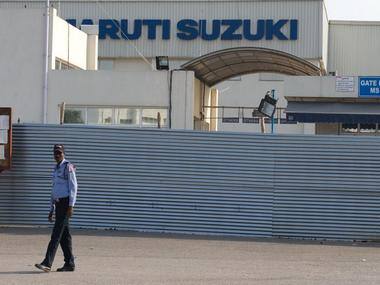 Maruti Suzuki’s Manesar plant. Naresh Sharma/ Firstbiz[/caption]
Last year, Maruti wanted to expand manufacturing in preparation for a larger market for cars in India. That expansion, like beginning production from the Gujarat plant, has had to be scaled back. What is the total capacity now, by how much will it expand in the 2014 calendar year and how does this impact SMC’s global ambition through Maruti? Also, what is the capex for FY15?
Our current capacity stands at 1.5 million units per annum which looks quite sufficient for our needs so far. Due to sluggish market conditions, we may at best close the year at with last year numbers. Going forward of course, as indicated by Suzuki, start of production will be within 2017. In the initial stage, the capacity will be 100,000 vehicles per year and the capacity will be increased gradually. I cannot give guidance for capex of FY 15.
How is the competitive landscape now? Datsun is arriving, Tata Motors is readying a new lineup of products, other car makers also readying to face the market with new and better cars. Your thoughts on competition in Indian market, will you be able to keep 40% market share this year?
Competition is good for customers, we welcome it. India is a long term growth market, and global players are bound to take interest here. In fact, it was there last year too. Our market share shot up to 42.8 per cent in the third quarter, a gain of 2.5 per cent . Our efforts are built around product development and R & D, expanding our network to remain close to the customer, reaching out to new segments of customers, superior product quality and remaining cost effective. Going forward, we would like to expand our portfolio, foray in newer segments some of which are being displayed at the Expo.
Could you share some details about Maruti’s plans to set up assembly plants in other countries. By when and which countries will these be operational, what all products will be supplied there and how much will this help the bottomline of the Indian company?
We are studying the markets we will share details at an appropriate time
This will be your first year with Maruti. Would you have taken some decisions - administrative and product related - differently had the deadly labour trouble not preceded your arrival? Are relations between labour and management cordial now? Were any product launches/developement delayed because of the strike?
Among several other initiatives, I think our team focused on improving communication across all levels. I have personally met workers’ union representatives on at least two occasions. Efforts are on family connect programmes and team building initiatives. Engagement is being looked at 360 degree.