

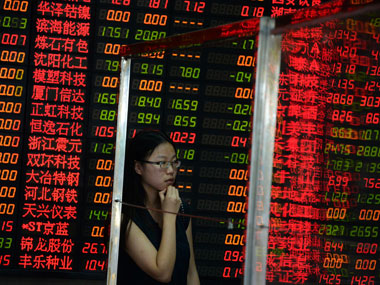
 "Calm down, Indian stocks falling 500 pts is over-reaction; China's not really a worry now")
By Rajesh Padanthil and Prasanna Deshpande Chinese stock markets are falling and it is taking a toll on global markets. The Shanghai composite index fell 8 percent today at the opening, extending a 30 percent decline it already witnessed over a month until yesterday. Asian share indices hit one-and-half-year low and the yen rallied. MSCI’s broadest index of Asia-Pacific shares outside Japan was at its lowest level since February 2014, said a Reuters report. “Shanghai’s early losses were like a cliff-dive, which had a huge impact on investor sentiment,” Ayako Sera, senior market economist at Sumitomo Mitsui Trust Bank in Tokyo, told Reuters. India’s Sensex too is reacting to the equity rout there. The benchmark index today opened down about 300 points. At 12:38 pm, the index exended the losses and was at 27690, down 481 points or 1.7 percent. Here is an explainer on why Indian stock market is over-reacting: The reason for Chinese rout For about one year until last month, the Chinese stock markets were in a bull phase. Despite the visible signs of economy slowing down, there was no stopping the rally in the stock markets, with retail investors participating in droves. [caption id=“attachment_2332870” align=“alignleft” width=“380”] 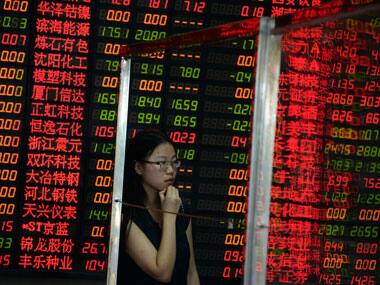 AFP[/caption] A more than doubling of China’s stock market in a year’s time had been underpinned by rapidly expanding margin financing, monetary easing and hopes of economic restructuring. However, with the regualtors beginning to clamp down on margin financing, the stock markets started their downward spiral. What have added to negative sentiment is the feeling that economy is not growing at a scorching pace anymore (the GDP growth was 7 percent in January-March) and also fizzling out of reforms process. According to various estimates, about $3 trillion of market value has been eroded in about a month. With the rout today, more than half of the listed stocks have been suspended from trading. Various theories are doing the rounds about the reason for the rout. Everything from the name of the chairman of China Securities Regulatory Commission - Xiao Gang, which means cutting it all - to foreign investors’ short selling have been blamed. What ever the reason, one thing is sure: the fall has been aggravated by the panic spread by the authorities. They unleashed a slew of measures. The central bank cut lending interest rates, and also reserve ratio for select banks. The regulator even relaxed the rules on margin trading, by lowering threshold for individual investors to trade on margins and expanding brokerages’ funding channels. However, the stocks continued to crash. Commodities feel the jitters The direct impact of the nose dive is in the commodities market, where the prices are falling. According to reports, prices of copper on the London Metal Exchange hit a six-year low yesterday. The reason? China is the biggest consumers of all commodities. The stock market rout has accentuated the already prevailing fears of demand slowdown from the country. It’s political The stock market crash has snowballed into a political issue. An article in The Economist notes that the stock market fall will not hurt the economy much because “only 15 percent of household assets are invested in these assets. For the government, though, this is a prestige issue as it has projected the rising stockmarket as a symbol of economic growth, the article says. So the authorities would do whatever they can to prop up the market, the article says explaining their panic-striken moves. Should India worry? Not too much at least now. “Indian markets have the resilience to stave off concerns emerging from global economies such as Greece. In case of China, while the fall is steep there, Indian markets have shown some strength in early trades. China and Greece cannot be compared as China is a much bigger economy and if the fall continues going ahead, it will engulf other global markets, including India as well. While Chinese government is taking measures to cool off the market, Indian markets will stay subdued, as globally the fragile mood will keep investors cautious,” said Arun Kejriwal, founder at Kejriwal Research & Investment Services. But G Chokkalingam, founder, Equinomics Research & Advisory, says India and Chinese stock markets have the weakest corelation. Between June 12 till date, Chinese markets have fallen 30 percent where as Indian markets are up over 5 percent, indicating no underlying impact on our markets. In the last one year, China markets rose by a whopping 150 percent, and were already showing signs of getting into bubble zone which seemed to have busted of late. However, China has strong forex reserves position, and the government will certainly intervene to curb the fall going ahead, he said. The Economist article also supports this view. According to it, the Chinese economy is not in that bad shape. “Growth, though slowing, has stabilised recently. Other asset markets are performing well. Property, long in the doldrums, is turning up. Money-market rates are low and steady, suggesting calm in the banking sector,” the article says. The correction in the stock market there was long overdue. It is happening now. On the whole the fall in the Indian stock market is just an over reaction.
On the whole the fall in the Indian stock market is just an over reaction
Advertisement
End of Article
Written by FP Archives
see more


 "Israel targets top Hamas leaders in Doha; Qatar, Iran condemn strike as violation of sovereignty")
 "Nepal: Oli to continue until new PM is sworn in, nation on edge as all branches of govt torched")
 "Who is CP Radhakrishnan, India's next vice-president?")
 "Israel informed US ahead of strikes on Hamas leaders in Doha, says White House")
 "Israel targets top Hamas leaders in Doha; Qatar, Iran condemn strike as violation of sovereignty")
 "Nepal: Oli to continue until new PM is sworn in, nation on edge as all branches of govt torched")
 "Who is CP Radhakrishnan, India's next vice-president?")
 "Israel informed US ahead of strikes on Hamas leaders in Doha, says White House")



](https://images.firstpost.com/wp-content/uploads/2015/07/chinese-stock-market_AFP_380.jpg)