New Delhi: A check on air fares on 10 busy domestic routes by the Ministry of Civil Aviation this Diwali found airlines pricing tickets at “reasonable” levels.[caption id=“attachment_2184139” align=“alignleft” width=“380”]
 No predatory air fares this Diwali. Reuters[/caption] A senior ministry official told Firstpost the ministry checked up prices on these routes on three days - on the 10th, a day prior to Diwali; Diwali day 11th November and on the 12th. And was satisfied with the fare levels on each day. The monitoring of domestic fares comes a few weeks after all domestic airlines were summoned by the secretary over what the ministry has termed “predatory” pricing earlier during peak travel season. Does the satisfaction with Diwali fares mean the ministry will no longer crack the whip on air fares, in any form, in the near future? Remember, fare monitoring and informal discussions with airlines have been ongoing for the last several months as the ministry tried to cajole airlines to be reasonable with last minute fares and those during peak travel seasons. It had received numerous complaints earlier about last minute fares sometimes being as high a 10 times the average fare on a route. The ministry official said airlines had been specifically asked to reduce the gap between average and highest fares on each sector as well as the gap between fares during peak and non-peak seasons. “We had requested the airlines to do some self regulation. We are happy to see they have heeded to our request. This festival season we did not find fares to be exorbitant. Besides, we did not receive any complaints either on exorbitant fares,” said the ministry official. The official was answering a question about whether another meeting has been called with domestic airlines to bring in some sort of fare regulation. Ministry officials have been vehemently denying any move to regulate fares in the past even though Minister of State for Civil Aviation, Mahesh Sharma, has repeatedly said if airlines failed to fall in line, then regulation would be looked into. The official quoted earlier did not say if another meeting with airlines is scheduled in the coming weeks to fine tune a fare regime. He also did not answer a question on whether Re 1 fares and other such schemes where some seats are being sold below cost by airlines are under the scanner. But it is clear that nudging by the ministry on fares has worked - earlier, officials had admitted they told airlines informally to keep the maximum fare on any sector between two to three times the average fare, no more. An analysis by travel portal Cleartrip.com shows how Diwali fares were really nothing to complain about this year even though they were about 6 percent more than last Diwali.
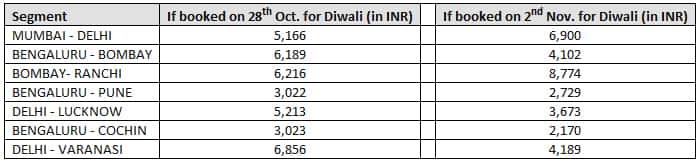 Cleartrip’s chief revenue officer Amit Taneja said, “On Cleartrip we saw a 13 percent increase in travel during Diwali when compared to the same period last year. The average air fare this year was 6 percent higher than it was last year for travel during Diwali. Since people traditionally return to their hometown for Diwali, we saw the majority of travelers flocking to New Delhi, Mumbai, Bangalore and Goa as their top destinations of choice this festival of lights.” Not just on domestic routes, there has been concern over air fares on some international ones as well. Some weeks back Prime Minister Narendra Modi had expressed concern over high air fares to high density overseas routes during festival seasons and asked the Ministry of Civil Aviation to suggest ways to end this menace. Modi received representations from some Indians residing in the UAE on his visit - the Indians there pointed out that fares are being hiked by airlines during festivals like Onam, making it difficult for them to go home. The PM brought it up at a meeting held with ministry officials. Modi’s concern over high air fares was neither new nor unfounded. There has been a long drawn debate within the ministry about how to control last-minute steep fares on domestic routes. In fact, minister Sharma has pointed out fare regulation is necessary to dissuade airlines from indulging in what he called “predatory pricing”. Sharma was referring to domestic concerns whereas Modi picked out the concerns raised by the Indian diaspora abroad on the same issue. Sharma’s comments followed complaints from numerous members of parliament about steep last minute fares, specially flights to the north east region. Sharma had earlier hinted that if airlines did not fall in line, he could ask state-owned Air India to reduce fares on high density routes, forcing private carriers to also lower fares. An earlier fare study conducted by the DGCA had also exonerated airlines since it found that less than 2 percent of all domestic fares were in the highest fare bucket. Last year, the ministry had been mulling a cap on lowest and highest fares an airline can charge on any domestic route but that proposal was shelved after much internal discussion.
Airlines fall in line after ministry steps in, no exorbitant fares this Diwali
Sindhu Bhattacharya
• November 16, 2015, 15:11:56 IST
Not just on domestic routes, there has been concern over air fares on some international ones as well.
Advertisement
 "Airlines fall in line after ministry steps in, no exorbitant fares this Diwali")
End of Article