 "Sport in the time of YouTube")
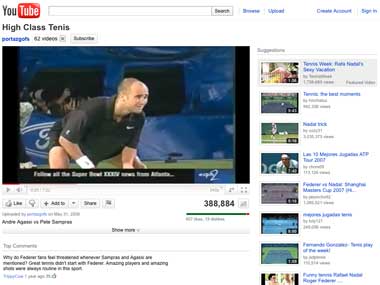
These days I get my highlights reel off the Web. Nadal’s tweener, IPL moments, Warne’s last ball in international cricket – it’s all there. Virtually nothing escapes the Internet’s grasp. Television has been rendered a classic medium, in other words obsolete. YouTube is in a manner of speaking a real world manifestation of Harry Potter’s pensieve, a repository for memories buried or tucked away, to be drawn from when the need arises. Like many people I have spent thousands of hours searching through its recesses for obscure visual data. I don’t know about you, but I am an indiscriminate consumer of musical performances from the 1920s. They make me feel, I suppose, like a great-grand nephew who has unexpectedly run into luck and some cache. At other times I am left feeling like one of those cartoon hound detectives searching for clues. Not that I ever expect to find it, but any stock evidence that conclusively elevates Sachin Tendulkar over Don Bradman as the greatest batsman in history would make my day. Far from being parochial, I’m merely observing that all things considered, privileging Bradman seems, depending on how you view it, a case of reinforcing history by consensus or indulging romanticism. *** Nostalgia has its place in sport, yet – as YouTube demonstrates, time and again – it is dangerously overrated. The other day it struck me to return to my childhood and cast, this time, a more unbiased eye on sport as it evolved through the 1980s, a period of anti-romance widely derided by the cognoscenti as a barren winter of decadence and mercifully replaced by the spring of modernity. [caption id=“attachment_15414” align=“alignleft” width=“380” caption=“YouTube also comes in handy when trying to get a sense of contemporaneous developments across sports from eras past. Screengrab from YouTube”]
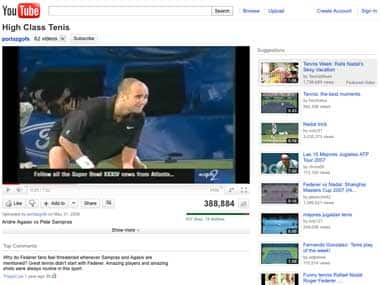 [/caption] But as I surfed from link to link, half-expecting at every instance to be Rickrolled – or worse, to recoil from Andre Agassi’s mullet bobbing to an ironic score of synthesizer pop – I grew convinced that there was much to salvage from the junk. While on the one hand YouTube videos, divorced from their original context, have a slightly disorienting effect on the viewer, one has to take the position that something is better than nothing. Scouring through old French Open matches, I caught up with this beauty – the complete video of John McEnroe
blowing off
Jimmy Connors in straight sets in the Wimbledon final, in the middle of his spectacular 1984 run (when he compiled a win-loss record of 82-3). I remember watching this match live as a four-year-old; it was the first notch in my career as a tennis watcher. The quality of McEnroe’s game was apparently even more sublime than my mother, an inveterate fan, taught me to believe. His overall run that year was superior even to Federer’s best of 81-4 in 2005. So much for my fear of nostalgia. *** YouTube also comes in handy when trying to get a sense of contemporaneous developments across sports from eras past. When referencing advancements in tennis and cricket – the two most popular televised sports of my adolescence – it must be pointed out that the much-cited experiments in racquet technology (for example, the replacement of wooden frames with composite material) foreshadowed the tinkering with cricket bats. At the same time, there is no doubt that both games emphasise physicality now more than they ever did. This much is obvious, the visual evidence is out there, clear for us to see. But most interesting of all – and this does not come through on YouTube quite as explicitly as the others – while the touring circus still stops pretty much at the same tennis venues, contemporary cricketers play far more matches than their predecessors. What impact did that have on professionalism, success, and media exposure vis-à-vis cricket? Let us be clear: that factor cannot in isolation explain, say, the disparity in the batting averages of VVS Laxman and Gundappa Viswanath – reputedly two of history’s prettiest stroke-makers, both endowed with a genius for dealing serenely and professionally with crumbling wickets on the final day of a Test match. But while I have seen a fair bit of Laxman, both on television and on the Internet, I have barely got to see Viswanath bat. YouTube is surprisingly hushed on the subject of this rumouredly great stylist. The relative barrage of recent performances, in addition to his 281 against Steve Waugh’s Australians, have guaranteed Laxman, hitherto a valiant foot soldier in the cause of Indian cricket, a measure of notoriety on the Web as one of the criminally underrated greats; even as Viswanath continues to be spoken of in reverential tones as a brilliant batsman who has barely received his due. Here’s the only available footage on YouTube of Viswanath batting, from 1981: here he square cuts his way to 114
against Australia
in Melbourne. Meanwhile I continue to hope someone will post a video of the unbeaten 97 he scored against the West Indies in Chennai. Wisden ranked that one the 38th greatest innings of all time, the second greatest of all non-centuries. Quite remarkably, almost nobody I know has ever managed to see it. For all practical purposes, given we inhabit a simulacrum of the world, if it’s not on YouTube, Viswanath might very well have played that innings in his dreams.
[/caption] But as I surfed from link to link, half-expecting at every instance to be Rickrolled – or worse, to recoil from Andre Agassi’s mullet bobbing to an ironic score of synthesizer pop – I grew convinced that there was much to salvage from the junk. While on the one hand YouTube videos, divorced from their original context, have a slightly disorienting effect on the viewer, one has to take the position that something is better than nothing. Scouring through old French Open matches, I caught up with this beauty – the complete video of John McEnroe
blowing off
Jimmy Connors in straight sets in the Wimbledon final, in the middle of his spectacular 1984 run (when he compiled a win-loss record of 82-3). I remember watching this match live as a four-year-old; it was the first notch in my career as a tennis watcher. The quality of McEnroe’s game was apparently even more sublime than my mother, an inveterate fan, taught me to believe. His overall run that year was superior even to Federer’s best of 81-4 in 2005. So much for my fear of nostalgia. *** YouTube also comes in handy when trying to get a sense of contemporaneous developments across sports from eras past. When referencing advancements in tennis and cricket – the two most popular televised sports of my adolescence – it must be pointed out that the much-cited experiments in racquet technology (for example, the replacement of wooden frames with composite material) foreshadowed the tinkering with cricket bats. At the same time, there is no doubt that both games emphasise physicality now more than they ever did. This much is obvious, the visual evidence is out there, clear for us to see. But most interesting of all – and this does not come through on YouTube quite as explicitly as the others – while the touring circus still stops pretty much at the same tennis venues, contemporary cricketers play far more matches than their predecessors. What impact did that have on professionalism, success, and media exposure vis-à-vis cricket? Let us be clear: that factor cannot in isolation explain, say, the disparity in the batting averages of VVS Laxman and Gundappa Viswanath – reputedly two of history’s prettiest stroke-makers, both endowed with a genius for dealing serenely and professionally with crumbling wickets on the final day of a Test match. But while I have seen a fair bit of Laxman, both on television and on the Internet, I have barely got to see Viswanath bat. YouTube is surprisingly hushed on the subject of this rumouredly great stylist. The relative barrage of recent performances, in addition to his 281 against Steve Waugh’s Australians, have guaranteed Laxman, hitherto a valiant foot soldier in the cause of Indian cricket, a measure of notoriety on the Web as one of the criminally underrated greats; even as Viswanath continues to be spoken of in reverential tones as a brilliant batsman who has barely received his due. Here’s the only available footage on YouTube of Viswanath batting, from 1981: here he square cuts his way to 114
against Australia
in Melbourne. Meanwhile I continue to hope someone will post a video of the unbeaten 97 he scored against the West Indies in Chennai. Wisden ranked that one the 38th greatest innings of all time, the second greatest of all non-centuries. Quite remarkably, almost nobody I know has ever managed to see it. For all practical purposes, given we inhabit a simulacrum of the world, if it’s not on YouTube, Viswanath might very well have played that innings in his dreams.
Vijay Parthasarathy covered the city transport beat for The Indian Express, Delhi, and wrote on sport, music and books for The Hindu for many years before leaving to get a PhD at the University of Texas, Austin, on cultural globalisation. He has an undergraduate degree in Physics from St. Xavier’s College, Mumbai, a PGDip. in print media from Asian College of Journalism, Chennai, and a MA in Creative Writing from the University of East Anglia, Norwich. His fiction has appeared in the Penguin Book of New Writing from India and Litro. He blogs at the heretic (http://garplives.blogspot.com/</a>).