 "Legalising Mumbai's pre-2000 slums: Why it won't do any good")
After pushing through the Bill to confer legitimacy on slums built between 1 January, 1995 and 2000, the Maharashtra Chief Minister was brutally honest. He spoke of the fact that the Congress-NCP’s promise to regularise them had resulted in the alliance winning two Assembly elections, in 2004 and 2009. “People
liked
our decision. They gave us plenty of votes”, Prithviraj Chavan said. Thus he admitted to the worst kept secret in town, to the politics of vote banks. It is also why the opposition was muted, lest they lose the votes from the slums. In a city where every other citizen is a slum dweller, and slum dwellers vote with greater enthusiasm, they are a treasured lot. However, the Chief Minister has risked stepping into a legal quagmire with this decision . The state had filed an affidavit in a PIL (Relief Road Association V/s. State of Maharashtra being Writ Petition No.98 of 1999) in Mumbai High Court that the cut-off of 1995 will not be extended and that all encroachments after that cut-off would be a cognizable office, and gazetted it on 5 January, 2002. [caption id=“attachment_1418057” align=“alignnone” width=“380”]
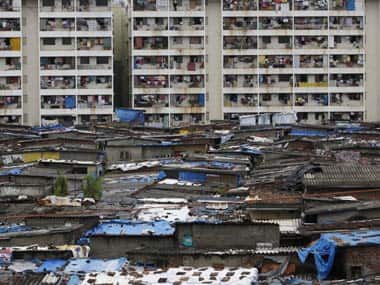 Most of the pre-1995 slums still aren’t proper buildings yet. Reuters[/caption] In another (PIL No.637 of 2003) the court allowed use TDRs (Transfer of Development Rights) generated by a slum replacement project to an another crowded, but preferred area for construction, by selling area on which the slum rehabilitation was to take place, “considering (that) the cut-off date as 1-1-1995 which shall not be extended further.” Though it isn’t concerned with the cut-off date, but with regard to permitting such TDR use, the Janhit Manch has moved the Supreme Court in appeal. It is now possible this extension of cut-off could become an issue. The government has relied on the opinion of the Attorney General that it would not constitute contempt of court. But we don’t know what view the apex court would take. On the politics of it, the opposition cannot complain because when in government between 1995 and 1999, it had protected all pre-1999 slums and even set course on a failed policy to provide free replacement housing to as many as 40 lakh slum residents. They could have had an objection to the extension. But discretion prevailed on the eve of polls. The Shiv Sena which set the pre-1995 slum protection policy had always linked slums to migrants, especially non-Maharashtrian migrants. The Congress governments had dreamt of Mumbai as Singapore or Shanghai without reckoning with the slums. The two parties had always believed that slums could be excluded from city planning. A major reason why post-1995 and pre-2000 slums were sought to be regularised had less to do with a feeling of benevolence, or an inclusive policy towards the slum dwellers. It is aimed at providing spaces for developers to exploit. Quite a few slum rehabilitation projects are held up because they had a sprinkling of new dwellings amid them. Given that a large eviction and demolition is no more a standard practice, the real estate developers who took up projects would have pushed for smoothening their project plans. Since they couldn’t go, the slum dwellers had to be included. Many a slum unit was squeezed in between the pre-1995 structures by design, hoping for regularisation. However, this particular move of regularising slums built in five years since January 1, 1995, is a sleight of hand. Because apart from protection from bulldozers, nothing else concrete is provided. It could be years, and going by the speed seen so far, even decades, before these approximately three lakh dwellings morph into liveable, planned housing. To a slum dweller, the assurance that his home would not be razed is great relief, something to revel in, and was visible when the news trickled down to the slums with pre-2000 units. The resident’s realisation of a dream of a concrete house would be possible only if it was amid the pre-1995 slum dwellings and had prevented initiation of the slum replacement scheme. Rehabilitation schemes for all pre-2000 slum dwellings still have to evolve. However, much like they held up rehabilitation of the slums prior to 1995, the pre-2000 slums too have homes amid them that came up afterwards and will prove a headache in furthering the projects mentored by the Slum Rehabilitation Authority. If in five years since 1995, some three lakh dwellings came up, one can only guess how many came up after them. Slum evolution is not like a township development undertaken by a developer on a tract of land. The dwellings come up at places guided by the ease of availability of land parcels of even 10x10 ft, proximity to likely livelihood sources, and some access to social resources, even if it is already used by another slum. In that, these extensions are of no consequence. The regularisation of structures prior to 1995, has not resulted in them being replaced by better housing or improved civic facilities within the slums. The SRA has barely helped move approximately 4 to 5 percent of eligible slum dwellers to free, new housing. All it does is offer some comfort to them – their homes won’t be be bulldozed.
Mahesh Vijapurkar likes to take a worm’s eye-view of issues – that is, from the common man’s perspective. He was a journalist with The Indian Express and then The Hindu and now potters around with human development and urban issues.