

 "Jayalalithaa should wait till 6 March to release Rajiv Gandhi's assassins")
The Supreme Court’s order restraining Tamil Nadu government from releasing convicts in the Rajiv Gandhi assassination case pertains only to three convicts, V Sriharan alias Murugan, T Suthendraraja alias Santhan and AG Perarivalan alias Arivu, whose death sentence was commuted to life imprisonment by the apex court on Tuesday. It does not pertain to four other convicts Nalini, Robert Payas, Jayakumar and Ravichandran who are undergoing life sentence. But this is a mere technicality and the Tamil Nadu government will be playing with fire if it were to go ahead with the release of four other convicts not specifically mentioned in the Supreme Court order. [caption id=“attachment_1401731” align=“alignleft” width=“380”] 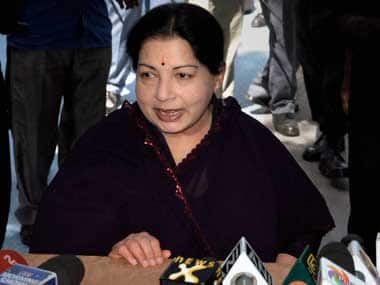 Shouldn’t Jayalalithaa wait for the SC’s verdict. PTI[/caption] The Jayalalithaa government will have to hold its horses, at least till 6 March when the Supreme Court hears the case again. The apex court may come up with a clear and unambiguous order on that day with regard to the release of four other convicts in the Rajiv Gandhi assassination case. Also, the Tamil Nadu government cannot afford to ignore a highly significant observation made by Chief Justice of India P Sathasivam today. The Chief Justice duly noted the hectic pace with which the Jayalalithaa government moved on Wednesday morning even though the apex court’s judgment was delivered Tuesday morning and the order was made available only at 5 pm the same day. Solicitor General Mohan Parasaran told the Supreme Court and contended that permission to free the convicts could not be granted without the approval of the central government whose investigating agency CBI probed the matter leading to the convictions. Section 435 (2) of the Criminal Procedure Code (CrPC), which deals with a state government’s power to remit or commute a sentence, makes it clear that the state government is not merely required to “consult” the Central government while remitting a sentence. Rather, the Central government will also have to on board and no suspension, remission or commutation of a sentence by a state government will have effect unless the Centre too was to pass such an order. Consider the relevant section entitled “State Government to act after consultation with Central Government in certain cases” reproduced below: “No order of suspension, remission or commutation of sentences passed by the State Government in relation to a person, who has been convicted of offences, some of which relate to matters to which the executive power of the Union extends, and who has been sentenced to separate terms of imprisonment which are to run concurrently, shall have effect unless an order for the suspension, remission or commutation, as the case may be, of such sentences has also been made by the Central Government in relation to the offences committed by such person with regard to matters to which the executive power of the Union extends.” Moreover, Section 432 of the CrPC (which deals with power to suspend or remit sentences), is also highly relevant.
Tamil Nadu government will be playing with fire if it were to go ahead with the release of four other convicts not specifically mentioned in the Supreme Court order.
Advertisement
End of Article
Written by Rajeev Sharma
Consulting Editor, First Post. Strategic analyst. Political commentator. Twitter handle @Kishkindha. see more

 "Russian drones over Poland: Trump’s tepid reaction a wake-up call for Nato?")
 "As Russia pushes east, Ukraine faces mounting pressure to defend its heartland")
 "Why Mossad was not on board with Israel’s strike on Hamas in Qatar")
 "Turkey: Erdogan's police arrest opposition mayor Hasan Mutlu, dozens officials in corruption probe")
 "Russian drones over Poland: Trump’s tepid reaction a wake-up call for Nato?")
 "As Russia pushes east, Ukraine faces mounting pressure to defend its heartland")
 "Why Mossad was not on board with Israel’s strike on Hamas in Qatar")
 "Turkey: Erdogan's police arrest opposition mayor Hasan Mutlu, dozens officials in corruption probe")



](https://images.firstpost.com/wp-content/uploads/2014/02/Jaya-pti.jpg)