

 "The strange history of books bound in human skin: Megan Rosenbloom's latest is a deep dive into the practice")
By Elizabeth Svoboda In 2015, Megan Rosenbloom traveled to Harvard University’s Houghton Library in search of a book called Des destinées de l’âme (Destinies of the Soul), by the French author Arsène Houssaye. This copy of Houssaye’s masterwork had a singular distinction: At the time, it was the only book on the planet proven to be bound in human skin. For Rosenbloom, a librarian at the University of California, Los Angeles, the trip served as her entrée into a field she’d studied for years: anthropodermic bibliopegy, the practice of binding books in human epidermis. It’s easy to assume this topic is too restricted or too gruesome for a book of its own, but
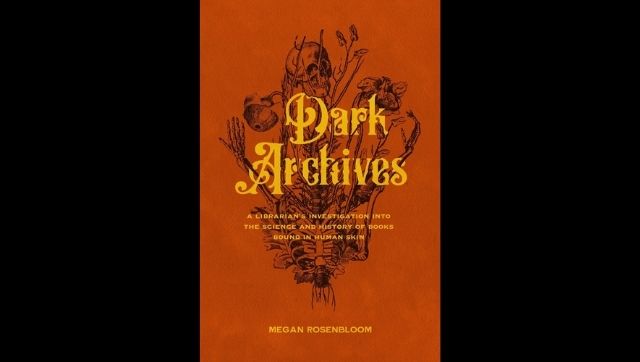
Dark Archives: A Librarian’s Investigation Into the Science and History of Books Bound in Human Skin, proves that assumption wrong. As Rosenbloom crisscrosses the globe to confirm the purported origins of skin-bound books — a cracking detective story in itself — her journey offers unusual insight into what defines informed consent, what separates homage from exploitation, and how power disparities can breed casual inhumanity. Human skin-covered books have captivated literary audiences for centuries: A classic HP Lovecraft short story features ‘
a locked portfolio, bound in tanned human skin,’ and a skin-bound volume drives the plot of Chuck Palahniuk’s 2002 novel
Lullaby. Still, it appears so far that impostor skin books outnumber real ones. The
Anthropodermic Book Project, of which Rosenbloom is a member, has identified only 18 books to date that live up to their human-skin billing. (By claiming a volume was bound in skin, book dealers of yore could juice their profit margins, creating ample incentive to lie.) Authentic specimens, though rare, take on outsized importance because they betray a human willingness to obliterate consent, and even personhood, for aesthetic or supremacist ends. The books’ “very ordinary appearances,” Rosenbloom writes, “mask the horror inherent in their creation.” Part of her goal in documenting anthropodermic books’ origins is to restore dignity to those whose remains were sewn into bindings. [caption id=“attachment_9069201” align=“alignnone” width=“640”]
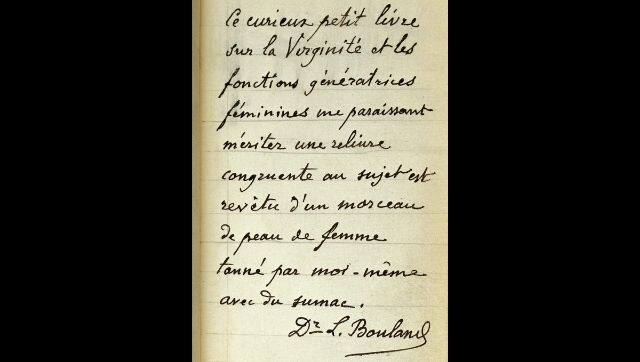 An inscription from a book possibly bound in human skin by Dr. Bouland reads in part, “It is bound with a piece of female skin tanned by myself with sumac.” Image via Undark/ Wellcome Library/ Wikimedia Commons[/caption] The blade of a doctor’s scalpel, Rosenbloom observes, was often the prime instrument of this desecration. In the late 1800s, an upstart physician named John Stockton Hough harvested skin from the thighs of Mary Lynch, a woman who had died penniless of a combination of tuberculosis and trichinosis. Decades later, Hough, an avid book collector, used the preserved skin to cover several of his favorite books on female anatomy. Other bibliophile doctors also helped themselves to skin from dead patients, sending the samples to professional tanners for preservation — a practice that revealed their lack of respect for their patients as human beings. The grotesque custom, Rosenbloom writes, embodied “The worst of what can come from the collision of acquisitiveness and clinical distancing.” While rumors persisted for decades about the provenance of books like Hough’s, it wasn’t until 2014 that a new analytic method allowed researchers to separate real anthropodermic books from the rest. The method, known as peptide mass fingerprinting, involves taking a tiny sample of a book’s cover, adding the enzyme trypsin to digest its contents, and putting the sample in a mass spectrometer to see which peptides, or protein building blocks, it contains. Dried human skin might look a lot like stripped goat pelt or cow hide, but it has different peptides. (Because DNA degrades over time, DNA sequencing methods generally cannot determine whether older book covers contain human skin.) It was peptide mass fingerprinting, Rosenbloom explains, that allowed Harvard to verify that its copy of Des destinées de l’âme was skin-bound. The Houssaye volume once belonged to the French physician and bibliophile Ludovic Bouland, and people had speculated about it ever since a collector found a cryptic note inside. “A book on the human soul,” Bouland scrawled on one of the front papers, “merits that it be given human clothing.” When Houghton Library announced, in 2014, that peptide testing confirmed the book’s long-suspected origins, the internet seethed with disgust. One critic opined that the only way forward was to detach the book’s cover and give it a proper burial. “The binding is a macabre disgrace,” another wrote. “Got any vintage WWII lampshades, Harvard?” But if you’re conjuring up shelves of Third Reich books cloaked in prisoners’ skin, you’re probably off base. There’s no concrete evidence that the Nazis actually created skin-bound volumes, Rosenbloom says, even though — like certain bibliophiles — they had no qualms about plundering the physical bodies of the least powerful. One widely told story about Buchenwald overseers Karl-Otto Koch and his wife Ilse Koch alleges they owned a human skin lampshade, but the lampshade itself has never been found. Before becoming a librarian, Rosenbloom worked as a journalist, and she shows off her reporting chops in letter-perfect descriptions of the literary world’s sordid corners. During a visit to a leather tannery to get a sense of how human skin might have been prepared for binding, she’s hit with a stench so pungent it seems otherworldly. “It was not merely a smell,” she writes. “It felt like having raw animal organs stuffed into my mouth and pulled through my nose.” The stink so penetrates her shoes that she has to chuck them into the garbage. In another scene, she heads out in search of a skin-bound book and a librarian ambushes her with a desiccated, centuries-old Jesus tattoo. But while shock value might pull readers into the narrative, what sustains it is Rosenbloom’s incisive commentary on what contexts promote inhumane treatment of human bodies, as well as how such conditions persist today. She remains implacable in the face of criticism about her motives, convincing us that excavating our darkest impulses is one of the surest routes to understanding ourselves. In an era laser-focused on appearances, Dark Archives also offers a timely reminder of just how much can lurk beneath a tidy-seeming exterior. It’s likely there are plenty more human skin books “resting in library stacks, hiding in plain sight,” Rosenbloom writes. “Even if you were holding one right now, you probably wouldn’t be able to tell.” This article was originally published on
Undark. Read the
original article.
As Rosenbloom crisscrosses the globe to confirm the purported origins of skin-bound books — a cracking detective story in itself — her journey offers unusual insight into what defines informed consent, what separates homage from exploitation, and how power disparities can breed casual inhumanity.
Advertisement
End of Article

 "Charlie Kirk, shot dead in Utah, once said gun deaths are 'worth it' to save Second Amendment")
 "From governance to tourism, how Gen-Z protests have damaged Nepal")
 "Did Russia deliberately send drones into Poland’s airspace?")
 "Netanyahu ‘killed any hope’ for Israeli hostages: Qatar PM after Doha strike")
 "Charlie Kirk, shot dead in Utah, once said gun deaths are 'worth it' to save Second Amendment")
 "From governance to tourism, how Gen-Z protests have damaged Nepal")
 "Did Russia deliberately send drones into Poland’s airspace?")
 "Netanyahu ‘killed any hope’ for Israeli hostages: Qatar PM after Doha strike")



](https://images.firstpost.com/wp-content/uploads/2020/12/SKinBound_640.jpg)