

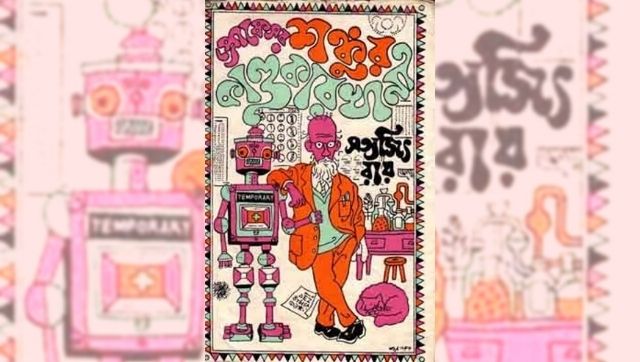
 "History of Indian science fiction: How the genre, rooted in mythology and science, has evolved over the years")
The Oxford dictionary defines science fiction as “[F]iction based on imagined future scientific or technological advances and major social or environmental changes, frequently portraying space or time travel and life on other planets.” To a large extent, this definition is mirrored in the many portrayals of science-fiction in popular culture. But because fiction is an atomic view of a larger bodily reality, it can’t always comprehensively answer the many socio-economic queries that fiction needs to avoid to be fantastical. Given its social complexities, diversity and class inequalities, what is fiction for one might not be something else for another person, which makes it difficult to ascertain what exactly qualifies science fiction in India, and where do we even begin to draw the map that will tell us where we have come from, and where we are headed. Indian science fiction — according to assistant professor Sami A Khan who has extensively worked on the subject — cannot be simplistically deduced as recreation of popular tropes in the west (Koi Mil Gaya as a copy of ET). It’s rather far more complicated. “There exists more than a century of ‘modern’ Indian SF. To cite from two languages: Hindi has of Pandit Ambika Dutt Vyas’s ‘Ascharya Vrittant’ published in Piyush Pravaha (1884), Babu Keshav Prasad’s ‘Chandra Lok Ki Yatra’ published in Saraswati (1900) and Bengali has Hemlal Dutta’s ‘Rahasya’ published in Vigyan Darpan (1882), Jagadananda Ray’s ‘Shukra Bhraman’ (1892), and Jagadish Chandra Bose’s ‘Palatak Toofan’ published in Avyakta (1896),” Khan says. Indian languages today, Khan says, are carrying forward the legacy of these works. Sci-fi writing traditions, Khan explains, easily pre-date the advent of the modern era defined by printing and journals. So where does Indian mythology, seen through the rationale of frameworks, stand amid all of this? Khan suggests that the nature of fiction is often defined by society’s notion of science and fantasy. “A person instantaneously travels from point A to point B in a speculative text. In fantasy, this might be due to ‘floo power/apparition’ (Harry Potter), in SF this may be explained by teleportation (Star Trek), and in mythology it can be the result of the will of a divine being (Bifröst in Thor). While the event/happening remains the same (faster-than-light travel), the way it is described determines whether the text is classified/read/marketed as SF or fantasy or mythology,” Khans explains. Vijayendra Mohanty has been working with speculative fiction for years now; a former journalist, the writer recently launched his anthology of science fiction online titled Kalp Fiction. A plethora of science, supernatural and familiar mythological tropes abound in this intriguing collection that finds new ways of seeing the rumoured and the believed. “We have managed to convince ourselves that culture is a static thing that came into existence long ago and that now needs to be “preserved” (whatever that means). Nothing could be further from the truth. We create culture all the time, ourselves,” Mohanty says about why he consistently returns to mythology. In one story from his anthology a goat and a cow speak and bear witness to the supernatural phenomenon of Hanuman carrying the Doragiri mountains in his palm. This switch of the perspective alone speculates on the many overseen realities of our ancient texts, repositioning some as new queries into the old. Science fiction is also usually regarded as an urban phenomenon, where a larger proportion of the population is science literate. “While SF may have begun in the metropolitan cities it slowly started seeping into towns and other areas – with an increase in scientific education the stage was set for the rise of SF a few decades ago. And Indian writers have played with/on this: Ray’s Professor Shonku, for example, lives in Giridih. Plus, with increasing urbanisation and more rural to urban migration, where does a city actually stop?” Khan says. That said, the overlap of folklore and superstition still makes it difficult to delineate boundaries. “SF is hard to define because it is the literature of change and it changes while you are trying to define it (Tom Shippey’s definition). By the time we do come up with a definition that differentiates science and superstition, both science and superstition change – and us with it,” Khan adds. Modern Indian science fiction echoes modern sensibilities and anxieties, most recently collected under the _Gollancz Book of South Asian Fictio_n. But these anxieties, one could argue, remain rooted in an Indian morality or aesthetic. Mohanty believes the assumption that science fiction hasn’t really ‘taken off’ is a relative term. “We have had authors such as Samit Basu, Achala Upendran, Shweta Taneja, Indra Das, Tashan Mehta and others writing speculative literature for years now. We have had a comic book industry that focusses on fantasy and science fiction primarily. Our TV channels have mythological or fantasy stories running almost all the time. Podcast statistics will tell you that one of the most popular genres in India is mythology. The Indian imagination, like everything else in India, is not a monolith. Large parts of it continue to be dominated by speculative literature,” Mohanty says. Khan, on the other hand, believes the genre, historically, took off a century ago and has only gone from strength to strength, set to explode beyond the rigidity of urban cultures. “The more science and technology penetrates a society, the more we need SF – and the more it emerges. The next wave of SF is going to come from Y and Z cites – and also small towns and mofussils,” he says. Mohanty represents a generation that is now using technology to get to its reader rather than wait for them to find him. Community, Mohanty believes, plays an important part, and it will eventually define if India’s sci-fi movement and its proponents survive the struggles of everyday life to leave small, but intriguing legacies of wonder and disbelief.
Community plays an important part, and it will eventually define if India’s sci-fi movement and its proponents survive the struggles of everyday life to leave small, but intriguing legacies of wonder and disbelief.
Advertisement
End of Article

 "Charlie Kirk, shot dead in Utah, once said gun deaths are 'worth it' to save Second Amendment")
 "From governance to tourism, how Gen-Z protests have damaged Nepal")
 "Did Russia deliberately send drones into Poland’s airspace?")
 "Netanyahu ‘killed any hope’ for Israeli hostages: Qatar PM after Doha strike")
 "Charlie Kirk, shot dead in Utah, once said gun deaths are 'worth it' to save Second Amendment")
 "From governance to tourism, how Gen-Z protests have damaged Nepal")
 "Did Russia deliberately send drones into Poland’s airspace?")
 "Netanyahu ‘killed any hope’ for Israeli hostages: Qatar PM after Doha strike")



