

 "Why is India staying silent on the bloodbath in Egypt?")
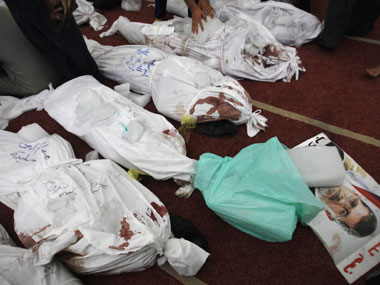
To come to the brass tacks upfront, India’s silence over the ongoing violence and political turmoil in Egypt - which has left over 500 people dead in past few days - is at once mystifying and galling. The Indian silence thus far on the ongoing bloodbath in Egypt can have two connotations. One, the Indian diplomatic establishment is in a wait-and-watch mode and is no hurry to take a position as the military government and the Muslim Brotherhood continue to play the bloody game of one-upmanship against one another. This is a serious dereliction of diplomatic duty on part of India. Two, it is so because India is too bogged down with its own domestic politics and more pressing foreign policy imperatives. This is even more serious as it connotes a policy paralysis that the UPA 2 government has constantly been accused of. [caption id=“attachment_1037345” align=“alignleft” width=“380”] 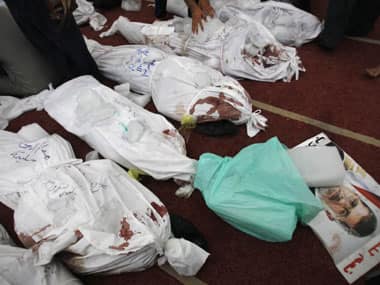 The victims of Egypt violence. Reuters.[/caption] Whichever way you look at it, the Indian silence on the political game being played out in Egypt is galling. The significance of the Egyptian situation can be gauged by the fact that the United States President Barack Obama has canceled the joint US-Egypt military exercises “Bright Star”, saying that Washington’s traditional cooperation with Egypt “cannot continue as usual” in the face of ongoing bloodbath in that country. If India has to ever become a superpower, its foreign policy establishment will have to keep pace with important developments across the globe. India’s foreign policy czars will have to think ahead of times and the least they are expected to do is to react to global upheavals. But the movers and shakers of the Indian foreign policy have left much to be desired in this context. Egypt is a case in point. Egypt is burning. And Egypt is not of peripheral significance to India – diplomatically and strategically. Egypt, the most populated country of Africa, is a transcontinental country spanning the northeast corner of Africa and southwest corner of Asia through a land bridge formed by the Sinai Peninsula. It is a country that has been continuously inhabited since ten thousand years ago Before Christ (BC). India has been in touch with this ancient country for millennia as India and Egypt are two of the world’s oldest civilizations. In more recent times, Egypt and India have been the co-founders of the Non-Aligned Movement (NAM), a major bloc founded in Belgrade way back in 1961 when Egypt’s second president Gamal Abdel Nasser played a crucial role. Nasser, along with the then Indian prime minister Jawahar Lal Nehru and three more world leaders – Indonesia’s first president Sukarno, Ghana’s first president Kwame Nkrumah and Yugoslavian president Josip Broz Tito – had founded NAM. The India-Egypt bilateral trade in the last financial year (2012-13) was to the tune of $ 5.48 billion which is double the India-Pakistan official trade. There are about 3000 Indian nationals in Egypt and fifty Indian companies are presently doing business in Egypt. The last time when India’s Ministry of External Affairs had made a statement on Egypt was on 4 July, 2013. Apart from saying the usual stuff like ““We are closely monitoring the evolving situation in Egypt,” the MEA had then urged “all political forces to abjure violence, exercise restraint, respect democratic principles and the rule of law and engage in a conciliatory dialogue to address the present situation.” Since then the MEA continues to watch the situation in Egypt without commenting on the worst phase of Egyptian politics since President Hosni Mubarak was ousted in January 2011, the first major victim of the Arab Spring. What is happening in Egypt today can be summed up in one sentence. Egypt is being torn asunder by a bloody fight for supremacy between the military and the main opposition force, the Muslim Brotherhood, as the country is supposedly going through a democratic transition. The Egyptian military has become far more ambitious since the 3 July military coup when President Mohamed Morsi was ousted. The Muslim Brotherhood, Egypt’s best organized political force with a support base of over 600,000 supporters, has since then taken up cudgels on behalf of Morsi since his ouster. Egypt today is vertically split between two ideologies: Morsi and Islamist allies on one side and a rag-tag bloc of moderate Muslims, Christians and liberals on the other. The former blames the latterfor trying to destabilize the country to derail the elected leadership while the latter accuses Morsi and the Muslim Brotherhood of seeking to monopolize power. Egypt is back to square one and is in fact much worse off today than it ever was during Mubarak’s reign. The relationship between the Egyptian government under Mubarak and the Muslim Brotherhood was never so bad, and in fact inimical, as it is today. Then the Muslim Brotherhood was given enough elbow room politically and allowed to contest elections. But today, the current military government seems hell bent on wiping out the Muslim Brotherhood as a political force. This leaves us with the question: was Mubarak that bad? And if indeed he was, how has Egypt fared as a nation since he was ousted? A leaked diplomatic cable from the US embassy in Cairo in 2009 and released by whistle-blowing website WikiLeaks brought to the fore Mubarak’s foreign policy thinking and how the Egyptian leader, who was criticized by his detractors as being an unashamed lackey of the US, was on the same page as the Arab world. The cable described Mubarak as “a tried and true realist, innately cautious and conservative,” and with “little time for idealistic goals.” The cable revealed that Mubarak disapproved of the 2003 U.S. invasion that toppled Saddam Hussein of Iraq, which he believed was in need of a “’tough, strong military officer who is fair’” as leader. “This telling observation, we believe, describes Mubarak’s own view of himself as someone who is tough but fair, who ensures the basic needs of his people. In Mubarak’s mind, it is far better to let a few individuals suffer than risk chaos for society as a whole,” the cable said. Lastly, let’s come back to the issue of India’s silence over Egypt. This writer is aware of how the MEA will react to this: that this writer has jumped the gun; that an Indian statement on the present situation in Egypt is in the works. While the MEA is well within its right to issue a statement on Egypt as per its own time frame, it will do well to let the world know where it stands on the current Egyptian political divide. Merely stating that India is closely watching the situation and appealing all to abjure violence will be hackneyed diplomacy which won’t be suitable for a country aspiring to be a major world power, leave alone a superpower. The writer is a Firstpost columnist and a strategic analyst. His Twitter handle is @Kishkindha
Whichever way you look at it, the Indian silence on the political game being played out in Egypt is galling.
Advertisement
End of Article
Written by Rajeev Sharma
Consulting Editor, First Post. Strategic analyst. Political commentator. Twitter handle @Kishkindha. see more


 "Russian drones over Poland: Trump’s tepid reaction a wake-up call for Nato?")
 "As Russia pushes east, Ukraine faces mounting pressure to defend its heartland")
 "Why Mossad was not on board with Israel’s strike on Hamas in Qatar")
 "Turkey: Erdogan's police arrest opposition mayor Hasan Mutlu, dozens officials in corruption probe")
 "Russian drones over Poland: Trump’s tepid reaction a wake-up call for Nato?")
 "As Russia pushes east, Ukraine faces mounting pressure to defend its heartland")
 "Why Mossad was not on board with Israel’s strike on Hamas in Qatar")
 "Turkey: Erdogan's police arrest opposition mayor Hasan Mutlu, dozens officials in corruption probe")



](https://images.firstpost.com/wp-content/uploads/2013/08/egypt-victimsReuters.jpg)