

 "US presidential election 2016: Brief history of women and their role in American politics")
Women’s political capital has waxed and waned at different points in US history. In light of the fact that America might soon be electing a woman president, it is worth learning a bit more about women’s accumulation of political power through US history. Since the nation was established, women have struggled for their voices to be heard. Though people might claim that having a woman president means that sexism will cease to exist (much like what people claimed about racism after a black president was elected), there are many indicators, anecdotal and statistical, that prove it has not and will not. It is important to pay tribute not only to the heroes, the names and faces that will make it into the history books, but also to the countless and nameless women who took to the streets. It is a little known fact, but
before 1776, women were eligible to vote in many American colonies. After independence, most states rewrote their state constitutions to exclude women from voting. After the US Constitution was drafted, New Jersey was the the only state that allowed women to vote. This final state barred women from voting in 1807. The road to enfranchisement would be long. It would take more than 100 years before all
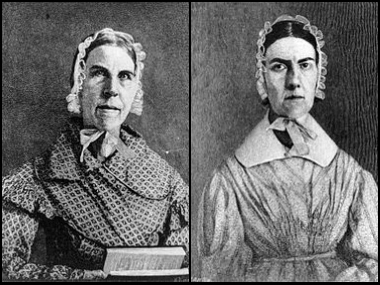
(white) American women could exercise the right to vote. There were many prominent female political figures during the movement to end slavery, leading up to the Civil War. Angelina and Sarah Grimke were two abolitionists from South Carolina. They made speeches to mixed audiences in a time when men and women had little to no interaction in public spheres. The
Grimke sisters (subscription required) were the first women agents of the American Anti-Slavery Society. They would travel and proselytise in the north, drawing larger and larger crowds. [caption id=“attachment_3091856” align=“alignleft” width=“380”] The Grimke Sisters — Angelina (right) and Sarah — were the first women agents of the American Anti-Slavery Society. Image courtesy: Wikimedia Commons[/caption] These two women attracted large crowds of interested female abolitionists. One can argue that these meetings between women in public and politicised forums contributed to the early feminist movement in the US. A clear tactic in suppressing dissent is the criminalisation of such meetings. When women started congregating, they started accumulating political power. Women were actively encouraged to participate in the abolition movement — to a point. The prominent abolitionist organizations made a concerted effort to reach out to women. With such prominent orators and communicators as the Grimke sisters, women were emboldened to clamor for change. However, women still faced discrimination within the abolition movement. Even in the most radical circles, and the abolitionist movement was certainly radical in its nascent stages, women are often marginalised. Even within the Black Lives Movements, we’ve seen many women attempting to correct for this sort of discrimination. Efforts such as the #sayhername campaign attempt to bring more attention to the many black women who are victims of police brutality and state violence. Women often fight alongside men to end oppression and discrimination in its many forms and then find themselves sidelined when they demand rights of their own. In this vein, the Grimke sisters faced persecution for being outspoken women. Angelina Grimke often found herself defending her right to speak in a public forum to men in the movement. Other early abolitionists and feminists, like Elizabeth Cady Stanton and Lucretia Mott, were refused seats at the World Anti-Slavery Convention because they were women. The next widespread political movement where women participated in large numbers was the temperance movement.
Women were instrumental in ushering in the prohibition of alcohol. Of course, this social experiment ended up being a failure, but women were galvanised when they saw their husbands squander away money and mistreat women due to alcohol. This was the first time in US history where we saw women organising en masse. Women formed coalitions like the National Prohibition Party and the Women’s Christian Temperance Union. Coalitions and forums for public debate are the beginnings for any accumulation of political capital. When people speak and agree about an issue, they have the power to bend the state to their will. It is not a small accomplishment to get a Constitutional amendment passed, especially when your coalition does not have the vote to pressure lawmakers, but women did it twice: first for prohibition, and later for women’s suffrage. In 1920, the 19th amendment passed, finally enfranchising women. Suddenly, half the electorate became eligible to vote. Women were now courted as a significant voting bloc. Women’s enfranchisement has been linked to more social welfare policies. The passage of the 19th amendment and the
women’s vote arguably ushered in the Progressive era, during which the social safety net was constructed. Amid arguments for female representation in legislative and judicial bodies, it is important to remember that it’s rank-and-file women who hold the power to change the world. It is important that we fight for changes, small and large in our own lives and communities. True power exists in mutual aid and interest. Social change comes from the streets and from the people, and in these dark times, this truth should be a flickering light, for women and for all.
Women’s political capital has waxed and waned at different points in US history. In light of the fact that America might soon be electing a woman president, it is worth learning a bit more about women’s accumulation of political power through US.history.
Advertisement
End of Article


 "Charlie Kirk, shot dead in Utah, once said gun deaths are 'worth it' to save Second Amendment")
 "From governance to tourism, how Gen-Z protests have damaged Nepal")
 "Did Russia deliberately send drones into Poland’s airspace?")
 "Netanyahu ‘killed any hope’ for Israeli hostages: Qatar PM after Doha strike")
 "Charlie Kirk, shot dead in Utah, once said gun deaths are 'worth it' to save Second Amendment")
 "From governance to tourism, how Gen-Z protests have damaged Nepal")
 "Did Russia deliberately send drones into Poland’s airspace?")
 "Netanyahu ‘killed any hope’ for Israeli hostages: Qatar PM after Doha strike")



