

 "Saddam Hussein still haunts United States, 10 years after his execution")
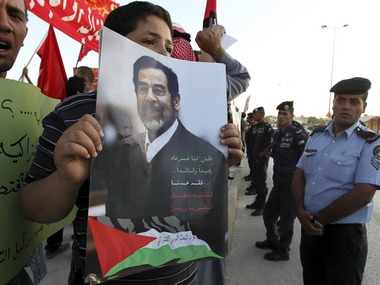
Ten years after Saddam Hussein’s execution, the ghost of the Iraqi strongman still haunts America, serving as a potent reminder of its broken ambitions to bring stability and democracy to the Middle East. When Saddam was hung in Baghdad on 30 December, 2007, then president George W Bush already knew that the invasion of Iraq, which had already left 3,000 US forces dead, had not yielded the progress Washington sought. “Many difficult choices and further sacrifices lie ahead. Yet the safety and security of the American people require that we not relent in ensuring that Iraq’s young democracy continues to progress,” Bush said at the time. The democratic Iraq that Bush had envisioned turned out to be little more than a pipe dream, with the Americans failing to stop the deadly spiral of sectarian violence in the country. [caption id=“attachment_335834” align=“alignleft” width=“380”] A boy holds a picture of late Iraqi President Saddam Hussein. File photo. Reuters[/caption] The Sunni minority that once ruled Iraq grew increasingly resentful toward a predominantly Shiite government — a resentment that helped fuel the rise of the ultra-radical Islamic State group that counts former Saddam military officials in its ranks. More than 5,000 US soldiers are still on the ground providing critical support to an Iraqi army still unable to alone man a war against the violent extremist fighters. The American public, which once gave strong support to the 2003 US-led invasion, is still recovering from the trauma of war. The failures in Iraq heavily influenced US President Barack Obama’s decision not to intervene militarily against Syrian President Bashar al-Assad in the country’s bloody civil war that will soon stretch into its sixth year. Meanwhile, Obama’s successor Donald Trump built his presidential campaign in part on pledges that the United States would never again engage in “regime change” or “nation building.” Trump also said repeatedly that unlike his opponent Democrat Hillary Clinton, he was against the war in Iraq — despite telling radio personality Howard Stern in a 2002 interview that he would support an invasion. ‘Clueless’ More than a decade later, some American policy-makers are still trying to understand the reasons for the failure. John Nixon, the first CIA analyst to interrogate Saddam after his capture in December 2003, says in a new book that US intelligence and White House officials had mistaken views of the Iraqi leader. Far from being an all-powerful dictator, Saddam during his last years in power “seemed clueless about what had been happening inside Iraq,” Nixon wrote in a recent newspaper column ahead of the Thursday release of “Debriefing the President: The Interrogation of Saddam Hussein.” “He was inattentive to what his government was doing, had no real plan for the defense of Iraq and could not comprehend the immensity of the approaching storm,” Nixon said. “Saddam was busy writing novels in 2003. He was no longer running the government.” Complex picture But top US officials firmly believed that toppling Saddam’s Baathist regime would lead to peace in Iraq, Nixon said. Nixon tells a story of briefing Bush in the Oval Office in 2007, an exchange that perhaps underscores why the US was doomed to fail in Iraq. Bush asked Nixon to describe Saddam’s character. “I told him that he was disarming at first and used self-deprecating wit to put you at ease,” he said. “The president looked as if he was going to lose his cool. I quickly explained that the real Saddam was sarcastic, arrogant and sadistic, which seemed to calm Bush down.” Bush “blamed the agency (CIA) for everything that went wrong and called its analysis ‘guesswork,’ while hearing only what he wanted to hear,” Nixon said. The former analyst paints a complex picture of Saddam as a brutal dictator who through methods like murder, threats and intimidation was nevertheless able to achieve an equilibrium in ethnically diverse Iraq. “Although I found Saddam to be thoroughly unlikable, I came away with a grudging respect for how he was able to maintain the Iraqi nation as a whole for as long as he did,” according to an excerpt of Nixon’s book published in Time. “It is improbable that a group like ISIS would have been able to enjoy the kind of success under his repressive regime.”
Ten years after Saddam Hussein’s execution, the ghost of the Iraqi strongman still haunts America, serving as a potent reminder of its broken ambitions to bring stability and democracy to the Middle East.
Advertisement
End of Article


 "Charlie Kirk, shot dead in Utah, once said gun deaths are 'worth it' to save Second Amendment")
 "From governance to tourism, how Gen-Z protests have damaged Nepal")
 "Did Russia deliberately send drones into Poland’s airspace?")
 "Netanyahu ‘killed any hope’ for Israeli hostages: Qatar PM after Doha strike")
 "Charlie Kirk, shot dead in Utah, once said gun deaths are 'worth it' to save Second Amendment")
 "From governance to tourism, how Gen-Z protests have damaged Nepal")
 "Did Russia deliberately send drones into Poland’s airspace?")
 "Netanyahu ‘killed any hope’ for Israeli hostages: Qatar PM after Doha strike")



