

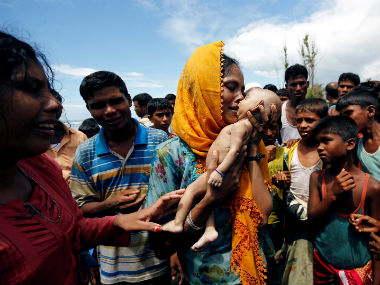
 "Rohingya crisis: Tracing the tumultuous history of world's largest stateless population")
Bangkok, Thailand: Nearly 400,000 Rohingya Muslims have fled renewed violence in Myanmar, crossing the border in Bangladesh in waves following a military crackdown the United Nations says amounts to ethnic cleansing. It is the latest chapter in a long and tumultuous history of the Rohingya, the world’s largest stateless population. Before the most recent surge of violence, there were over one million Rohingyas in Myanmar’s restive Rakhine state. But the questions of who they are, how many live in Myanmar and when they arrived is hotly disputed, highly emotive and behind much of the current unrest. Many of the Muslim minority trace their lineage in Myanmar back generations, but were effectively stripped of their citizenship by the former junta and are demonised among the Buddhist-majority population as illegal immigrants. [caption id=“attachment_4050253” align=“alignleft” width=“380”] Representational image. Reuters[/caption] Here is a brief history of Myanmar’s Rohingya Muslims When did they first arrive in Myanmar? By some accounts, they are descendants of Arab, Turkish or Mongol traders and soldiers who in the 15th Century migrated to Rakhine state, previously called the Kingdom of Arakan. Other historians say they emigrated from Bangladesh in several waves, a widely held view among most Burmese. For centuries the small Muslim minority lived peacefully alongside Buddhists in the independent kingdom, some were even advisors to Buddhist royals, according to historians. Upheaval ensued from the late 18th century. In 1784 the kingdom was conquered by the Burmese and later by the British following the first Anglo-Burmese war of 1824-1826. Under British rule, a large number arrived to work as farmers and later as military recruits. “In the 1830s there was a massive influx of Muslim peasants from neigbouring Bengal, mostly to work in the agriculture sector,” said Sophie Boisseau du Rocher, Southeast Asia expert at the French Institute for International Relations. By 1912, more than 30 percent of the population of Arakan state were Muslim, up from five percent in 1869, according to British census data cited by historian Jacques Leider. When did tensions start? Tensions between the Rohingya Muslims and the Buddhist majority date back to the beginning of British rule in 1824. As part of their divide-and-rule policy, British colonists favoured Muslims at the expense of other groups. They recruited them as soldiers during World War II, pitting them against Buddhists aligned with the Japanese as the war played out on Burmese soil. “Both armies, British and Japanese, exploited the frictions and animosity in the local population to further their own military aims,” said Moshe Yegar, author of a book about Muslim communities in Southeast Asia. Their status was fortified in 1947 when a new Constitution was drafted, enshrining them with full legal and voting rights, which would be later stripped and render them stateless. Rakhine has a poverty rate nearing 80 percent, double the national average, kindling resentments over ethnic claims to the area. What happened under the junta? A 1962 military coup ushered in a new era of repression and brutality. The country’s ethnic minorities like the Rohingya did not fare well. Most were effectively rendered stateless in 1982 when the junta issued a new law on citizenship, requiring minorities to prove they lived in Myanmar prior to the first Anglo-Burmese war in 1823 to obtain nationality. After the junta was dissolved in 2011, the country saw a rise in Buddhist extremism which further sidelined the Rohingya and marked the beginning of the latest era of tensions. The 20th century saw a series of military crackdowns against the group: in 1978 and 1991-1992, which prompted hundreds of thousands to flee to Bangladesh. Some were sent back by Dhaka, and the United Nations questioned the supposedly “voluntary” nature of the repatriations. What’s behind the latest violence? They have been subjected to restrictions on movement, employment and access to basic services since another outbreak of violence in 2012. Tensions mounted again in October 2016, when a small and previously unknown militant group, the Arakan Rohingya Salvation Army (ARSA), staged a series of deadly attacks on Burmese military forces. The army responded with a massive security crackdown, sparking a new wave of refugee arrivals into Bangladesh. On 25 August, ARSA again launched an early morning attack on army installations in Rakhine, triggering a brutal military campaign in response. An estimated 391,000 Rohingya have fled to Bangladesh in the last three weeks, according to the United Nations, which has said the military crackdown amounts to ethnic cleansing of Rohingya Muslims.
Nearly 400,000 Rohingya Muslims have fled renewed violence in Myanmar, crossing the border in Bangladesh in waves following a military crackdown the United Nations says
Advertisement
End of Article

 "‘I’d love to do it’: Trump refuses to rule out third term — despite constitutional limit")
 "What is the ‘Golden Fleet’ of navy ships that Trump wants to counter China with?")
 "‘Ramayan country’: Why Trinidad and Tobago wants to build a large Ram temple")
 "How China's rare earths choke changed America's trade deals")
 "‘I’d love to do it’: Trump refuses to rule out third term — despite constitutional limit")
 "What is the ‘Golden Fleet’ of navy ships that Trump wants to counter China with?")
 "‘Ramayan country’: Why Trinidad and Tobago wants to build a large Ram temple")
 "How China's rare earths choke changed America's trade deals")



