

 "NATO gives up Afghanistan, what's next on its platter?")
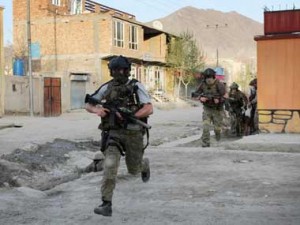
NATO put on a brave face at its Chicago summit but the reality is that the alliance has been weakened by the euro zone crisis and faces an identity crisis about what its role will be once it ends its intervention in Afghanistan in 2014. [caption id=“attachment_317227” align=“alignleft” width=“300” caption=“NATO will hand over controls of Afghanistan to its own security forces.”]  [/caption] NATO leaders sealed a landmark agreement to hand control of Afghanistan over to its own security forces by the middle of next year, putting the Western alliance on an “irreversible” path out of the unpopular, decade-long war. The big question mark hanging over the summit was how will NATO, a 28-nation grouping originally designed for the Cold War, adapt to the world beyond 2014? In an era where governments are slashing defense spending to cut budget deficits, the United States is increasingly tilting towards defense challenges in Asia while many of NATO’s other members, preoccupied by economic problems, have little appetite for foreign adventures. That raises the question of whether the United States, which accounts for three-quarters of NATO defense spending, will remain committed to the 63-year-old organization despite its frustrations at European allies’ reluctance to contribute more towards their own defense. “The U.S. has been NATO’s quarterback since the alliance was founded. That’s OK by us, but we’re increasingly concerned that - in light of economic pressures in Europe - we’re going to have to play quarterback, running back, and wide receiver all at the same time. That’s not good for the team,” said a senior U.S. official, speaking on condition of anonymity. SOFT TARGET While the Pentagon is also being forced to cut defense spending - by $487 billion over the next decade - the gap between the United States and its European allies is only likely to widen as many governments see defense as a “soft target” for budget cuts they are being forced into by the debt crisis. Big European nations such as Germany and Britain are sharply cutting defense and only five allies meet NATO’s benchmark of spending 2 percent of their gross domestic product on defense. Belgian Defense Minister Pieter de Crem said he agreed with former U.S. Defense Secretary Robert Gates’s warning last year that NATO risked “collective military irrelevance” unless alliance members acted to reverse declining capabilities. “NATO is a political-military organization for collective defense and one cannot have all the advantages and all the assets without participating or bringing in a fair share,” he told Reuters during the summit. He said the challenge was to have fair burden-sharing between the two sides of the Atlantic “taking into account budgetary constraints.” NATO’s answer to the money shortage is “smart defense,” saving money by sharing equipment and facilities between allies and having countries specialise in different areas of defense. “I think this summit sent a very clear message that the European allies are committed to acquiring the necessary military capabilities in the future, despite the economic crisis, despite declining defense budgets,” NATO Secretary-General Anders Fogh Rasmussen told Reuters in an interview. “We won’t get more money for defense in the very near future - let’s face it … That makes it necessary to do business in a new way and I think multinational cooperation is the way forward,” he said. The summit approved an initial package of 20 multinational projects, including enabling fighter jets to use munitions from various sources and countries and a scheme to pool maritime patrol aircraft from various nations. A broader question being asked in Chicago was what role should NATO have in the future - should it continue to fight fires in different parts of the world or pull in its horns and concentrate on defending its own territory? REINVENTION NATO has reinvented itself several times before. Originally a mutual defense pact that bound North America and Western Europe together during the Cold War, the alliance survived the collapse of the Soviet Union and intervened in wars in the former Yugoslavia during the 1990s. Afghanistan was NATO’s first mission outside its traditional area of operations and its most ambitious. NATO forms the core of the 50-nation International Security Assistance Force that is battling the Taliban in Afghanistan. Last year, with the United States taking a low profile but providing critical capabilities and supplies, Britain and France led a NATO air operation in Libya that helped rebels topple Muammar Gaddafi, a key milestone in the Arab Spring. Czech Defense Minister Alexandr Vondra argued that the crucial issue for the alliance now was not enlargement, or out-of-area operations, but common defense of its member countries. NATO’s article 5 commitment to mutual defense was the “bedrock” that justified NATO in the eyes of its population, he said. Other leaders, like British Prime Minister David Cameron, disagreed that NATO should lower its ambitions and “look inwards.” “I argued, and this summit agreed, that NATO should actually do the opposite,” he told a news conference. “We should look outwards, reassert NATO’s relevance and make sure it is ready and capable to tackle the threats that may lie outside its territory but nonetheless are very real threats to us at home.” Jamie Shea, NATO’s deputy assistant secretary general for emerging security challenges, wrote recently that NATO could soon be an alliance without a major operation under way. While crises could come out of the blue, NATO interventions of the future were unlikely to follow past patterns, he said in an article on the website of the Carnegie Endowment for International Peace think tank. “They are likely to be more spaced out and more focused on air and naval operations than on land deployments,” Shea wrote. “The objectives are more likely to be limited and short-term, involving more intelligence-gathering and special forces, to say nothing of the increased use of robotics and drones in place of soldiers. “Moreover, if Libya is to be the model for the future, not all the allies will decide to participate, particularly in the sharp end of the operation,” he said. Clara O’Donnell, visiting scholar at the Brookings Institution, said the fact that countries traditionally active in NATO operations, such as Poland and the Netherlands, chose not to take part in the Libya operation showed a dwindling desire to show solidarity with other NATO members, reflecting the unpopularity of foreign expeditions in many countries. In a sign that NATO remains a controversial organization, baton-wielding police clashed with anti-war protesters marching on the summit on Sunday while leaders met behind heavy security in a cavernous convention center. Despite the doubts, few see the United States walking away from NATO or the alliance breaking up because Washington knows it can generally count on its European allies in time of crisis and derives valuable political support from them in pursuit of its interests. “Afghanistan will end, some day, it’s not going to be tomorrow, but there’s going to be something else - I can’t predict where, when - and the West is going to need a tool to act and until we find a better one, I’d like to keep the alliance around for a while,” Leo Michel of the Institute for National Strategic Studies at the U.S. National Defense University said in London recently. Reuters
The big question mark hanging over the summit was how will NATO, a 28-nation grouping originally designed for the Cold War, adapt to the world beyond 2014?
Advertisement
End of Article
Written by FP Archives
see more

 "Israel targets top Hamas leaders in Doha; Qatar, Iran condemn strike as violation of sovereignty")
 "Nepal: Oli to continue until new PM is sworn in, nation on edge as all branches of govt torched")
 "Who is CP Radhakrishnan, India's next vice-president?")
 "Israel informed US ahead of strikes on Hamas leaders in Doha, says White House")
 "Israel targets top Hamas leaders in Doha; Qatar, Iran condemn strike as violation of sovereignty")
 "Nepal: Oli to continue until new PM is sworn in, nation on edge as all branches of govt torched")
 "Who is CP Radhakrishnan, India's next vice-president?")
 "Israel informed US ahead of strikes on Hamas leaders in Doha, says White House")



](https://images.firstpost.com/wp-content/uploads/2012/05/NATO_AP_18April1.jpg)