

 "Is China hoodwinking the world on its shrinking trade gap?")
R Jagannathan After two successive blow-ups — the Lehman crisis of 2008 and the euro crisis of 2011 — everyone knows that the world economy will not stabilise unless four things happen: the US consumes less and saves more, China consumes more and saves less, Germany spends more and exports less, and rest of Europe (especially the southern fringe) does the opposite. Put another way, the US has to become a bigger exporter, China and Germany lesser ones. If this does not happen, we are heading for another blowout in the world economy once the artificial pump-priming with easy money ends. [caption id=“attachment_179625” align=“alignleft” width=“380” caption=“China is far from adjusting to the reality that it must export less and grow domestic consumption faster. AFP”] 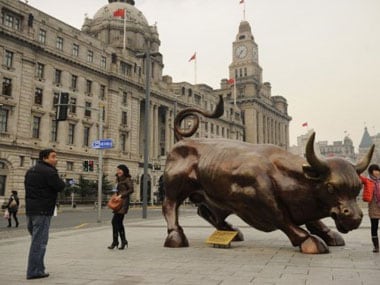 [/caption] While the jury is out on how the euro part of the adjustment will happen – or even whether it will happen at all – figures for China in 2011 show that it has begun lowering its trade surpluses. In 2011, China’s trade surplus – exports minus imports – fell 14.5 percent to $155 billion, reports The Wall Street Journal. If this trend continues for a couple of more years, China will become a less export-dependent economy. As the Journal reports, from 3.1 percent of GDP, the surplus is now 2.2 percent. But a closer look at the numbers put out by the newspaper shows that nothing fundamental has changed in China’s export policy. If the US-China trade gap was the world’s fundamental imbalance, the 2001 figures show that it is getting worse. China’s surplus with the US actually went up to $202 billion from $181 billion in the 2010. The dollar’s strength has obviously not helped. But look at a different set of numbers, and the reasons become clear: despite a slowing economy, China has been importing more and more raw materials like iron ore and copper. This is a key reason why its trade surplus is shrinking. In fact, China is running a trade deficit with commodity exporters like Australia ($48.81 billion) and Brazil ($20.52 billion) and this partly explains the drop in the trade surplus. So what’s China really up to? There could be two reasons for this. One, China is trying to lower the trade surplus by buying commodities when they are cheap. Two, by investing in commodities, China is actually deploying its foreign exchange reserves in real assets instead of just the dollar. Huge purchases of raw materials like iron ore and copper, when the real estate and construction sectors are down, cannot otherwise be explained easily. China is far from adjusting to the reality that it must export less and grow domestic consumption faster. Is it trying to pull over the world’s eyes?
China’s trade surpluses are shrinking. Does this mean China is consuming more and exporting less. Not quite.
Advertisement
End of Article
Written by The Business Blog
The Business Blog is a daily business blog anchored by Firstpost senior editors. It will offer quick comments and insights into major business news developments from the pink press. see more

 "Israel targets top Hamas leaders in Doha; Qatar, Iran condemn strike as violation of sovereignty")
 "Nepal: Oli to continue until new PM is sworn in, nation on edge as all branches of govt torched")
 "Who is CP Radhakrishnan, India's next vice-president?")
 "Israel informed US ahead of strikes on Hamas leaders in Doha, says White House")
 "Israel targets top Hamas leaders in Doha; Qatar, Iran condemn strike as violation of sovereignty")
 "Nepal: Oli to continue until new PM is sworn in, nation on edge as all branches of govt torched")
 "Who is CP Radhakrishnan, India's next vice-president?")
 "Israel informed US ahead of strikes on Hamas leaders in Doha, says White House")



](https://images.firstpost.com/wp-content/uploads/2012/01/chinatrade1.jpg)