

 "'Fanatical and disciplined': Islamic State troops trained to fight to the death")
Baghdad: Bearded and wearing bright blue bandanas, the Islamic State group’s “special forces” unit gathered around their commander just before they attacked the central Syrian town of al-Sukhna. “Victory or martyrdom,” they screamed, pledging their allegiance to God and vowing never to retreat. The IS calls them “Inghemasiyoun,” Arabic for “those who immerse themselves.” The elite shock troops are possibly the deadliest weapon in the extremist group’s arsenal: Fanatical and disciplined, they infiltrate their targets, unleash mayhem and fight to the death, wearing explosives belts to blow themselves up among their opponents if they face defeat. They are credited with many of the group’s stunning battlefield successes — including the capture of al-Sukhna in May after the scene shown in an online video released by the group. “They cause chaos and then their main ground offensive begins,” said Redur Khalil, spokesman of the U.S.-backed Kurdish People’s Protection Units, which have taken the lead in a string of military successes against the IS in Syria. [caption id=“attachment_2333108” align=“alignleft” width=“380” class=" “] 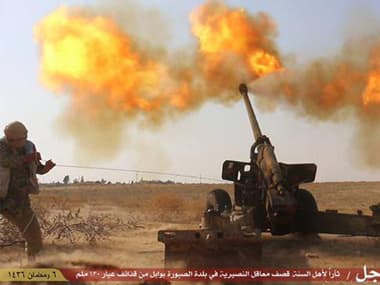 In this photo released on June 23, 2015, by a website of Islamic State militants, an Islamic State militant fires artillery against Syrian government forces in Hama city, Syria. AP[/caption] Though best known for its horrific brutalities — from its grotesque killings of captives to enslavement of women — the Islamic State group has proved to be a highly organized and flexible fighting force, according to senior Iraqi military and intelligence officials and Syrian Kurdish commanders on the front lines. Its tactics are often creative, whether it’s using a sandstorm as cover for an assault or a lone sniper tying himself to the top of a palm tree to pick off troops below. Its forces nimbly move between conventional and guerrilla warfare, using the latter to wear down their opponents before massed fighters backed by armored vehicles, Humvees and sometimes even artillery move to take over territory. The fighters incorporate suicide bombings as a fearsome battlefield tactic to break through lines and demoralize enemies, and they are constantly honing them to make them more effective. Recently, they beefed up the front armor of the vehicles used in those attacks to prevent gunfire from killing the driver or detonating explosives prematurely. Those strategies are being carried over into new fronts as well, appearing in Egypt in last week’s dramatic attack by an IS-linked militant group against the military in the Sinai Peninsula. Andreas Krieg, a professor at King’s College London who embedded with Iraqi Kurdish fighters last fall, said IS local commanders are given leeway to operate as they see fit. They “have overall orders on strategy and are expected to come up with the most efficient ways of adapting it,” he said. The group “is very much success oriented, results oriented.” That’s a strong contrast to the rigid, inefficient and corrupt hierarchies of the Iraqi and Syrian militaries, where officers often fear taking any action without direct approval from higher up. IS fighters are highly disciplined — swift execution is the punishment for deserting battle or falling asleep on guard duty, Iraqi officers said. The group is also flush with weaponry looted from Iraqi forces that fled its blitzkrieg a year ago, when IS overtook the northern city of Mosul and other areas. Much of the heavy weapons it holds — including artillery and tanks — have hardly been used, apparently on reserve for a future battle. Iraqi army Lt. Gen. Abdul-Wahab al-Saadi said IS also stands out in its ability to conduct multiple battles simultaneously. “In the Iraqi army, we can only run one big battle at a time,” said al-Saadi, who was wounded twice in the past year as he led forces that retook the key cities of Beiji and Tikrit from IS. Even the group’s atrocities are in part a tactic, aimed at terrorizing its enemies and depicting itself as an unstoppable juggernaut. In June 2014, the group boasted of killing hundreds of Shiites in Iraq’s security forces, issuing photos of the massacre. It regularly beheads captured soldiers, releasing videos of the killings online. It is increasing the shock value: Recent videos showed it lowering captives in a cage into a pool to drown and blowing off the heads of others with explosive wire around their necks. The number of IS fighters in Iraq and Syria is estimated between 30,000 to 60,000, according to the Iraqi officers. Former army officers of ousted Iraqi dictator Saddam Hussein have helped the group organize its fighters, a diverse mix from Europe, the United States and Arab and Central Asian nations. Veteran jihadis with combat experience in Afghanistan, Chechnya or Somalia have also brought valuable experience, both in planning and as role models to younger fighters. “They tend to use their foreign fighters as suicide bombers,” said Patrick Skinner, a former CIA officer who now directs special operations for The Soufan Group, a private geopolitical risk assessment company. “People go to the Islamic State looking to die, and the Islamic State is happy to help them.” The group’s tactics carried it to an overwhelming sweep of northern and western Iraq a year ago, capturing Mosul, Iraq’s second-biggest city. Shortly thereafter, IS leader Abu Bakr al-Baghdadi declared a “caliphate” spanning its territory in Iraq and Syria. In May, it captured Ramadi, capital of Iraq’s vast western Anbar province, in a humiliation for Iraqi forces. In Syria, it seized the central city of Palmyra. The elite shock troops were crucial in the capture of Ramadi. First came a wave of more than a dozen suicide bombings that hammered the military’s positions in the city, then the fighters moved in during a sandstorm. Iraqi troops crumbled and fled as a larger IS force marched in. “The way they took Ramadi will be studied for a while,” Skinner said. “They have the ability to jump back and forth between traditional (military operations) and terrorism.” He said a similar combination of suicide bombings ahead of ground forces was used in last week’s Sinai attacks in Egypt. Since US-led airstrikes in Syria and Iraq have made it more difficult for the group’s forces to advance, IS has lost ground. Iraqi troops and Shiite militiamen retook areas to the south and northeast of Baghdad, the oil refinery city of Beiji and Saddam Hussein’s hometown of Tikrit north of the capital. In Syria, Kurdish fighters backed by heavy U.S. airstrikes wrested the border town of Kobani from the IS after weeks of devastating battles. More recently, IS lost Tal Abyad, another Syrian town on the Turkish border. Despite that loss, IS shock troops attacked Kobani last month. Around 70 of them infiltrated and battled a much larger Kurdish force for two days, apparently on a mission not to retake the town but to cause chaos. They were all slain, but not before killing more than 250 civilians, including roughly 100 children, and more than 30 Kurdish fighters. At the same time, they attacked the northeast Syrian city of Hassakeh, driving out thousands of people and still holding out in parts of the city despite continued fighting. Last week, they carried out a bloody incursion into Tal Abyad, again fighting until they were all killed but demonstrating their relentlessness. “We are still nursing our wounds in Kobani,” said Ghalia Nehme, a Syrian Kurdish commander who fought in last month’s battle. “From what we saw, they weren’t planning to leave alive. It seems they were longing for heaven,” she said. The use of suicide bombings has forced IS’s opponents to adapt. Al-Saadi defied his own Iraqi military commanders who demanded a fast assault to retake Beiji. Instead, he adopted a slow, methodical march from a base near Tikrit, moving only a few miles each day while clearing roads of explosives and setting up barriers against suicide attacks. It took him three weeks to go 25 miles to Beiji, fighting the whole way and fending off more than two dozen suicide attacks, then another week to take Beiji, but he succeeded with minimal casualties. IS also has adapted, and recently began using remote controlled aircraft fitted with cameras to film enemy positions. It is believed to have agents within the military. It also has superior communications equipment, using two-way radios with a longer range than the Iraqi military’s, said Maj. Gen. Ali Omran, commander of Iraq’s 5th Division. Omran said that when the extremists figured out the military was listening in on its radio frequencies, it switched to more secure lines but continued using the infiltrated frequencies to feed the military false information. Even IS supply chains are robust. Its fighters’ rations often include grilled meat kebabs and chicken, better than what Iraqi troops eat, Omran said. But IS has its vulnerabilities, noted Skinner. It has no air force. And its open, state-like organization gives an opportunity for spies to infiltrate, something the group clearly fears given the many killings of people it suspects of espionage. It also faces internal strains, trying to control and direct its multi-national personnel. “We think of them as this spooky faceless organization that runs seamlessly,” Skinner said. “I imagine it’s probably the hardest organization to run, because it’s staffed with unstable, violent people.” AP
Bearded and wearing bright blue bandanas, the Islamic State group’s “special forces” unit gathered around their commander just before they attacked the central Syrian town of al-Sukhna. “Victory or martyrdom,” they screamed, pledging their allegiance to God and vowing never to retreat.
Advertisement
End of Article
Written by FP Archives
see more

 "Israel targets top Hamas leaders in Doha; Qatar, Iran condemn strike as violation of sovereignty")
 "Nepal: Oli to continue until new PM is sworn in, nation on edge as all branches of govt torched")
 "Who is CP Radhakrishnan, India's next vice-president?")
 "Israel informed US ahead of strikes on Hamas leaders in Doha, says White House")
 "Israel targets top Hamas leaders in Doha; Qatar, Iran condemn strike as violation of sovereignty")
 "Nepal: Oli to continue until new PM is sworn in, nation on edge as all branches of govt torched")
 "Who is CP Radhakrishnan, India's next vice-president?")
 "Israel informed US ahead of strikes on Hamas leaders in Doha, says White House")



](https://images.firstpost.com/wp-content/uploads/2015/07/ISLAMICSTATE_380.jpg)