

 "Your govt is asking YouTube to remove your videos and you don't even know about it")
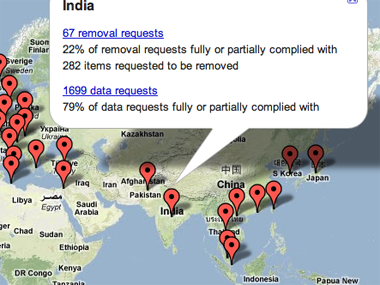
By Shivam Vij After reporting Google Transparency Tools’ latest revelations about how much India asks Google to delete content and pass government agencies private user data, Firstpost writes, “To put all this in its proper perspective, Indians still enjoy robust Internet freedom – and occasionally even an excess of freedoms…” And then it goes on to compare internet freedom with China, assuring all is well with the world. There is no such thing as excess freedom – There is a way to deal with the “scurrilous postings and videos” the article talks about. It’s called the law. I write an article in a newspaper that is seen as “scurrilous”. The offending party will go to court. The court will decide if it is scurrilous enough to violate the law of the land (be it defamation, libel, or whatever) and summon me. I get a chance to defend myself. [caption id=“attachment_33926” align=“alignleft” width=“380” caption=“Photo credit: Shivam Vij”] 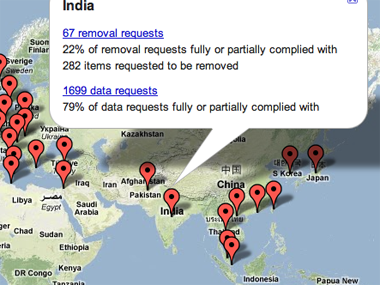 [/caption] But what Google Transparency Tools reveals is that different central and state governments and their various departments (we don’t know exactly who) have been asking Google to remove content they deem to be scurrilous. Since we don’t even know what this content is, we can’t say whether it really is scurrilous. Google started putting out such data at its ‘Internet at Liberty’ conference in Budapest in September 2010. They released worldwide data about the period July-December 2009. This massive conference was held because Google wanted to candidly share this problem with us. While Google did not want to infringe upon the rights and privacy of its users, governments across the world, even the most avowedly democratic ones, were forcing it to do so. They wanted ideas from the 400 policy wonks and bloggers they had invited about how they could deal with this. This honest attitude showed poorly on other internet companies by contrast – such as Facebook, whose sole representative was pilloried with a lot f hard questions. As one of the bloggers in attendance, I was happy to add to those questions. But when Google’s very honest and convincing man for public policy, Bob Boorstin, was asked about China, it was clear that surviving in global markets was more important for Google than defending free speech and privacy. “Let’s just say Google has issues in China,” he replied. Google has offices, employees, an advertising programme and services to sell in India, and we can only take Google on face-value when it says, “Whenever we receive a request, we first check to make sure it meets both the letter and spirit of the law before complying. When possible, we notify affected users about requests for user data that may affect them. And, if we believe a request is overly broad, we will seek to narrow it.” Sure, Google has been accepting fewer and fewer Indian requests — for July-December 2009 it was 77 percent, for January-June 2010 it was 53 percent and data just put out for July-December 2010 says it was 22 percent. But we don’t know what requests were complied to by Google because they do not tell us. The decreasing percentage of removal requests accepted by Google indicates the increasing percentage of requests made by Google that Google thought were invalid under Indian law! And, what exactly does that say about the Indian government? In the latest data for July-December 2010, Google has taken one small step further to tell us about the nature of requests. Our elected, democratic governments asked them to remove 199 YouTube videos, of which 100 were considered defamatory, and only one such was a court order! If we have to allow our government to censor our videos in such a way for alleged defamation, let’s do away with our courts and our (admittedly slow) judicial system. Why, let’s do away with our laws altogether! Before you call me alarmist, let’s examine a Google quote: “We received requests from different law enforcement agencies to remove a blog and YouTube videos that were critical of Chief Ministers and senior officials of different states. We did not comply with these requests.” Such censorship through Google is taking place not just of YouTube videos but of a variety of services, and on a steep rise has been removal of “items” from Google Web Search. This means that your website exists but India has asked Google not to let it appear on a Google search! In the world we live, this has to be rated as the most severe form of censorship. If your website doesn’t turn up on Google search, it does not exist. Story continues on the next page There are “items” being removed from Google Books. We once lived in a world where the government ban on a book by Salman Rushdie that nobody read became a landmark event in Indian politics. Today we live in a world where such censorship happens clandestinely, chori-chori chupke-chupke as it were. We can’t debate its rights and wrongs because we don’t even know which books we are talking about here! [caption id=“attachment_33946” align=“alignleft” width=“380” caption=“Screen grab from Google’s transparency report on India.”] 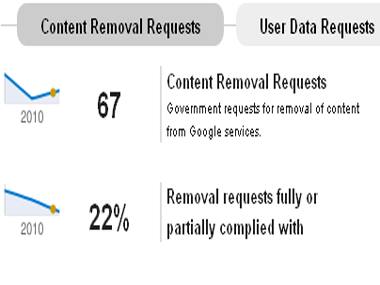 [/caption] Even when Google finds a request lawful and accordingly removes my blog-post, YouTube video or my webpage from its search engine, remember that laws can be misused, applied arbitrarily and in a free world their application is open to challenge in a court of law. Some removal is for impersonation. Consider this: There are two popular twitter accounts, one that impersonates Manmohan Singh and another that impersonates Sonia Gandhi. They have not pictures but cartoons as profile images. They tweet as if they were Manmohan and Sonia, with Manmohan often re-tweeting Sonia like a good sub-ordinate following orders, and they’re most funny. This is obviously not the case of someone misleading the world into thinking it’s actually Manmohan and Sonia tweeting, but who knows, offended Congressmen and women who don’t like the cheeky criticism may think so, and ask for those accounts to be taken down. And that is not the worst. For the same 18 months, Google has also revealed 4,190 “user data requests” — that is, requests made by government authorities to reveal the private data of users. This could include anything and everything except passwords. This could include the Google Account username with which you post on an anonymous or pseudonymous blog; it could mean your private emails, even the ones you did not send out and saved in your drafts folder. Only for the period of July-December 2010 does Google tell us how many of these requests it complied with: 79 percent of 1,699 requests, and each request could have many “items”. If Google’s lawyers did not find over a fifth of such requests to be lawful, it prima facie means there is misuse. Internet users in India have the right and bear the onus to demand more transparency from the government. One problem is that you can’t even file an RTI application and find out what this snooping and censorship actually was. You won’t know where to file an RTI application. For that reason, it is important that all such communication of Indian government agencies with online service companies be routed through one central office — it could be the Law, Information and Broadcasting Ministry or the Information Technology Ministry. Even if a state government has to do it directly, there should be one such nodal office in every state. Such an authority should be mandated by law to publish online, in real time, all such letters sent out by them —the only exception to be made here perhaps is “national security”. A committee should vet which requests would jeopardise national security if they were put out. The government plans to bring in the forthcoming monsoon session of the Parliament a Right to Privacy Bill. This proposed law should take into account that government institutions are asking internet companies like Google for private user data and should bring such communication under its legislative overview to prevent misuse and bring about accountability. On its part Google could help us by giving us a little more detail about the data: for one, it could give us state-wise break-up, so we can check which states are asking for more data and content removal than others. Shivam Vij is a writer and journalist based in Delhi. He is a member of the team blog Kafila.org and tweets as @DilliDurAst.
Our elected, democratic governments asked them to remove 199 YouTube videos, of which 100 were considered defamatory, and only one such was a court order!
Advertisement
End of Article
Written by FP Archives
see more

 "Israel targets top Hamas leaders in Doha; Qatar, Iran condemn strike as violation of sovereignty")
 "Nepal: Oli to continue until new PM is sworn in, nation on edge as all branches of govt torched")
 "Who is CP Radhakrishnan, India's next vice-president?")
 "Israel informed US ahead of strikes on Hamas leaders in Doha, says White House")
 "Israel targets top Hamas leaders in Doha; Qatar, Iran condemn strike as violation of sovereignty")
 "Nepal: Oli to continue until new PM is sworn in, nation on edge as all branches of govt torched")
 "Who is CP Radhakrishnan, India's next vice-president?")
 "Israel informed US ahead of strikes on Hamas leaders in Doha, says White House")



](https://images.firstpost.com/wp-content/uploads/2011/06/india_google.png)
](https://images.firstpost.com/wp-content/uploads/2011/06/googletransparency-report.png)