

 "What Team Anna can learn from Nirma, Sony, Apple and Ford")
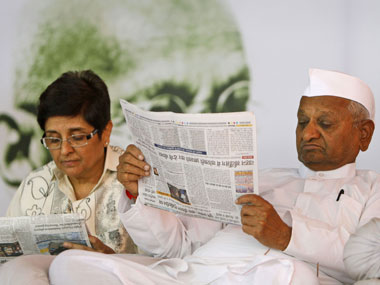
The decision by Team Anna to form a political party has become the butt of jokes on the internet. A Facebook friend suggested that they name their party, the Char Anna Party and someone else suggested the name Kejriwal Liberal Party for Democracy (KLPD). The jokes are clearly in bad taste and reflect the level of cynicism that has seeped into us. Let me paraphrase lines written by my favourite economist John Kenneth Galbraith (borrowed from his book The Affluent Society) to capture this cynicism. “When Indians see someone agitating for change they enquire almost automatically: “What is there for him?” They suspect that the moral crusades of reformers, do-gooders, liberal politicians, and public servants, all their noble protestations notwithstanding, are based ultimately on self interest. “What,” they enquire, “is their gimmick?” The cynicism comes largely from the way things have evolved in the 65 years of independence where the political parties have taken us for a royal ride. Given this, the skepticism that prevails at the decision of Team Anna to form a political party isn’t surprising. Take the case of Justice Markandey Katju, who asked at a CNN-IBN programme: “Which caste will this political party represent? Because unless you represent one caste, you won’t get votes…Whether you are honest or meritorious nobody bothers. People see your caste or religion. You may thump your chest and say you are very honest but you will get no votes.” Former Supreme Court Justice Santosh Hegde said, “Personally, I am not in favour of Annaji floating a political party and contesting elections, which is an expensive affair and requires huge resources in terms of funds and cadres.” Some other experts and observers have expressed their pessimism at the chances of success of the political party being launched by Team Anna. Questions are being raised. Where will they get the money to fight elections from? How will they choose their candidates? What if Team Anna candidates win elections and start behaving like other politicians? [caption id=“attachment_404912” align=“alignleft” width=“380”]  Team Anna is a disruptive innovation which can disrupt the model of the existing political parties in India. There are three things that can happen with this disruptive innovation.AP[/caption] All valid questions. But I remain optimistic despite the fact that things look bleak at this moment for Team Anna’s political party. I look at Team Anna’s political party as a disruptive innovation. Clayton Christensen, a professor of strategy at Harvard Business School is the man who coined this phrase. He defines it as “innovations that transform an existing market or create a new one by introducing simplicity, convenience, accessibility and affordability. It is initially formed in a narrow foothold market that appears unattractive or inconsequential to industry incumbents.” An excellent example of a home-grown disruptive innovation is Nirma detergent. Karsanbhai Patel, who used to work as a chemist in the Geology & Mining Department of the Gujarat government, introduced Nirma detergent in 1969. He first started selling it at Rs 3.50 per kg. At that point of time Hindustan Lever Ltd’s (now Hindustan Unilever) Surf retailed for Rs 15 per kg. The lowest-priced detergent used to sell at Rs 13.50 per kg. The price point at which Nirma sold made it accessible to consumers, who till then really couldn’t afford the luxury of washing their clothes using a detergent and had to use soap instead. If Karsanbhai Patel had thought at the very beginning that Hindustan Lever would crush his small detergent, he would have never gotten around launching it. The same applies to Team Anna’s political party as well. They will never know what lies in store for them unless they get around to launching the party and running it for the next few years. Getting back to Nirma, the logical question to ask is who should have introduced a product like Nirma? The answer is Hindustan Lever, the company which, through the launch of Surf detergent, pioneered the concept of bucket wash in India. But they did not. Even after the launch of Nirma, for a very long time they continued to ignore Nirma, primarily because the price point at which Nirma sold was too low for Hindustan Lever to even think about launching a product. And by the time the MBAs at Hindustan Lever woke up, Nirma had already established itself as a pan-India brand. But, to their credit, they were able to launch the ‘Wheel’ brand, which competed with Nirma directly. At times the biggest players in the market are immune to the opportunity that is waiting to be exploited. A great example is that of Kodak which invented the digital camera but did not commercialise it for a very long time thinking that the digital camera would eat into its photo film business. The company recently filed for bankruptcy. Ted Turner’s CNN was the first 24-hour news channel. Who should have really seen the opportunity? The BBC. But they remained blind to the opportunity and handed over a big market to CNN on a platter. [caption id=“attachment_404917” align=“alignleft” width=“380”] 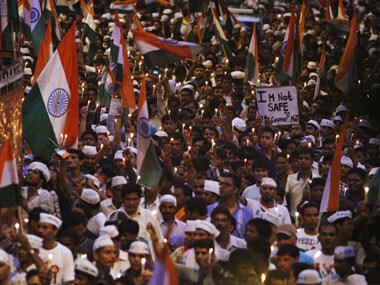 Team Anna political party deserves a chance and should not be viewed with the cynicism and skepticism which seems to be cropping up. AP[/caption] Along similar lines, maybe there is an opportunity for a political party in India which fields honest candidates who work towards eradicating corruption and does not work along narrow caste or regional lines. Maybe the Indian voter now wants to go beyond voting along the lines of caste or region. Maybe he did not have an option until now. And now that he has an option he might just want to exercise it. While there is a huge maybe, the thing is we will never know the answers unless Team Anna’s political party gets around to fighting a few elections. The other thing that works to the advantage of disruptive innovators is the fact that the major players in the market ignore them initially and do not take them as a big enough force that deserves attention. A great example is the Apple personal computer. As Clayton Christensen told me in an interview I carried out for the Daily News and Analysis (DNA) a few years back, “Apple made a wise decision and first sold the personal computer as a toy for children. Children had been non-consumers of computers and did not care that the product was not as good as the existing mainframe and minicomputers. Over time Apple and the other PC companies improved the PC so it could handle more complicated tasks. And ultimately the PC has transformed the market by allowing many people to benefit from its simplicity, affordability, and convenience relative to the minicomputer.” Before the personal computer was introduced, the biggest computer available was called the minicomputer. “But minicomputers cost well over $200,000, and required an engineering degree to operate. The leading minicomputer company was Digital Equipment Corporation (DEC), which during the 1970s and 1980s, was one of the most admired companies in the world economy,” write Clayton Christensen, Michael B Horn and Curtis W Johnson in Disrupting Class —How Disruptive Innovation Will Change the Way the World Learns. But even then DEC did not realise the importance of the personal computer. “None of DEC’s customers could even use a personal computer for the first 10 years it was on the market because it wasn’t good enough for the problems they needed to solve. The more carefully DEC listened to its best customers, the less signal it got that the personal computer mattered — because in fact it didn’t — to those customers,” the authors explain. That DEC could generate a gross profit of $112,500 when selling a minicomputer and $300,000 while selling the much bigger ‘mainframe’ also didn’t help. In comparison, the $800 margin on the personal computer looked quite pale. Another example is Sony. “In 1955, Sony introduced the first battery-powered, pocket transistor radio. In comparison with the big RCA tabletop radios, the Sony pocket radio was tiny and static laced. But Sony chose to sell its transistor radio to non-consumers — teenagers who could not afford big tabletop radio. It allowed teenagers to listen to music out of earshot of their parents because it was portable. And although the reception and fidelity weren’t great, it was far better than their alternative, which was no radio at all,” write Christensen, Horn and Johnson. Sony went onto to come up with other great disruptive innovations like the Walkman and the CDMan. But Sony did not see the rise of MP3 players. The point is that incumbents are so clued in to their business that it is very difficult for them to see the rise of a new category. So what is the learning here for Team Anna? The learning is that their political party may not take the nation by storm all at once. They might appeal only to a section of the voters initially, probably the urban middle class, like Apple PCs had appealed to children and Sony radios to teenagers. So the Team Anna political party is likely to start off with a limited appeal and if that is the case the bigger political parties will not give them much weight initially. Chances are if they stay true to their cause their popularity might gradually go up over the years, as has been the case with disruptive innovators in business. The fact that political parties might ignore them might turn out to be their biggest strength in the years to come. Any disruption does not come as an immediate shift. As the authors write, “Disruption rarely arrives as an abrupt shift in reality; for a decade, the personal computer did not affect DEC’s growth or profits.” Similarly, the Team Anna political party isn’t going to take India by storm overnight. It will need time. Business is littered with examples of companies that did not spot a new opportunity that they should have and allowed smaller entrepreneurial starts up to grow big. The only minicomputer company that successfully made the transition to being a personal computer company was IBM. “They set up a separate organisation in Florida, the mission of which was to create and sell a personal computer as successfully as possible. This organisation had to figure out its own sales channel, it had its own engineers, and it was unencumbered by the existing organization,” said Christensen. But even IBM wasn’t convinced about the personal computer and that is why it handed over the rights of the operating system to Microsoft on a platter. Even disruptive innovators get disrupted. Microsoft did not see the rise of email and it’s still trying to correct that mistake through the launch of Outlook.com. It didn’t see the rise of search engines either. Nokia did not see the rise of smart phones. Google did not see the rise of social media. And Facebook will not see the rise of something else. Years ago, Henry Ford had captured the imagination of America through his Model T automobile. The trouble was that Model T came in just one colour and that was black. Ford, the biggest player in the automobile market, failed to see the rise of General Motors which started to offer cars to customers in different colours and with financing schemes. Team Anna is a disruptive innovation which can disrupt the model of the existing political parties in India. There are three things that can happen with this disruptive innovation. The Team Anna political party tries for a few years and doesn’t go anywhere. That doesn’t harm us in anyway. The party fights elections and is able to build a major presence in the country and stays true to its cause. That benefits all of us. Third, the party fights elections and its candidates win. But these candidates and the party turn out to be as corrupt as the other political parties that are already there. While this will be disappointing, one more corrupt political party is not going to make things more difficult for the citizens of this country in anyway. We are used to it by now. Given these reasons the Team Anna political party deserves a chance and should not be viewed with the cynicism and skepticism which seems to be cropping up. However, they would be wise to note what Nirma, Sony, Apple and others did to find success. Be disruptive. Vivek Kaul is a writer and can be reached at vivek.kaul@gmail.com)
Team Anna is being wrongly panned for trying to become a political party. They should use this skepticism as their greatest strength
Advertisement
End of Article

 "Israel targets top Hamas leaders in Doha; Qatar, Iran condemn strike as violation of sovereignty")
 "Nepal: Oli to continue until new PM is sworn in, nation on edge as all branches of govt torched")
 "Who is CP Radhakrishnan, India's next vice-president?")
 "Israel informed US ahead of strikes on Hamas leaders in Doha, says White House")
 "Israel targets top Hamas leaders in Doha; Qatar, Iran condemn strike as violation of sovereignty")
 "Nepal: Oli to continue until new PM is sworn in, nation on edge as all branches of govt torched")
 "Who is CP Radhakrishnan, India's next vice-president?")
 "Israel informed US ahead of strikes on Hamas leaders in Doha, says White House")



](https://images.firstpost.com/wp-content/uploads/2012/08/teamanna_ap.jpg)
](https://images.firstpost.com/wp-content/uploads/2012/08/ANNASUPPORTERS_AP.jpg)