

 "The Bihar conundrum: How appetite for development works in tandem with caste politics")
by Badri Narayan Indian democracy is full of paradoxes. On one hand there is commitment for development, aspiration for equality and incorporation of election-based State power; on the other hand the construction of democracy and development rests on caste, religion and identity-based people’s plebiscite. The people’s democratic decisions are dynamically motivated and shaped. At times the issue of development may be at forefront, at times caste-religion may take the front seat and at times both hold equal importance. This internal contradiction of democracy and democratic decision-making is clearly visible in Bihar politics. [caption id=“attachment_2477730” align=“alignleft” width=“380”] 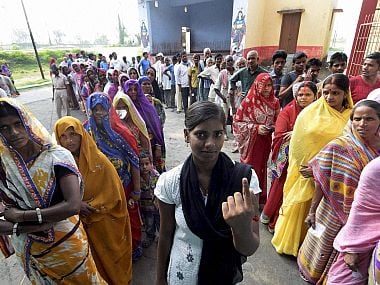 Representational image. PTI[/caption] As we enter Bihar crossing the UP border the roads become smooth and comfortable giving us respite from the rough roads of the other state. On the path of these developed roads, school-going girls dressed up in uniforms cycle their way to school. Many villages are illuminated with solar lights. The Buxar region, located on the UP Bihar border shows signs of development with 16-17 hours of electricity supply. This development of Buxar is a departure from the past. Given the conventional parameters of development in terms of availability of electricity, roads, water, health and education facilities etc., Bihar in comparison to other Hindi-speaking states is better off. But if we pose this development with respect to people’s aspirations - magnified by propagation of democracy, aspiration for better life and well-being - we find it falls short. Thus, we may infer that the module of development that addresses the infrastructural base at a point of time without sustaining a continuous process creates dissatisfaction among people. It becomes evident with empirical regional observations and informal discussions with people in some villages of the state. The people acknowledge that the different development efforts made by the government reflected their aspirations of growth and development in different facets of life. While they admit that the Buxar region has shown remarkable improvement in basic infrastructural base life - defined by electrified roads and villages, smooth running metalled roads etc - they still live in the perception of being in poverty and expect the State to be the deliverer. It is important to mention that poverty here does not imply the material construct of poverty, but the perceived construct. Nayan from Buxar states that though the Nitish government made concerted efforts to develop the state, the sting of poverty remains and seems to be growing. This conceptual understanding of poverty is determined by the process of ever-changing comparative frames that impacts people’s minds, especially that of the subaltern class that is socially and economically marginalised. Interestingly, this state of influenced perception has motivated even the middle class people to term themselves as ‘poor’. Thus, the rift between the rich and the poor has aggravated and the dependence of the classes on the State has gone up. The experience of development in Bihar is full of problems, which fit into a pattern. First, there’s the experience of growth; second; there’s is desire for more; and third, sense of frustration and resentment against the State for its failure to meet aspirations. Where does caste fit into in this construct? It gets a bit complex here. Whenever there is discussion on elections in the rural hamlets or urban suburbs, the pertinent issue is ‘caste’ and not development. Which party would perform better? Who has a better hold in public view? Who will vote whom? All these questions are described and decided from the perspective of ‘caste’. This despite the fact that people accept that the Nitish government has made concrete development efforts that has inculcated among general mass a sense of self-confidence and put a check on major scams. Despite his image as a development-oriented and progressive person Nitish Kumar and his party, JD(U) stand on the support of some Mahadalit caste categories, some Koris, Kurmis and other middle order caste groups apart from the support of some general caste groups. The Yadav-Muslim equation determines the strong political base of Lalu Yadav. While a major chunk of the population of Bihar believes that the Lalu regime had been a major impediment in the development of Bihar, he still commands good loyalty among his caste and beyond it. Though people at large believe Nitish Kumar is the person who can lead the state to development, his victory is going to be determined by his alliance with Lalu, who banks on caste. Caste politics runs in atypical manner. The general caste groups vote in favour of the BJP while the vote of the higher castes among the general category like the Brahmins gets bifurcated between the BJP and the Congress. The reservation controversy which arose from Mohan Bhagwat’s statement for reviewing reservation sharply polarised this election on backward forward line. Two phases of polling have already passed. Political analysts find this election a ‘caste plus election’ in which caste goes with development aspiration and Bihari swabhiman. The ‘Bihari and Bahari’ slogan is also popular in public discussions in villages, quasbas and chai pattis. The Jitan Ram Manjhi factor is being discussed in this elections. He may get five percent of the Mahadalit votes, especially of the Mushsahars. Amongst the 19 Mahadalit groups of Bihar, the Mushashars have emerged as a major political caste category. This caste has in the recent past been rampantly politicised. This caste has been targeted widely by the Nitish-Lalu government in the name of improving social justice. Many of their MLAs, panchayat pradhans and social leaders hail from this caste. But this caste support alone cannot ensure Manjhi’s success in the Vidhan Sabha elections. Therefore, Manjhi faces the challenge to evolve people’s confidence from the Mahadalit community to form his ‘fundamental political base’ and eventually work to incorporate public confidence from other middle order caste groups or high castes. Thus, he will have to work to evolve a “winning social and caste equation. It is paradoxical yet interesting to see that development-centered democracy and so called democratic decision still seems to be guided and influenced by ‘caste power’. Fundamentally development is a double-edged sword. On one side it tries to fulfill people’s aspirations while on the other it creates demand for new aspirations. In such situation, ‘caste sentiments’ try to remove the imbalance in development aspirations. This process is ever true for all parties and all electives. In the contemporary elections in Bihar it is eminently visible. Badri Narayan is a Professor at Jawaharlal University, Delhi
The experience of development in Bihar is full of problems, which fit into a pattern. First, there’s the experience of growth; second; there’s is desire for more; and third, sense of frustration and resentment against the State for its failure to meet aspirations.
Advertisement
End of Article
Written by FP Archives
see more

 "Israel targets top Hamas leaders in Doha; Qatar, Iran condemn strike as violation of sovereignty")
 "Nepal: Oli to continue until new PM is sworn in, nation on edge as all branches of govt torched")
 "Who is CP Radhakrishnan, India's next vice-president?")
 "Israel informed US ahead of strikes on Hamas leaders in Doha, says White House")
 "Israel targets top Hamas leaders in Doha; Qatar, Iran condemn strike as violation of sovereignty")
 "Nepal: Oli to continue until new PM is sworn in, nation on edge as all branches of govt torched")
 "Who is CP Radhakrishnan, India's next vice-president?")
 "Israel informed US ahead of strikes on Hamas leaders in Doha, says White House")



](https://images.firstpost.com/wp-content/uploads/2015/10/Bihar-polling-PTI2.jpg)