

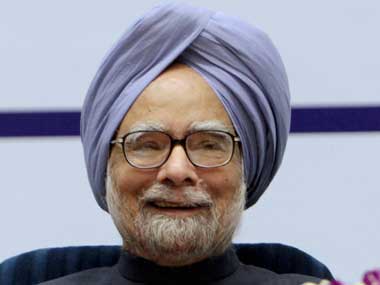
 "Rupee, inflation, BJP: How Manmohan cracked the best joke")
Rhetoric, of any kind, needs to be delivered with a lot of passion.
When it is delivered in the deadpan style of our Prime Minister Manmohan Singh, it usually turns out to be a damp squib or comic (depends on how you look at it), like was the case with his speech in the Rajya Sabha yesterday.
In this speech, Singh, tried to explain why the rupee has been falling against the dollar, among other things. As Singh put it “we must realise that part of this depreciation was merely a needed adjustment. Inflation in India has been much higher than in the advanced countries. Therefore, it is natural that there has to be a correction in the exchange rate to account for this difference.”
That’s a valid explanation as far as the depreciation of the rupee goes. To be fair, you’d expect an Oxford-educated economist to be able to do at least that. But what the explanation does not tell us, where did the inflation come from in the first place?
[caption id=“attachment_1075137” align=“alignleft” width=“380”] Manmohan Singh in this file photo. PTI[/caption]
You and me did not create inflation. Singh’s government did. India has been battling high levels of consumer price inflation for sometime now. This has happened largely on account of the government increasing minimum support prices(MSPs) by a huge amount. As economist Surjit Bhalla writes in a column in The Indian Express “As commented by me on several occasions over the last three years, this high food inflation was literally engineered by the UPA government via massive increases in procurement prices.”
Every year the Food Corporation of India (FCI), or a state agency acting on its behalf, purchases rice and wheat at MSPs set by the government. With the government offering increasing the MSPs, more and more of rice and wheat landed up at the godowns of the FCI and not the open market. A December 2012, , which comes under the Ministry of Agriculture points out “Since 2006-07, the procurement levels for rice and wheat have increased manifold…Currently, piling stocks of wheat with FCI has led to an artificial shortage of wheat in the market in the face of a bumper crop.”
This has led to a massive food inflation and in turn very high consumer price inflation because food constitutes nearly 50 percent of it. The irony is that no specific formula has been followed for deciding the minimum support prices. The Comptroller and Auditor General (CAG) of India in a recent report titled “ Performance Audit of Storage Management and Movement of Food Grains in Food Corporation of India (FCI)" questioned the logic behind how the MSPs are being set .
The report was presented to the Parliament on 7 May,2013. As the report points out “No specific norm was followed for fixing of the Minimum Support Price (MSP) over the cost of production. Resultantly, it was observed the margin of MSP fixed over the cost of production varied between 29 per cent and 66 per cent in case of wheat, and 14 per cent and 50 per cent in case of paddy during the period 2006-2007 to 2011-2012. Increase in MSP had a direct bearing on statutory charges levied on purchase of food grains by different State Government… All this resulted in rising of the acquisition cost of food grains.” To cut a long story short, inflation did not appear on its own, Singh’s government engineered it.
Singh also pointed out that the rupee was not the only currency falling against the dollar, but there were other currencies as well. As he said “However, foreign exchange markets have a notorious history of overshooting. Unfortunately this is what is happening not only in relation to the Rupee but also other currencies.”
Fair point. But the question Singh did not answer was why has the rupee fallen far more than these ‘other’ currencies that he is referring to? A report on the Reuters website published yesterday morning points out that “The rupee has tumbled 10.4 percent against the dollar so far this month, which would be its largest monthly depreciation ever if it ends around current levels, according to Thomson Reuters data.” In comparison “the Indonesian rupiah has lost 5.9 percent so far in August, which would be its biggest monthly fall since November 2008.” The Philippine peso has fallen 2.7 percent. The Thai baht has slid 2.4 percent and the Malaysian ringgit has weakened 1.6 percent.
Our Oxford educated economist did not tell us why the Indian rupee has fallen much more against the dollar than other emerging market countries in Asia. The rupee crisis is largely a _desi._We are paying the cost of running a high current account deficit over the last few years. (You can read a detailed argument here ).
Singh also tried to set aside the concerns being raised about the ability of the government to meet its fiscal deficit target of 4.8 percent of GDP, that it had set for this financial year (ie the period between April 1, 2013 and March 31, 2014). Fiscal deficit is the difference between what a government earns and what it spends. As Singh said “There are questions about the size of the fiscal deficit. The government will do whatever is necessary to contain the fiscal deficit to 4.8 percent of GDP this year.”
Now the least one could expect from an Oxford educated economist is to explain what is this “whatever”? Does the Prime Minister plan to rein in the fiscal deficit by raising diesel prices? The latest available data on the under-recovery on diesel was published on 16 August, 2013. The under-recovery on diesel was around Rs 10.22 per litre. At that point of time the price of crude oil was at Rs 6680.46 per barrel (around 159 litres). Since then the price of crude oil has gone up to Rs 7723.68 per barrel as on 29.08.2013. This means diesel under-recoveries must also have risen to roughly around Rs 12 per litre.
And if raising diesel prices is not an option, does the PM plan to raise fertilizer prices? Or does he plan to cut down on other planned expenditure? And if he cuts down the planned expenditure, will it not have an impact on economic growth? And if the economic growth slows down, how will the nation meet the economic growth target of 5.5 percent, of which Singh is so confident about?
The Prime Minster, like the minister of finance P Chidambaram has on occasions, blamed our fascination for buying gold for our problems. As he said “clearly we need to reduce our appetite for gold.” Our fetish for gold as this writer has explained on earlier occasions is not the problem. It is a symptom of the problem of high inflation.
High inflation has led to a situation where the purchasing power of the rupee has fallen dramatically over the last few years. And given that people have been moving their money into gold (though that may not be the case lately). As Dylan Grice writes in a newsletter titled On The Intrinsic Value Of Gold, And How Not To Be A Turkey “Now consider gold. In ten years’ time, gold bars will still be gold bars. In fifty years too. And in one hundred. In fact, gold bars held today will still be gold bars in a thousand years from now, and will have roughly the same purchasing power. Therefore, for the purpose of preserving real capital in the long run, gold has a property which is unique in comparison with everything else of which we know:the risk of a loss of purchasing power approaches zero as one goes further into the future. In other words, the risk of a permanent loss of purchasing power is negligible.”
The Prime Minister also went onto blame the high current account deficit on our coal imports. As he said “In 2010-11 and the years prior to it, our current account deficit was more modest and financing it was not difficult, even in the crisis year of 2008-09. Since then, there has been a deterioration, mainly on account of huge imports of gold, higher costs of crude oil imports and recently, of coal.”
The question is why does a country like India which has third largest coal reserves in the world, need to import coal? The Prime Minister who was also the coal minister between 2006 and 2009, should have had an answer for that.
The total geological reserves of coal blocks given away to private companies (excluding ultra mega power projects) for free between 1993 and 2009 amounted to 17397.22 million tonnes. Of this, a total of 14060.34 million tonnes was allocated between 2006 and 2009, when the free giveaway of coal blocks was at its peak. Prime Minister Manmohan Singh was also the Coal Minister for a large part of this period. But the total production of coal from these mines was close to zero.
Guess the Prime Minister would have an explanation for that.
The Prime Minister went onto say several such other absurd things during the course of his speech. He asked the members of the parliament to “trust the ability of the government to tackle economic difficulties.” In a season of very good jokes on the Indian economy in general and the Indian rupee in particular, this was by far the best joke.
If not for anything else, Manmohan Singh deserves kudos for being India’s best stand-up comedian with a deadpan expression.
Vivek Kaul is a writer. He tweets @kaul_vivek

 "Russian drones over Poland: Trump’s tepid reaction a wake-up call for Nato?")
 "As Russia pushes east, Ukraine faces mounting pressure to defend its heartland")
 "Why Mossad was not on board with Israel’s strike on Hamas in Qatar")
 "Turkey: Erdogan's police arrest opposition mayor Hasan Mutlu, dozens officials in corruption probe")
 "Russian drones over Poland: Trump’s tepid reaction a wake-up call for Nato?")
 "As Russia pushes east, Ukraine faces mounting pressure to defend its heartland")
 "Why Mossad was not on board with Israel’s strike on Hamas in Qatar")
 "Turkey: Erdogan's police arrest opposition mayor Hasan Mutlu, dozens officials in corruption probe")



