

 "Rajiv Gandhi, the wrestler baba and Ram Lalla of Ayodhya")
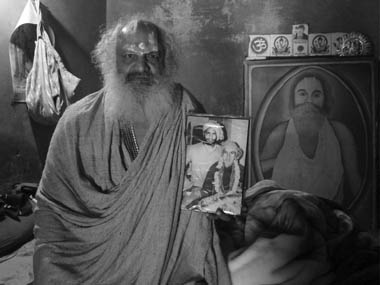
by Scharada Dubey Editor’s Note: The mandir-masjid controversy of Ayodhya comes to a life in a completely different way in Scharada Dubey’s book Portraits from Ayodhya - Living India’s Contradictions (Tranquebar). Two decades after the Babri Masjid came down, Dubey visits the barricaded Ram Janmabhoomi site and meets some of its residents, some of whom played a part in the town’s history and all of whom are living in its aftermath. One of them is Baba Dharamdas, a wrestler turned sadhu, who has a direct and controversial connection to Ayodhya’s contested history. Here is an excerpt from Dubey’s profile of Baba Dharamdas. The mahant of Hanuman Garhi, often referred to in these pages, Mahant Gyandas, has been an expert wrestler. This is entirely in keeping with the tradition of the famous akharas of Hanuman Garhi, where young men who had chosen sadhuhood as a way of life have been trained in wrestling and exercise. In the past, this was not only to improve their physical prowess but also underlined their constant readiness to battle for their faith. While the akharas still exist, what is more fascinating is the lore that has sprung around them – stories of sadhus who were unstoppable wrestlers – the WWF champions of their time. Baba Dharamdas is one such living legend. Born in 1945, in Dumari village of Bihar’s Buxar district into a Bhumihar family, Baba Dharmadas is tall and well-built, which accounts for the immediate awe one feel in his presence. His white hair and beard notwithstanding, he shows no sign of enfeeblement. He is also bashful about his wrestling tales, retreating into a gruff acknowledgement of sundry details, while others outline the heroic narrative. [caption id=“attachment_217915” align=“alignleft” width=“380” caption=“Baba Dharamdas represents an important link to the mandirmasjid controversy in many ways. Image courtesy: Westland.”] 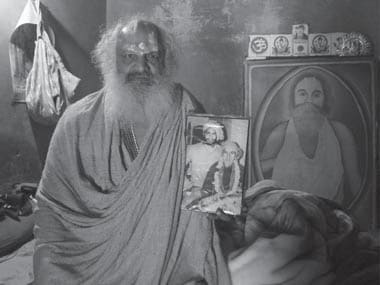 [/caption] Baba Dharamdas came to Ayodhya as a teenager. What brought you here, I ask. Was it curiosity? ‘Not curiosity,’ he replies. ‘Prarabdha (destiny). In the past, every village had sadhu role models, men who had left their homes to pursue a different life. In our childhood, we could see such people around us. Becoming a sadhu is a soul journey. Many factors play a part – purva janma sanskar, jahan anna daana paani likha hai, bhagwan ke bhajan, bhagwan ke naam se lagav, bairagya (past life karma, where one is destined to receive food and water, the attachment one begins to feel for God’s name, the final sense of detachment from other ties). I came alone to Ayodhya, not on some family outing, but for myself.’ It was here that he met Abhiramdas, on the banks of the Sarayu. The senior sadhu from Bihar was returning after a bath. The two got talking and Abhiramdas offered to take on the teenager as a disciple, to which he agreed. Thus began a life in Ayodhya, one where the boy ‘used to feel the presence of God everywhere.’ Abhiramdas is in fact the key figure of the gang that placed the idols of infant Rama, Lakshman, Bharat and Shatrughna in the Babri Masjid on the intervening night of 22-23 December 1949. When I meet Baba Dharamdas in the small room he occupies next to the Hanuman Garhi temple, I am standing in the same space occupied by Dharamdas’ guru. The area is dominated by a portrait of Abhiramdas painted by an unknown artist. Dharamdas, on his part, insists on having his picture taken holding a black and white photograph of himself as a young sadhu with his guru Abhiramdas. As to the relationship shared by the two, Dharamdas’ good friend and fellow Bihari, Hari Dayal Mishra describes an occasion when Baba Dharamdas was inspired to give a discourse (pravachan) on some aspect of devotion to Rama. While he sat on stage and held forth, his guru arrived and was enraged to see his disciple having assumed such a lofty position. He stormed towards the stage and cuffed Dharamdas, sending the latter flying into the bewildered audience. Later, he thundered at his penitent disciple, ‘There’s no need for you to be messing around with theRamayana and Bhagwat. You stick to wrestling and protecting the Lord from attack. For all the learning and Sanskrit, we have Satyendra, don’t we?’ Dharamdas himself puts it another way. ‘I wanted to be a learned sadhu too, but Guruji assigned to me the duty of wrestling, so this is the path I followed.’ Baba Dharamdas represents an important link to the mandirmasjid controversy in many ways. First, he provides me with a clue as to why Rajiv Gandhi, grandson of Jawaharlal Nehru, and leader of India’s supposedly most secular party, the Congress, should have taken the inexplicable step of having the locks of the disputed site opened in 1986. This in turn provided a boost to pro-mandir groups, and granted momentum to the movement for a Rama temple in Ayodhya. Whatever Rajiv Gandhi’s other political compulsions may have been, one thing that emerges from knowing Baba Dharamdas more closely is that the late prime minister had great admiration for wrestler sadhus at one point in time. As the story gets told, I learn that one of Baba Dharamdas’ disciples, a young wrestler, had become very close to Rajiv Gandhi. Once, Baba Dharamdas had occasion to accompany him when he was going to the prime minister’s residence in Delhi. As the two orange-robed figures were walking towards the PM’s house, the armed security guards who were familiar with only one of them, challenged the other sadhu, Baba Dharamdas. Baba Dharamdas ignored their calls and continued walking. When the guards rushed towards him to stop him physically, he threw them both to the ground in seconds with a few deft movements. ‘Unko patak diya’ is the succinct description. This incident is reported to have brought much amusement to Rajiv Gandhi, who is supposed to have then asked his security guards, ‘Why shouldn’t my security be assigned to these powerful sadhus, instead of to you?’ When I ask Baba Dharamdas to corroborate this incident, he mutters, ‘All exaggeration,’ and looks down, pretending to read from a small holy book. ‘But did you really get challenged by the guards? Did this happen?’ I persist. He nods in assent. ‘They called me, I didn’t listen, that’s all. Then they tried to catch me,’ he stops, not wanting to say more. But when asked about Rajiv Gandhi’s fascination for the wrestling sadhus from Hanuman Garhi, he is more open. ‘Yes, he was a wonderful man, a really good human being. He genuinely liked and respected us,’ he says. The other association that Baba Dharamdas has with the mandirmasjid controversy is that he grabbed land at the disputed site over which he then had control by continuous occupation. It was this land, earlier part of the Nirmohi Akhara’s holdings, that he gave to the VHP in 1984, out of a belief that his guru would have wished him to contribute towards a temple for Rama at the place of his birth. Ask Baba Dharamdas about the separate Nirmohi Akhara claim on Rama Janmabhoomi, and he says, ‘It is all char-sau-bisi (referring to Sec. 420 of the I.P.C. – cheating).’ Ask Tarunjeet Varma, whose family has long represented the Nirmohi Akhara, about Baba Dharamdas, and he turns pale and says, ‘Oh he is a very bad and dangerous man! He burnt or threw in a well many precious documents relating to the disputed land, destroying some proof forever, besides snatching the land in the first place.’ Continues on the next page Baba Dharamdas, who won second position in the Twentyfourth International Wrestling Meet when it was held in Shimla, has wrestled for Hanuman Garhi in several places in Jammu and Kashmir, like the Rani Mandir at Jammu, besides matches at Muthi and Akhnoor. His guru, Abhiramdas, breathed his last on 3 December 1981 at Varanasi, after naming Dharamdas his successor and keeper of all his landed property. Sometime before or after this date, it is not exactly clear, Baba Dharamdas and a few others forcibly occupied portions of the land around the Babri Masjid which was then under the control of the Nirmohi Akhara. They also looted some household goods and other articles of daily use from the site. A case of looting and encroachment was registered against Baba Dharamdas and others, and he spent two months in jail before being granted bail. In 1984, he gave the portion of the land that he had forcibly occupied to the VHP. ‘I gave the land on the condition that the temple would be built with my help,’ he says. ‘A lot of people told me that they (the VHP) are shopkeepers, not true Rambhakts, but I gave them the land anyway, as my gilehri prayas for Rama.’ Baba Dharamdas, of course, wishes to compare himself to the squirrel or gilehri in the story of Rama who fetches pebbles and sand in her mouth to build the bridge to Lanka. Avoiding further questions on his involvement with the land around the disputed site, Baba Dharamdas says, ‘If I say anything about the matter now, it may be used in favour of the other side (the Muslims). That is why I will keep quiet.’ However, he is clear about a few things. ‘Hanumanji will take care of everything for me. The judgement has come in our favour. I expect even the Supreme Court to decide by Chait-Baisakh (April-May). All will belong to Rama Lalla at the end and all will be clear for a temple to be built,’ he says. When I ask him if the leadership for a Rama temple will ever be the same after the death of Paramhans Ramachandra Das, he bristles and says, ‘Paramhans became the face of the temple movement only because of the VHP and the media. The real hero of the Rama temple was and is Abhiramdas.’ On the fate of the idols his Guru had placed in December 1949 under the dome of the masjid, I share with Baba Dharamdas the anguish his gurubhai, Mahant Satyendra Das felt when it was suggested that he had failed to protect the idols of Rama Lalla and his brothers. Baba looks up, ‘Satyendra protected the idols? Why would he do that? It wasn’t his job.’ ‘He told me he took Rama Lalla away to a safe place before the domes fell down, and did phalahar for twelve years because bhog could not be offered on that day,’ I tell Baba Dharamdas. A snort is heard in reply. Baba Dharamdas says, ‘I carried away the idols in a gamchha (cloth worn on the upper body) and kept them in a trunk for some hours when things started getting ugly. Satyendra did not have to trouble himself. Such situations are not for the likes of him. It was my duty to protect the idols and I did it. As for the phalahar, why did he do it for twelve years? The domes fell only late in the afternoon. Bhagwan had already had his bhog many hours prior. And late that night, even before the morning of 7 December, the idols had been placed back in their spot.’ It looks like I have stumbled upon a rivalry of gurubhais.
Two decades after the demolition of the Babri Masjid, meet a man whose connection to that history is both direct and controversial. But few know of Baba Dharamdas’ other link - to the former Prime Minister Rajiv Gandhi.
Advertisement
End of Article
Written by FP Archives
see more

 "Israel targets top Hamas leaders in Doha; Qatar, Iran condemn strike as violation of sovereignty")
 "Nepal: Oli to continue until new PM is sworn in, nation on edge as all branches of govt torched")
 "Who is CP Radhakrishnan, India's next vice-president?")
 "Israel informed US ahead of strikes on Hamas leaders in Doha, says White House")
 "Israel targets top Hamas leaders in Doha; Qatar, Iran condemn strike as violation of sovereignty")
 "Nepal: Oli to continue until new PM is sworn in, nation on edge as all branches of govt torched")
 "Who is CP Radhakrishnan, India's next vice-president?")
 "Israel informed US ahead of strikes on Hamas leaders in Doha, says White House")



](https://images.firstpost.com/wp-content/uploads/2012/02/baba-dharamdas.jpg)