

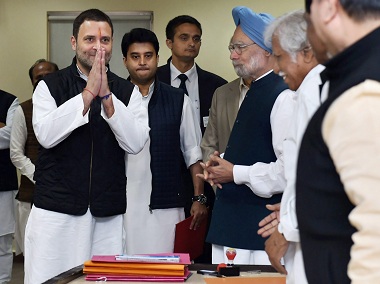
 "Rahul's elevation as Congress president may salvage Brand Gandhi, but is unlikely to win political points")
Rahul Gandhi is being repackaged. This should happen soon, if reports are to be believed. Like any smart company that is passionate about its pet, but so-far-failed, product by giving it a new appeal, the Congress is also making a last-ditch effort to salvage the Gandhi brand that has held the party together since its infancy. But make no mistake, there may be very few who expect a miracle for the Congress with Rahul’s elevation. Congress’ allies and party sympathisers are on wait-and-watch mode before expressing confidence (or discarding) the Gandhi factor. “In his recent campaign in Gujarat, he showed tenacity — contacting people at the grassroots, but his commitment will only be demonstrated when he is in a position of responsibility,” said CPM leader Sitaram Yechury last month. Even all those years in his capacity as Congress vice-president and while working under mother Sonia Gandhi, who has been Congress president, Rahul had all the powers he needed to govern the party’s affairs, whether questioning senior leaders or even the Prime Minister’s Office. [caption id=“attachment_4241311” align=“alignleft” width=“380”] 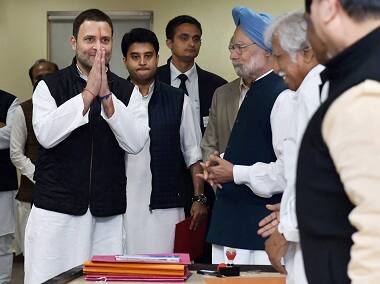 Rahul Gandhi during the filing of his nomination papers for post of Congress party president. PTI[/caption] Rahul took charge of the party’s poll campaigns way back in 2012. But his progress card shows that he hasn’t won any elections for the party, nor has he made a mark among his political allies. He was born with the guaranteed position of a future Congress chief and prime ministerial candidate, as was given to the family’s three previous generations before him. That is what has taken him so far in the power corridors of his party. Rahul’s key errors in judgement In Gujarat, where Assembly elections are imminent, Rahul made the tactical mistake of affiliating himself to what many call a “soft Hinduvta” stand — visiting temples. It contradicted starkly with his party’s secular image. Rahul walked right into the trap set by his political opponents and proclaimed himself as a sacred thread-wearing Hindu and a Shiva follower, at a time when BJP cornered him using a goof-up at Somnath Temple questioning his religious identity. He should not have taken the bait, and should have discarded the question as a politically motivated gimmick. He said exactly what his opponents wanted. Rahul’s second mistake was that he is yet to break free from the image that has imprisoned the party for long — the image of a corruption-prone, policy-paralysed and family-centered party that has nothing new to offer to the country. He hasn’t yet learned from the reasons behind the party’s past defeats and hasn’t managed to offer a convincing alternative. Beyond his new-found popularity on social media, with his wit and unrelenting focus on the man he’s pitted against, Narendra Modi, there is no clear strategy that Gandhi can boast of to counter the government’s economic or political policies. This is critical when he faces the informed voter who may have lost faith in personality politics. Gandhi’s strategies are more or less the same as what the Congress party has preached for decades. He still talks of loan waivers and freebies, and portrays corporations as enemies of the poor without understanding that unless big industries come up, there isn’t much the poor can hope for in an agriculture-dominated Indian economy. The Congress’ populist card worked in the past, but won’t work in the changed socio-political circumstances. In the 2014 Union elections and thereafter, the Congress failed to win the people’s mandate on account of its past image. Under Rahul’s active leadership in polls since 2012, he hasn’t shown either the political courage to admit his party’s wrongdoings or promise a change. He has fought tooth and nail against Modi’s controversial economic policies such as demonetisation and a flawed roll-out of Goods and Services Tax (GST). But beyond criticising the actions, Gandhi hasn’t yet offered credible alternatives to where the Modi-government may have gone wrong on fighting black money or how to implement a better GST structure. Even Congress party intellectuals would not disagree that these are key issues, but a solution is missing. Similarly, as pointed out in an earlier article , one of the charges Rahul raised against the Modi government was its failure to generate enough jobs, which again is a serious issue. Job creation has been at its lowest in the three-and-a-half years of Modi’s rule. Rahul is right in pointing out the problem. But what would Rahul Gandhi, as prime minister, do to generate enough jobs? Is there a well thought out, credible alternative plan to accommodate the millions of workers entering the job market every month? Rahul also lacks the aggression, the fighter instinct, to take on a powerful orator and master tactician that Modi embodies. His friendly and approachable appeal would make him the darling of social media but will hardly win him votes. Nevertheless, being the topmost leader of the only national political party that has the potential to at least challenge the BJP and the indomitable Modi-factor in 2019, or at least create a unified Opposition voice, the repackaged version of Gandhi offers some promise in the democracy.
Beyond his new-found popularity on social media, with his wit and unrelenting focus on Narendra Modi, there is no clear strategy that Rahul Gandhi can boast of to counter the government
Advertisement
End of Article

 "‘I’d love to do it’: Trump refuses to rule out third term — despite constitutional limit")
 "What is the ‘Golden Fleet’ of navy ships that Trump wants to counter China with?")
 "‘Ramayan country’: Why Trinidad and Tobago wants to build a large Ram temple")
 "How China's rare earths choke changed America's trade deals")
 "‘I’d love to do it’: Trump refuses to rule out third term — despite constitutional limit")
 "What is the ‘Golden Fleet’ of navy ships that Trump wants to counter China with?")
 "‘Ramayan country’: Why Trinidad and Tobago wants to build a large Ram temple")
 "How China's rare earths choke changed America's trade deals")



](https://images.firstpost.com/wp-content/uploads/2017/12/Rahul-Gandhi-Congress-president_PTI.jpg)