

 "Food Security Bill is UPA-2's NREGA - costlier and riskier")
An ambitious draft Food Security Bill (FSB) has been put in the public domain by the UPA government for comments.
The draft promises 7 kg of rice, wheat or coarse grains per person per month to “priority” households at hugely subsidised prices of Rs 3, Rs 2 and Re 1 a kg respectively. A family of five would thus get 35 kg of wheat at just Rs 70 a month.
The Bill proposes to cover 75 percent of the rural population and 50 percent of the urban population in its ambit, making it the biggest social security scheme in the history of independent India. It is UPA-2’s NREGA.
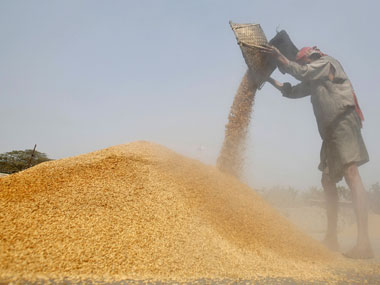
[caption id=“attachment_84164” align=“alignleft” width=“380” caption=“A labourer works at a rice mill on the outskirts of Agartala. Jayanta Dey/Reuters”]  [/caption]
For those who are not identified as “priority” households - that is, those who are clearly above the poverty line - the FSB proposes to supply 3 kg of any of the above grains per person at 50 percent of the minimum support price (MSP) paid to farmers.
In wheat, for example, the MSP is currently Rs 1,120 per quintal. Thus, general households-meaning those who are not “priority” cases and are also not specifically excluded from coverage altogether - will get wheat at Rs 5.60 per kg. So even the not-so-aam-aadmi household would get around 15 kg of wheat for just Rs 84. That’s a steal by any yardstick.
The political rationale for the Bill is clear - including its appearance in the midst of the biggest credibility crisis faced by the UPA, with its corruption scandals and governance failures. Having been battered by Team Anna and generally hauled over the coals by all and sundry, the government needs something to claim credit for. The Food Security Bill is one way to do it.
However, while the original intent of Sonia Gandhi’s National Advisory Council (NAC) - which drafted the Bill and then haggled over the details with the Food and Public Distribution Ministry - was to implement it from this year (2011-12), there is now little chance of that. By the time the Bill is passed into Act it will be winter, and only the tail end of the year will be left.
It will, therefore, be 2012-13 before the FSB is fully implemented. Politically, it is thus more than probable that, given the slowdown, even next year will see only a partial implementation. It will be accelerated in 2013-14 - the last year before the general elections in 2014.
This was the political time-table set by UPA-1. The farm loan waiver and NREGA went full steam only in 2008 - in the final year of the government and just before the general election.
If political calculations position the FSB as UPA-2’s centrepiece legislation, in terms of scope it will be twice as big as NREGA, if not bigger.
At a conservative estimate, FSB could cost more than Rs 1,00,000 crore annually in food subsidies. NREGA costs around Rs 40,000 crore annually currently.
The draft FSB, which also includes nutritional support to pregnant mothers and children and free meals to absolute destitutes from community kitchens, is more bankable that the NAC’s initial document as the PM’s Economic Advisory Council (PMEAC) ran a blue pencil on many of its more outrageous proposals.
This is what Sonia Gandhi’s NAC didn’t get from its original wish-list.
• Coverage of nearly 90-100 percent of the population, subject to specific exclusions. The target is now whittled down to 75 percent of the rural population and 50 percent of urban. This means entitlements will cover roughly two-thirds of the overall population - over 800 million people.
• The pace of rollout is also being staggered. While the “priority” households will be covered immediately after the Bill is legislated, the general population will get it at a later, unspecified, date. This means the government has some leeway, and the inclusion of the non-priority population may be linked to means testing in some form. That is, some of them will be excluded.
• The government has also put in some opt-out clauses in the draft. Thus, if there isn’t enough food to go around in any particular year, it will give cash to the people. Also, it has inserted a force majeure clause under which the government can’t be sued for failing to deliver the food to anyone. No one, of course, expects matters to head in this direction.
However, notwithstanding a bit of watering down of the original wish-list of NAC’s jholawalas, the FSB will test the government’s finances and infrastructure to the limit. The Union budget is already overstretched (the fiscal deficit was above 7.8 percent in the first quarter against the year’s target of 4.6 percent) and the economy is slowing down - with negative implications for tax revenue enhancement.
According to the PMEAC, the NAC has grossly underestimated the actual cost of subsidising food to so many people. In its original proposal, NAC claimed that its version would cost around Rs 71,837 crore in 2011-12 and Rs 79,931 crore in 2013-14.
The PMEAC faulted its math and came up with figures of Rs 79,234 crore and Rs 84,892 crore assuming only 95 percent of the priority population and 85 percent of the rest collected their rations. If 100 percent of those entitled to the subsidies picked up the grain, the subsidy bill would bloat to Rs 85,584 crore and Rs 92,060 crore in the two years respectively.
A small problem: the subsidy provided in the 2011-12 budget is just Rs 56,700 crore - over Rs 22,534 crore short of needs even if everyone didn’t take up their entitlements. In future years, the shortfall would rise to Rs 28,192 crore, said the PMEAC. If people take up all their entitlements, the shortfall rises to Rs 28,884 crore immediately, and to Rs 35,360 crore in later years (See here for the full details).
But even this is an underestimate. For the plan does not seem to have made provision for logistics and infrastructure - godowns, transport, wastage, etc - which would work out to another Rs 15,000 crore annually, though the states may bear part of the costs.
The chances are that towards 2013-14, which is when the government will be back to wooing the electorate, the food subsidy bill will cross Rs 1,10,000 crore.
If the upside of the Food Security Bill is that it will constitute the biggest attack on poverty and malnutrition ever, the downsides are numerous, too.
First, the 65-70 million tonnes of foodgrain procurement that the scheme entails annually will completely absorb all available marketable surpluses - pushing up open market prices significantly. This means, even the upper end of the subsidy bill may be an underestimate.
Second, in bad agricultural years, the country may have to import food. Since India is not normally an importer, even a small order of 5-10 million tonnes will rock the international markets. As international prices are far above domestic prices, the subsidy bill will bloat even more.
Third, the massive procurement plan will essentially create two unrelated grain markets - one for mass procurement, and another, smaller one, for the well off.
Fourth, massive investments in grain storage and transport infrastructure will be needed to procure, store, move and distribute grain from the granary states of the north to elsewhere in the country. The FSB fails to look at alternative means of delivering food security- including cash transfers-which would have obviated the need to create such massive public assets.
Fifth, a new bureaucracy will be created to oversee the FSB at the central and state levels. Moreover, since the government is again going to rely on a leaky public distribution system (PDS) to reach the grains to the masses, one can expect a further impetus to corruption. Losses in the PDS exceed the notional losses on the 2G scam, but that is obviously not a deterrent to the NAC and the Congress party presenting another wasteful scheme.
Six, all bets are off about putting the food inflation genie back in the bottle.
The FSB is what the country needs to wipe out the blot of poverty and hunger. Pity it did not plan for a better and cheaper way of achieving the same objective.
National Food Security Bill Draft

 "Israel targets top Hamas leaders in Doha; Qatar, Iran condemn strike as violation of sovereignty")
 "Nepal: Oli to continue until new PM is sworn in, nation on edge as all branches of govt torched")
 "Who is CP Radhakrishnan, India's next vice-president?")
 "Israel informed US ahead of strikes on Hamas leaders in Doha, says White House")
 "Israel targets top Hamas leaders in Doha; Qatar, Iran condemn strike as violation of sovereignty")
 "Nepal: Oli to continue until new PM is sworn in, nation on edge as all branches of govt torched")
 "Who is CP Radhakrishnan, India's next vice-president?")
 "Israel informed US ahead of strikes on Hamas leaders in Doha, says White House")



](https://images.firstpost.com/wp-content/uploads/2011/09/rice380.jpg)