

 "A shift too late: Mamata Banerjee's u-turn on Maoists")
There are many reasons for the persistence, the vigour and the virulence of the Maoist movement in India, but among the most significant has been the utter ineptness, confusion, opportunism and dishonesty of India’s political leadership. Nothing illustrates the entrenched stupidity and duplicity of political responses more dramatically than Mamata Banerjee’s shifting and shifty interface with the rebels in West Bengal. The Maoists, Banerjee now informs us on her excellent authority as chief minister of West Bengal, “are more dangerous than terrorists”. She declares that “Maoists were responsible for the Jnaneswari massacre” — the May 2010 train derailment that killed at least 141 passengers. She has also quickly discovered a ‘foreign hand’ supporting nefarious Maoist designs, though she was unduly coy about specifying the “names of such countries which are helping Maoists”. She has launched a broadside against ‘Maoist sympathisers’ and ‘intellectuals’, specifically including “two Jadavpur University professors”, and warned that “Those who are trying to glorify the Maoists would be arrested.” A new State Government ordinance is intended to prevent academicians connected with political parties from becoming or remaining Vice Chancellors of any University in West Bengal. For good measure, she adds, “Anybody who is allowing them (the Maoists) knowingly to carry out the criminal activities, are (sic) also criminals.” By this last yardstick, Banerjee and her Trinamool Congress (TMC) have been guilty of numberless crimes. For over two years in the run-up to the State Assembly elections of April-May 2011, TMC operated in open collusion with the Maoists to undermine the Communist Party of India-Marxist (CPI-M) government to cause widespread disruption and breach of law and order, and to obstruct effective action against Maoist cadres by state and Central forces through a range of activities that went infinitely beyond the mere ‘sympathy’ with the extremists that Banerjee demonises today. Throughout this period, in blatant disregard of mounting evidence, Banerjee and her TMC insisted that there was no Maoist presence or activity in the Jangal Mahal area, even as it became clear that her own agitations in Singur and Nandigram were backed by the Maoists. Crucially, reports indicate that senior Maoist leader Venkatesh Reddy aka Telugu Deepak, charged with creating a ‘safe corridor’ in the Jangal Mahal area, and arrested in Kolkata on 4 March 2010, had disclosed during interrogation that the TMC had provided the Maoists with arms, and that the Maoists had supported TMC and provided arms training to its cadres during the agitation in Nandigram. [caption id=“attachment_136787” align=“alignleft” width=“380” caption=“It is not clear what her ‘feelings’ are based on, though they cannot conceivably be on the evidence of history. AFP Photo”] 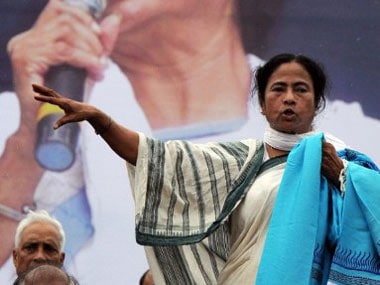 [/caption] Through 2009, according to South Asia Terrorism Portal data, a total of 158 fatalities connected with Maoist violence were recorded in West Bengal, including 134 civilians and 15 Security Forces (SF) personnel. By 2010, the total had risen to 425 fatalities – the highest for any State that year – including 328 civilians and 36 SF personnel. Banerjee insisted that the violence was being orchestrated by her bête noire, the then-ruling Communist Party of India-Marxist (CPI-M), despite the fact that the overwhelming proportion of civilians killed were CPI-M cadres. Throughout this period, the TMC did everything in its power to obfuscate the Maoist role in violence in the State, and to bring SF operations in the Jangal Mahal area to an end. The TMC leadership went so far as to meet and petition the President to secure an end to Joint Operations by State and Central Paramilitary Forces (CPMFs) in this theatre of the Maoists’ greatest dominance in the State. Significantly, she vehemently denied any Maoist role in the Jnaneswari derailment case – a matter of crucial importance, since she was the Union Minister for Railways – despite explicit evidence and even after the identification of the principal perpetrators in the investigation. That a ‘deal’ had been struck between the Maoists and Banerjee was widely known in the pre-election phase, but this has now been confirmed by these parties themselves in their mutual accusations of having ‘betrayed promises’ made during this period. In the run-up to the elections, Banerjee had made an unprincipled commitment to the Maoists that all ‘political prisoners’ – i.e., Maoists in custody – would be released, and that ‘Joint Forces’, State Police and CPMFs, would be withdrawn from the Jangal Mahal area. In other words, the Maoists were to be given complete sway over this area, and full freedom to consolidate and extend their activities. A ceasefire and suspension of operations against the Maoists was among the first acts of the Banerjee government after it assumed power in May 2011. Banerjee virtually dismantled the entire counter-insurgency network established by the State Police, denigrating, humiliating and transferring the most active officers on the grounds that they were “CPI-M agents”. Now that her own Party cadres have come under Maoist attack , she has gone back to the same officers to restore operations in Jangal Mahal. In the interim, however, significant gains, secured at high costs in effort and blood have been compromised, and the force in its entirety has been demoralised. It is significant that, through the period of escalating Maoist violence, TMC cadres went virtually unharmed in Jangal Mahal. On 22 September 2009, Nishidanta Mondal, the Pradhan of a TMC-run panchayat in Nandigram had been killed. The TMC leadership blamed the Marxists, but the Maoists admitted to the killing claiming that Mondal was ‘corrupt’. Two subordinate TMC cadre were also killed in 2010 but there had been no killing of TMC cadres in 2011 till the deal with the Maoists started turning sour and the rebels began to force TMC cadres to quit the party and join them. Continues on the next page It was on 24 August 2011, during a 24-hour Maoist bandh in the Jangal Mahal area that Rabindranath Mishra, a TMC activist, was shot dead at Dhangri, PS Jhagram, West Midnapore. Another five TC cadres or supporters, including the Jharkhand Janamukti Morcha President, Babu Bose, who was considered ‘close’ to the TC, have since been killed. There has also been a large number of incidents of intimidation, beatings and other lesser attacks, intended to exert increasing pressure on the TMC. Banerjee’s response has been as irrational and counter-productive as her earlier actions. Her most visible reaction, at present, is the tirades of abuse she is directing against the Maoists, describing them as “terrorists, murderers, jungle mafia and supari (contract) killers”. The TMC has further adopted the very strategies that it had denounced the CPI-M for — setting up armed groupings within the party to establish rival thuggeries across rural West Bengal rather than depend on the state apparatus to do the job of ensuring security and countering the insurgency. The most prominent among present TMC-linked vigilante formations are the Bhairav Vahni, the Janajagaran Manch and the Jangalmahal Unnayan Birodhi Pratirodh Committee. Reports of excesses against villagers by these groupings are already filtering through, and their existence can only create mounting crises of rights and administration in the proximate future with little potential for success against the Maoists. At the same time, Joint Forces’ operations have been restored and some minor successes are now being flaunted as breakthroughs. However, without strategic clarity and any confidence within the forces’ leadership that Banerjee can be relied upon, operational successes will remain fitful and will have little enduring impact on the ground. Banerjee has also both established and undermined a directionless and dysfunctional group of ‘interlocutors’, and continues to insist, “I still feel good sense will prevail on them (the Maoists) and they will come back to the mainstream.” It is not clear what her ‘feelings’ are based on, though they cannot conceivably be on the evidence of history. Meanwhile, the usual hotchpotch of a ‘developmental strategy’, ‘winning hearts and minds’, and political posturing, is also projected as a ‘solution’ to the Maoist challenge. In all, the idea appears to be that if she does everything as well as its opposite, something will eventually work out. The likelihood, however, is that contradictory initiatives will cancel each other out, and increasing incoherence will create widening spaces for disorder and Maoist consolidation. Ajai Sahni is executive director, Institute for Conflict Management & South Asia Terrorism Portal.
Mamata’s Maoist policy seems to do everything as well as its opposite and hopes something works out. But all she has done is strengthen the Maoists and undermine her own security forces.
Advertisement
End of Article
Written by Ajai Sahni
Ajai Sahni is Executive Director, Institute for Conflict Management and South Asia Terrorism Portal. see more

 "Israel targets top Hamas leaders in Doha; Qatar, Iran condemn strike as violation of sovereignty")
 "Nepal: Oli to continue until new PM is sworn in, nation on edge as all branches of govt torched")
 "Who is CP Radhakrishnan, India's next vice-president?")
 "Israel informed US ahead of strikes on Hamas leaders in Doha, says White House")
 "Israel targets top Hamas leaders in Doha; Qatar, Iran condemn strike as violation of sovereignty")
 "Nepal: Oli to continue until new PM is sworn in, nation on edge as all branches of govt torched")
 "Who is CP Radhakrishnan, India's next vice-president?")
 "Israel informed US ahead of strikes on Hamas leaders in Doha, says White House")



](https://images.firstpost.com/wp-content/uploads/2011/11/mamata3807.jpg)