

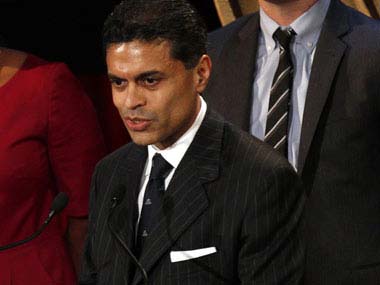
 "In defence of Fareed Zakaria, and so-called copying")
Who would have heard of Jill Lepore, Adam Winkler and a report on gun control carried in the New Yorker but for a Fareed Zakaria error of omission? In less than a week, Zakaria – after failing to attribute a passage he used from Lepore’s piece – has become some kind of intellectual pariah for an error that was quite easy to make by almost anybody. Winkler and Lepore have become better known now, and the point he was trying to make – the need for gun control – has been lost in the feast of Zakaria-bashing. A Washington Post report tried to pin another bit of alleged plagiarism on Zakaria, only to retract later. Zakaria did not steal Lepore’s quote. All he did was lift Lepore’s reference to yet another writer – Adam Winkler – on gun control. Zakaria, thinking he was quoting Winkler, made insignificant efforts to rewrite the passage attributed by Lepore to Winkler’s observations on the history of gun control laws in some US states. In short, he made one attribution correctly and not another. He did not read the original Winkler story on the assumption that if New Yorker carried that report, it must have been summarised correctly by Lepore. He did not “plagiarise” — a deadly word with loaded meaning when it may just have been a silly mistake for which Zakaria has apologised. It’s like using the word “foeticide” to label the act of abortion of female foetuses when it could quite easily also be called a “woman’s right to choose the sex of her child”. This is not to completely exonerate Zakaria, but there is absolutely no doubt in my mind that this is an error almost anybody could have made. Attributing something to Lepore would have done nothing to enhance or diminish the import of what he was trying to say. But the episode leaves me fuming about the tendency of Americans to make a moral issue out of anything. They elevate IPR — intellectual property rights —to stupid levels, where the intention is to allow someone to make a killing even on a trivial idea instead of protecting something superbly original and/or of great value to humankind — like a wonder drug for treating Aids. I would like to make three points in this oblique defence of Zakaria and his error – as I have done elsewhere in the past (Read here). One, copying and/or building on someone else’s idea – or articulation of an idea – is vital to human progress. Two, giving too much weightage to IPR is self-defeating both for the inventor and the human race. A pirate sometimes makes something of value more easily accessible to a larger audience than stick-in-the-mud IPR. Three, authors, musicians, and script-writers, in particular, should not be prickly about someone lifting their line or phrase – unless there is something egregious about the lifting. Very rarely do they really come up with something so extraordinarily original that they deserve kudos for it. They should, in fact, be secretly pleased that someone liked a passage or tune so much that they even tried to call it their own. Human beings learn by copying. From childhood, a kid grows up by observing what its parents or older siblings do. Once you grow up, you learn by observing others, and try to improve – whether it is just a simple style or mannerism – by aping. If Sunil Gavaskar had patented his cover drive or Muthiah Muralidharan his bowling action, cricket would be poorer, not richer, for this dog-in-the-manger act. History tells us that almost all our holy books – books that each religion treats as its own original version of God’s word – have taken ideas from folklore and local tradition and made it their own. In the west, there is now a Christian yoga, a Bharat Thakur yoga and all kinds of other yogas. AC Grayling has produced something called The Good Book, a kind of Secular Bible that still draws on the other book’s ideas. The world’s peoples have liberally drawn from each other’s stories, experiences and conversations for centuries – the idea of virgin birth, for example, happens not only in Christianity but Kunti in Mahabharata also manages the feat. The idea of the super-protective armour is exclusive not only to Karna in the Mahabharata, but also to Homer’s Iliad (where Achilles’ magical armour only excludes his heel). There are such tales in many other religious and secular literature too. So who copied from whom? When even what we consider “holy” owes a lot to the human tendency to copy, circulate and appropriate, what is so unholy about using ideas from somewhere else? The second point is about giving too much weightage to IPR. Here, too, it seems patent offices the world over have no clue on what is really patent-worthy – and a lot of ideas, which are merely interesting look-and-feel issues, are treated as great intellectual property. The crux of Apple’s case against Samsung is about design issues, not some great technology they invented. I hope Apple loses its case. In fact, even in cases where there is no dispute over who invented what – as in prescription drugs – today’s laws allow governments to force drug inventors to compulsorily license life-saving drugs for a reasonable fee. In February this year, the government of India forced Bayer to compulsorily license its anti-cancer drug Nexavar to Natco pharma since the German company was unable to make the drug available to needy Indian patients at a reasonable price. Copying is thus legal or illegal depending on the circumstances. In the Apple versus Motorola patent case - where both parties counter-sued each other for alleged patent infringements, just as Apple and Samsung now are doing - Circuit Judge Richard Posner produced a brilliant verdict that rubbished both for claiming infringement what he felt was only minor intellectual property (Read the full Posner verdict here). Said Posner in his order: “The notion that these minor-seeming infringements have cost Apple market share and consumer goodwill is implausible, has virtually no support in the record, and so fails to indicate that the benefits to Apple from an injunction would exceed the costs to Motorola. An injunction that imposes greater costs on the defendant than it confers benefits on the plaintiff reduces net social welfare.” Even in Capitalist US of A, bold judgments are being issued against flaky IPR claims on grounds of “net social welfare.” My own personal beliefs have always been that too much IPR is being claimed for too little additional originality in a product. In the case of Apple’s products, most of the technologies were not invented by the company – they are great products because of the kind of consumer usage insight they bring to designing the products, and this is what is original in Apple products. But the point is this: if I find that consumers like front-loading washing machines instead of top-loading ones, is this an insight worth patenting? If Apple designed iPad icons once way and Samsung – let’s assume – copied them, is this big-ticket plagiarism? Or is the idea of launching a patent suit intended to block Samsung out of the market? When Apple creates a device that can only run with Apple products and accessories, can it not be accused on deliberately hampering competition? For example, the iPad could easily have been designed with a USB port or a slot for a normal SIM card – but the intention was not to make it easy for users to use the products they are comfortable with, but to force them to use Apple’s hardware. This is not IPR protection, but monopoly protection. Tim Worstall, a technology writer, said as much in his Forbes.com column on the Posner verdict: “The important point here (is) that IP is not some natural right: it’s a deliberately constructed edifice to increase invention and innovation. And there’s an awful lot of people who think that this system has gone too far. Patents are now being issued on what 30 years ago would have been considered absurd bases: one-click shopping, slide to unlock features. (Italics mine) He added: “Further, these over-wide (patent) issuances are being used to restrict invention and innovation in subsequent rounds of technological development. As an example, there cannot be that many outside Apple itself who really believe that the European case against Samsung over the Galaxy Tablet is really about design patents. The general assumption is that it’s about keeping a competing product off the market by any means possible. For long enough that it doesn’t get a foothold in said market. (Italics mine) [caption id=“attachment_419675” align=“alignleft” width=“380”]  Agencies[/caption] There you have it. Many patents are really competition-zapping devices, not real inventions that deserve protection. The last point is about IPR in literary passages, music, etc. Every word used by anybody is found in the dictionary. Even combinations of words and phrases may have been used by somebody in ordinary speech, and writers may merely have taken then as their own (We are like that only is not someone’s invented phrase, but a mistake commonly made in Indian English usage). We frequently use book titles and well-known headlines (Catch-22, Through a glass, darkly, Pride and Prejudice, or lines from Shakespeare) as though they are our own because they have already become part of common usage. The point is: if something said centuries ago can be made your own, what is so criminal about using something said or written by someone yesterday? I am not making an argument in favour of stubbornly refusing to attribute a quote or fact to the right owner, but that there is little justification for making a song and dance about it – even if the IPR is about song and dance. The tunes of every song sung on earth – composed basically of 5-7 notes – would have been partially rendered by some people, some artiste or some exponent some time or the other. Many of OP Nayyar’s songs drew on folk tunes. When Pandit Jasraj or Kishori Amonkar have sung a Malkauns (with just five notes to it) for two hours, is it possible that they left out any lilting combo of notes on the same raga unsung? So how can any Hindi film music director patent a song in Malkauns? The same logic applies to music sung in English or any other language. Again, I am not making out a case for blatant copying of a very popular tune. Just that we should stop claiming so many things as original. There is no such thing as absolutely original in human learning. Everything we create is built on someone else’s creation – even though we may have added our bits of originality to it. Sometimes we know who the authors are, sometimes we don’t (Who created Darjeeling tea? We now call it a geographical indication) There is no case for giving IPR too much importance in most things that are of value to life. Zakaria does not deserve the abuse he received for making Jill Lepore famous in India.
The extreme criticism of Fareed Zakaria’s so-called plagiarism is totally unwarranted. As is excessive protection for IPR
Advertisement
End of Article
Written by R Jagannathan
R Jagannathan is the Editor-in-Chief of Firstpost. see more

 "Israel targets top Hamas leaders in Doha; Qatar, Iran condemn strike as violation of sovereignty")
 "Nepal: Oli to continue until new PM is sworn in, nation on edge as all branches of govt torched")
 "Who is CP Radhakrishnan, India's next vice-president?")
 "Israel informed US ahead of strikes on Hamas leaders in Doha, says White House")
 "Israel targets top Hamas leaders in Doha; Qatar, Iran condemn strike as violation of sovereignty")
 "Nepal: Oli to continue until new PM is sworn in, nation on edge as all branches of govt torched")
 "Who is CP Radhakrishnan, India's next vice-president?")
 "Israel informed US ahead of strikes on Hamas leaders in Doha, says White House")



](https://images.firstpost.com/wp-content/uploads/2012/08/fareed-zakaria2.jpg)