

 "The report card: For smaller companies, costs sting more")
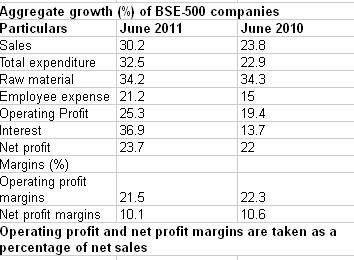
The results season is coming to an end as a majority of companies have announced their results for the June 2011 quarter. Firstpost did an analysis to ascertain the financial performance of BSE-500 companies as almost 80 percent of the companies have reported their results. For our analysis, we have excluded banks, NBFCs and OMCs (oil marketing companies).
[caption id=“attachment_61884” align=“alignleft” width=“380” caption=“The trend is also an indicator of the fact that large companies are able to withstand tougher external conditions. Yet, over the past two weeks, large cap shares have been battered. Reuters”]  [/caption]
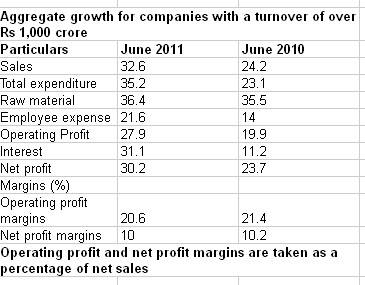
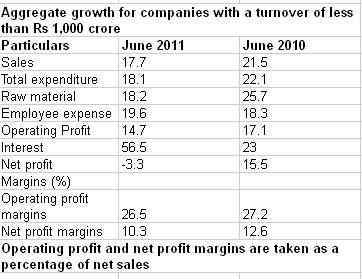
Large companies with a turnover of over Rs 1,000 crore reported a sales growth of 32.6 percent while smaller ones reported a 17.7 percent growth for the June 2011 quarter. Net profit of larger companies grew 30 percent while smaller companies logged a fall in profits. This clearly shows that smaller companies were impacted by higher commodity prices and interest costs. Interest outgo of larger companies rose 31 percent while the interest cost of smaller firms went up by a sharp 56.5 percent. Smaller players had to bear the brunt of higher interest cost while the biggies were aided by higher other income and high cash reserves.
The trend is also an indicator of the fact that large companies are able to withstand tougher external conditions. Yet, over the past two weeks, large cap shares have been battered. Foreign institutional investors have been selling across markets, beating down blue-chip shares. This means large-cap shares are available relatively cheap. While the BSE Sensex fell 9.28 percent, the BSE mid-cap index and the BSE-500 index declined 7 percent and 8.7 percent, respectively.
Sector-specific trend
•The auto and auto ancillary sector reported a 40 percent rise in interest cost for the June 2011 quarter. However, this was largely on account of a sharp rise in interest cost of Tata Motors.
Impact Shorts
More Shorts• Capital goods segment reported a sharp 140 percent rise in net profit. This was mainly skewed due to a low base effect of the year-ago quarter and a lower growth in total expenditure vis-vis revenues.
• Owing to salary hikes undertaken by IT firms in the June 2011 quarter, employee expenses jumped 26.7 per cent vis-a-vis the aggregate average of 21.2 percent. IT firms had undertaken salary hikes to the tune of 10-12 percent for offshore employees and about 2-3 percent for onshore employees to curb high attrition levels.
•While FMCG sector reported a fall in profitability in the June 2011 quarter y-o-y owing to higher raw material expenses vis-vis revenues, its net margin was higher at 11.8 percent compared to the aggregate industry margin of 10 percent.
• The pharmaceutical sector sales growth stood at 10 percent, much lower than the industry average of 30.2 percent. However, its net profit margin stood at 14.7 percent, much higher than the industry average of 10 percent owing to a fall in interest costs.
• Realty and Construction sales grew 14 percent, it reported an 8 percent fall in net profit. Fall in profits was due to a sharp 40 percent rise in interest costs.
• Among metals and mining companies, sales grew by 27 percent while net profit rose by 45 percent. The sharp rise in net profit was due to a nearly three-fold jump in the consolidated net profit of Tata Steel. This was mainly due to its one-time gain on sale of its stake in Riversdale mining to Rio Tinto for $1.1 billion.
•Telecom companies reported a 28.6 percent rise in revenues for the June 2011 quarter, profits slumped by 83 percent. The fall in profits is mostly due to loss-making companies like MTNL, Tata Communication and Tata Teleservices.


 "Israel targets top Hamas leaders in Doha; Qatar, Iran condemn strike as violation of sovereignty")
 "Nepal: Oli to continue until new PM is sworn in, nation on edge as all branches of govt torched")
 "Who is CP Radhakrishnan, India's next vice-president?")
 "Israel informed US ahead of strikes on Hamas leaders in Doha, says White House")
 "Israel targets top Hamas leaders in Doha; Qatar, Iran condemn strike as violation of sovereignty")
 "Nepal: Oli to continue until new PM is sworn in, nation on edge as all branches of govt torched")
 "Who is CP Radhakrishnan, India's next vice-president?")
 "Israel informed US ahead of strikes on Hamas leaders in Doha, says White House")



](https://images.firstpost.com/wp-content/uploads/2011/08/rupeeindiare1.jpg)